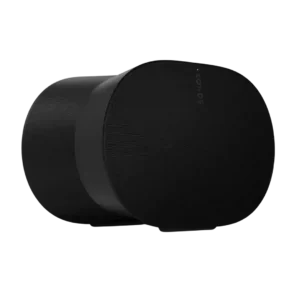
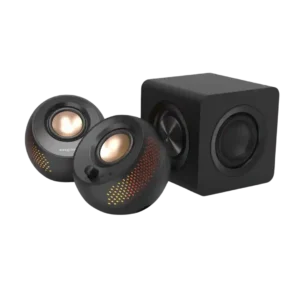
Average score
P1
Product 1: Sonos Era 300 Speaker
4.0
P2
Product 2: Creative Pebble X Plus Computer...
3.7
AirPlay compatibility
P1
Product 1: Sonos Era 300 Speaker
4.5
AirPlay was framed as easy and important for iPhone users, making playback simpler than the Android/Sonos-app path.
P2Product 2: Creative Pebble X Plus Computer...
No score yetAmplifier power requirements
P1Product 1: Sonos Era 300 Speaker
No score yet
P2
Product 2: Creative Pebble X Plus Computer...
2.7
Power requirements were a repeated caveat because full performance often required a separate 30W or higher USB-C PD adapter that was not included.
App reliability
P1
Product 1: Sonos Era 300 Speaker
3.2
App impressions were split: some reviewers praised the Sonos app as seamless or excellent, while others criticized search, speed, setup friction, and spatial-discovery limits.
P2
Product 2: Creative Pebble X Plus Computer...
2.9
App feedback was split: the app could detect or personalize the system, but several reviewers criticized limited mobile/Mac support, missing EQ, or Windows app issues.
Audio format support
P1
Product 1: Sonos Era 300 Speaker
3.5
Audio format support was both a strength and limitation: Dolby Atmos impressed, but Tidal, Spotify, and service/app restrictions drew criticism.
P2
Product 2: Creative Pebble X Plus Computer...
2.0
Audio format support was criticized in one review for being locked to 16-bit/48 kHz with no higher-resolution option.
Bluetooth codec support
P1Product 1: Sonos Era 300 Speaker
No score yet
P2
Product 2: Creative Pebble X Plus Computer...
2.0
Bluetooth codec support was a clear weakness because reviewers repeatedly noted SBC-only support and the lack of AAC or AptX.
Bluetooth connection stability
P1
Product 1: Sonos Era 300 Speaker
4.3
Bluetooth was welcomed as convenient and generally seamless, with quick pairing and useful guest-device flexibility.
P2
Product 2: Creative Pebble X Plus Computer...
5.0
Bluetooth stability had limited but strong positive evidence, with one reviewer reporting stable, issue-free Bluetooth testing.
Cabinet construction / bracing
P1
Product 1: Sonos Era 300 Speaker
4.8
Cabinet/build quality was praised as premium and well built, with one review saying no obvious corners were cut.
P2
Product 2: Creative Pebble X Plus Computer...
4.0
Build quality was generally solid, especially for the subwoofer, though some reviews still described plastic or less-premium satellite construction.
Chromecast compatibility
P1
Product 1: Sonos Era 300 Speaker
1.5
Chromecast compatibility was a clear weakness for Android users because the lack of Cast support detracted from the experience.
P2Product 2: Creative Pebble X Plus Computer...
No score yetCohesive presentation
P1
Product 1: Sonos Era 300 Speaker
4.9
Cohesion was a strength, with reviewers praising seamless surround fields, solid presentation, and a unified sound.
P2
Product 2: Creative Pebble X Plus Computer...
3.8
Cohesion was mixed: one review praised better layering and separation, while another found the subwoofer did not fully disappear into the system.
Control button responsiveness
P1
Product 1: Sonos Era 300 Speaker
5.0
The refreshed top controls were praised for satisfying responsiveness and useful feedback.
P2
Product 2: Creative Pebble X Plus Computer...
4.0
Physical control responsiveness was mixed-positive: several reviewers liked the tactile buttons and dial, while one criticized the cheap-feeling volume knob.
Design and aesthetics
P1
Product 1: Sonos Era 300 Speaker
3.6
Design reactions were mixed: some grew to like the unique look and premium feel, while others found the shape polarizing or dust-prone.
P2
Product 2: Creative Pebble X Plus Computer...
4.2
Design and aesthetics were usually praised for the compact, cute, tasteful, or good-looking Pebble style, with only minor reservations about plastic finish.
Detail retrieval
P1
Product 1: Sonos Era 300 Speaker
4.9
Detail retrieval was a repeated highlight, with reviewers praising high clarity, subtlety, and the sense of hearing more from recordings.
P2
Product 2: Creative Pebble X Plus Computer...
3.6
Detail retrieval was mixed: some reviewers praised treble/midrange detail and improved clarity, while others missed micro-details or upper-frequency sparkle.
Dialogue clarity (for TV/soundbar use)
P1
Product 1: Sonos Era 300 Speaker
3.7
Dialogue was considered clear in a TV-speaker experiment, though the same review noted less convincing center placement than expected.
P2Product 2: Creative Pebble X Plus Computer...
No score yetDistortion at high volume
P1
Product 1: Sonos Era 300 Speaker
4.7
High-volume distortion was generally well controlled, with reviewers noting loud playback without obvious distortion or harsh breakup.
P2
Product 2: Creative Pebble X Plus Computer...
4.2
High-volume behavior was mostly positive: one review found no driver or amplifier distortion at maximum volume, while another noted quality loss above roughly 80 percent.
Dynamic headroom
P1
Product 1: Sonos Era 300 Speaker
4.4
Dynamic headroom was strong, with reviews praising convincing dynamic shifts, attack, and clean output across large rooms.
P2
Product 2: Creative Pebble X Plus Computer...
3.5
Dynamic headroom depended heavily on power and volume level; some reviewers wanted more output, while others found the sound fuller with stronger power delivery.
EQ customization
P1
Product 1: Sonos Era 300 Speaker
4.2
EQ and Trueplay were mostly praised for improving sound, though reviewers also noted sensitivity, unfinished multi-speaker tuning, and app frustrations.
P2
Product 2: Creative Pebble X Plus Computer...
3.0
EQ customization was highly platform-dependent: some reviewers praised Windows equalizer controls, while others criticized no EQ or limited controls in mobile/Mac apps.
Frequency response balance
P1
Product 1: Sonos Era 300 Speaker
4.3
Frequency balance drew strong praise for bass texture, warmth, clarity, and control, with some caveats about bass depth, boominess, or physicality.
P2
Product 2: Creative Pebble X Plus Computer...
3.9
Frequency balance was mixed: several reviewers praised clear, full, or powerful sound, while others heard a warm tilt, muted treble, or mids that were too high or thin.
Google
P1
Product 1: Sonos Era 300 Speaker
2.0
Google support was the most repeated smart-feature complaint, with reviewers consistently criticizing the lack of Google Assistant or Chromecast.
P2Product 2: Creative Pebble X Plus Computer...
No score yetHome theater integration
P1
Product 1: Sonos Era 300 Speaker
4.4
Home theater integration was a major strength with Arc-based Atmos setups, though cost and Beam-based use were notable caveats.
P2Product 2: Creative Pebble X Plus Computer...
No score yetInter-speaker connectivity
P1
Product 1: Sonos Era 300 Speaker
4.5
Inter-speaker connectivity was praised for blending the Era 300 into an existing Sonos multiroom system.
P2
Product 2: Creative Pebble X Plus Computer...
2.1
Inter-speaker connectivity was a recurring complaint because fixed, short, hard-wired cables limited placement and raised durability concerns.
Latency with TV (lip sync)
P1Product 1: Sonos Era 300 Speaker
No score yet
P2
Product 2: Creative Pebble X Plus Computer...
4.5
Latency evidence was mostly positive, with two reviewers reporting no audio-video lag or latency issues and one noting a minor Bluetooth delay for video.
Lighting effects
P1Product 1: Sonos Era 300 Speaker
No score yet
P2
Product 2: Creative Pebble X Plus Computer...
3.9
Lighting was generally liked for customization and visual flair, though some reviewers found it dim, side-biased, or not personally useful.
Loudness / maximum volume
P1
Product 1: Sonos Era 300 Speaker
4.6
Reviewers consistently found the Era 300 loud enough to fill rooms, with praise for controlled output and added authority at higher levels.
P2
Product 2: Creative Pebble X Plus Computer...
4.2
Reviewers generally found the system loud for its compact size, with several saying it can get very loud, though a few noted limits near the top of the volume range.
Low-volume performance
P1
Product 1: Sonos Era 300 Speaker
2.6
Low-volume performance was a weakness in one review, which said the speaker is not ideal for quiet listening.
P2Product 2: Creative Pebble X Plus Computer...
No score yetMicrophone
P1
Product 1: Sonos Era 300 Speaker
4.0
Microphone quality was adequate to strong for voice control and Trueplay, with useful range but some caveats around real-world use.
P2
Product 2: Creative Pebble X Plus Computer...
4.2
Microphone-related usefulness was positive, with reviewers praising the handy input and external peripheral flexibility.
Multi-speaker pairing reliability
P1
Product 1: Sonos Era 300 Speaker
2.7
Multi-speaker pairing could be powerful but sometimes fussy, with complaints about reconfiguration friction and transfer pauses.
P2Product 2: Creative Pebble X Plus Computer...
No score yetOmnidirectional sound
P1
Product 1: Sonos Era 300 Speaker
4.9
Omnidirectional/spatial presentation was the dominant strength, with reviewers repeatedly praising room-filling, enveloping sound.
P2Product 2: Creative Pebble X Plus Computer...
No score yetOn-device controls
P1
Product 1: Sonos Era 300 Speaker
4.0
On-device controls were useful and modern, especially the volume slider, though one reviewer still preferred physical buttons.
P2
Product 2: Creative Pebble X Plus Computer...
3.9
On-device controls were generally useful and tactile, but one reviewer found volume steps coarse and another wanted more sound-shaping control.
Privacy and data
P1
Product 1: Sonos Era 300 Speaker
4.6
Privacy controls were praised for physical mic shutoff and a clear kill-switch approach.
P2Product 2: Creative Pebble X Plus Computer...
No score yetRemote control usability
P1
Product 1: Sonos Era 300 Speaker
2.5
Remote control usability was weak when using AirPlay with Apple TV, where volume control felt cumbersome.
P2Product 2: Creative Pebble X Plus Computer...
No score yetSetup simplicity
P1
Product 1: Sonos Era 300 Speaker
4.5
Setup was usually praised as quick and easy through the Sonos app, though one review found pairing less graceful than competing smart speakers.
P2
Product 2: Creative Pebble X Plus Computer...
3.3
Setup ranged from easy to mildly frustrating: reviewers liked basic plug-in simplicity but repeatedly criticized cable clutter and cable management.
Smart assistant integration (Alexa
P1
Product 1: Sonos Era 300 Speaker
4.2
Alexa and Sonos voice support were useful smart-speaker features, but the broader assistant story was limited by absent Google support.
P2Product 2: Creative Pebble X Plus Computer...
No score yetSmart features
P1
Product 1: Sonos Era 300 Speaker
5.0
Smart features stood out for versatility, with one reviewer calling it one of the most versatile standalone speakers available.
P2Product 2: Creative Pebble X Plus Computer...
No score yetSoundstage height
P1
Product 1: Sonos Era 300 Speaker
5.0
Soundstage height was one of the Era 300's standout qualities, especially in Atmos and Arc surround setups.
P2
Product 2: Creative Pebble X Plus Computer...
4.5
The angled drivers created a surprising sense of scale in one detailed review, supporting a strong score for perceived height and scale.
Stereo imaging accuracy
P1
Product 1: Sonos Era 300 Speaker
4.5
Stereo imaging was a major strength in many reviews, especially in pairs, though one long-term reviewer preferred Atmos tracks over regular stereo.
P2
Product 2: Creative Pebble X Plus Computer...
3.8
Stereo presentation was considered better than a single speaker and immersive at a desk, but constrained by short speaker spacing and imperfect handling of complex mixes.
Subwoofer
P1
Product 1: Sonos Era 300 Speaker
3.9
Subwoofer integration was context-dependent: some reviewers heard dramatic bass improvements, while others preferred the Era 300 pair alone or criticized Sub Mini articulation.
P2
Product 2: Creative Pebble X Plus Computer...
4.0
The subwoofer was the most discussed upgrade: reviewers often praised punch, boom, and better bass, but some still found sub-bass depth, integration, or headroom limited.
Surround sound simulation
P1
Product 1: Sonos Era 300 Speaker
4.3
Surround simulation was excellent in full Sonos setups and spatial demos, but a single unit was not described as true surround sound.
P2
Product 2: Creative Pebble X Plus Computer...
4.5
Surround-style processing had limited but positive evidence, with one reviewer saying the app processing brought the sound to life.
Value for money
P1
Product 1: Sonos Era 300 Speaker
4.4
Value was broadly favorable for spatial audio and Sonos ecosystem buyers, but several reviewers noted high pricing, Echo competition, or a Sonos tax.
P2
Product 2: Creative Pebble X Plus Computer...
4.2
Value was broadly positive for a compact 2.1 desktop system, but not unanimous because some reviewers preferred cheaper Pebble models or saw platform-dependent value.
Voice assistant responsiveness
P1
Product 1: Sonos Era 300 Speaker
4.4
Voice assistant responsiveness was positive overall, with reviewers saying Sonos Voice responded quickly and handled simple commands well.
P2Product 2: Creative Pebble X Plus Computer...
No score yetVoice clarity
P1
Product 1: Sonos Era 300 Speaker
4.6
Voice and vocal clarity were praised, with reviewers describing vocals as clear, forward, and well preserved in immersive mixes.
P2
Product 2: Creative Pebble X Plus Computer...
4.3
Voice and vocal clarity were a consistent strength, with reviewers praising clear vocals, good presence, and cleaner vocals through the Plus system.
Voice recognition accuracy
P1
Product 1: Sonos Era 300 Speaker
4.5
Sonos Voice Control was credited with better music-request recognition than broader assistants in one review.
P2Product 2: Creative Pebble X Plus Computer...
No score yetWeight convenience
P1
Product 1: Sonos Era 300 Speaker
2.8
The speaker's nearly 10-pound body was seen as awkward to move, though it is meant to stay positioned once placed.
P2
Product 2: Creative Pebble X Plus Computer...
4.5
One reviewer praised the compact size as easy to fit into a desktop setup.
Wi-Fi streaming reliability
P1
Product 1: Sonos Era 300 Speaker
3.9
Wi-Fi streaming was mostly reliable in modern Sonos use, though one reviewer noted occasional signal drops that quickly recovered.
P2Product 2: Creative Pebble X Plus Computer...
No score yetWired input
P1
Product 1: Sonos Era 300 Speaker
3.5
Wired input was useful for turntables and other sources, but the required USB-C adapter and extra cost were repeated drawbacks.
P2
Product 2: Creative Pebble X Plus Computer...
4.2
Wired input support was a strength overall, with reviewers praising broad audio-source support and USB/AUX options, though one noted limited additional connection methods.