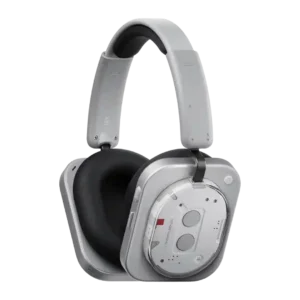
Average score
P1
Product 1: Gadhouse Wesley Retro Headphones
4.0
P2
Product 2: Nothing Headphone (1)
3.9
Active noise cancellation
P1
Product 1: Gadhouse Wesley Retro Headphones
1.0
ANC is not part of the Wesley package; coverage explicitly frames active noise cancellation as absent, so buyers should not expect active hush from this retro wired design.
P2
Product 2: Nothing Headphone (1)
3.8
ANC is broadly considered strong for the price and effective for travel/commuting, but it is usually ranked a step behind the best from Sony/Bose/Apple, especially for voices or tougher scenarios. Noise control modes and adjustability are a highlight: reviews repeatedly mention multiple ANC levels/adaptive behavior and the ability to map controls to switch modes.
App
P1Product 1: Gadhouse Wesley Retro Headphones
No score yet
P2
Product 2: Nothing Headphone (1)
4.6
The Nothing X app is repeatedly described as one of the best parts of the experience, with feature access, customization, and settings that help compensate for default tuning.
Audio-video sync accuracy
P1
Product 1: Gadhouse Wesley Retro Headphones
4.8
Its wired connection is presented as low-latency and free of the Bluetooth delay issues that can throw off lip-sync or gaming timing.
P2
Product 2: Nothing Headphone (1)
4.1
Several reviews mention low-latency or gaming modes and head-tracking features; real-world A/V performance is generally positioned as competent, not a class-leading differentiator.
Bass performance
P1
Product 1: Gadhouse Wesley Retro Headphones
2.9
Bass is adequate for casual listening but loses control as volume rises, with the clearest hands-on review calling out muddiness and low-end smearing.
P2
Product 2: Nothing Headphone (1)
3.8
Bass is usually described as controlled and textured rather than skull-rattling, with bass-enhancer tools available; some reviewers still want tighter tuning out of the box.
Battery
P1Product 1: Gadhouse Wesley Retro Headphones
No score yet
P2
Product 2: Nothing Headphone (1)
4.6
Battery life is a consistent highlight, with many reviews citing long runtime (often around 35 hours with ANC and far more without) and strong real-world endurance. Replaceable battery support is generally weak, with at least one review calling out a non-user-friendly internal battery design.
Bluetooth
P1Product 1: Gadhouse Wesley Retro Headphones
No score yet
P2
Product 2: Nothing Headphone (1)
4.3
Bluetooth stability is generally good with modern pairing features, though a few reviews mention occasional dropouts depending on environment or device.
Build quality
P1
Product 1: Gadhouse Wesley Retro Headphones
4.1
Construction looks simple but respectable for the price, with a stainless steel or robust headband noted alongside very light materials rather than heavy premium heft.
P2
Product 2: Nothing Headphone (1)
4.2
Build quality is generally seen as solid and premium-feeling for $299, though some reviews note more plastic than expected or worry about long-term cosmetic wear.
Built-in DAC and hi-res playback
P1
Product 1: Gadhouse Wesley Retro Headphones
4.6
Multiple sources highlight 48kHz lossless playback over USB-C as a useful modern upgrade on an otherwise old-school wired design.
P2Product 2: Nothing Headphone (1)
No score yetButton control usability
P1
Product 1: Gadhouse Wesley Retro Headphones
4.5
Inline controls are consistently described as easy, tactile, and intuitive for playback, track skipping, and everyday use.
P2
Product 2: Nothing Headphone (1)
4.4
Physical controls (roller + paddle + buttons + power switch) are a major highlight for tactility, but a few reviews mention learning curve, finicky behavior, or coarse volume steps.
Cable quality
P1
Product 1: Gadhouse Wesley Retro Headphones
2.6
The fixed 1.5 meter cable fits the retro concept but is also the biggest ergonomic drawback, with tangling and cumbersome handling called out.
P2
Product 2: Nothing Headphone (1)
3.6
Included cables are generally viewed as fine, though at least one review notes limitations (such as a 3-pole 3.5mm cable that does not carry mic).
Carry case quality
P1Product 1: Gadhouse Wesley Retro Headphones
No score yet
P2
Product 2: Nothing Headphone (1)
3.8
The case is usually described as sturdy and protective with space for cables, but multiple reviewers call it large or mention zipper/material quirks.
Charging
P1
Product 1: Gadhouse Wesley Retro Headphones
5.0
Because the Wesley is fully wired, there is nothing to charge; several pieces frame that as a real convenience for commuting and plug-and-play use.
P2
Product 2: Nothing Headphone (1)
4.5
Fast charging is frequently praised, with multiple reviews citing a short top-up delivering hours of playback; full-charge times are generally described as typical.
Clamping force comfort
P1
Product 1: Gadhouse Wesley Retro Headphones
4.5
Available hands-on impressions suggest an easy, non-fatiguing fit rather than an overly tight clamp, helping comfort over longer sessions.
P2
Product 2: Nothing Headphone (1)
3.9
Clamping force is commonly described as secure without being overly tight, though individual fit can vary and some users still feel pressure over time.
Codec support
P1Product 1: Gadhouse Wesley Retro Headphones
No score yet
P2
Product 2: Nothing Headphone (1)
4.5
Codec and connection support is repeatedly highlighted as a strength, with common mentions of SBC/AAC/LDAC and both USB-C and 3.5mm wired options.
Comfort during long use
P1
Product 1: Gadhouse Wesley Retro Headphones
4.8
Comfort is one of the product's clearest strengths thanks to its light build and soft foam pads, with multiple reviews describing it as easy to wear for extended listening.
P2
Product 2: Nothing Headphone (1)
4.0
Comfort is often rated good-to-very-good for long sessions, but the weight and occasional headband/pad pressure points mean not everyone finds it as effortless as the lightest competitors.
Design and Aesthetics
P1
Product 1: Gadhouse Wesley Retro Headphones
4.9
Retro styling is the Wesley's standout trait, repeatedly positioned as a nostalgic statement piece that channels Walkman-era fashion.
P2
Product 2: Nothing Headphone (1)
4.6
Design is consistently described as distinctive and polarizing, with many praising the transparent, cassette-like aesthetic and premium look for the price.
Detachable cable convenience
P1Product 1: Gadhouse Wesley Retro Headphones
No score yet
P2
Product 2: Nothing Headphone (1)
4.5
Having both USB-C audio and a 3.5mm option is repeatedly praised for flexibility, especially for laptops, planes, and modern phones.
Ear cup padding quality
P1
Product 1: Gadhouse Wesley Retro Headphones
4.8
The foam pads are described as soft and squishy, supporting the headphone's strong comfort story even if they are not plush modern luxury pads.
P2
Product 2: Nothing Headphone (1)
3.9
Ear pad comfort and seal are regularly praised, though some reviews mention thinner cushioning than expected, heat buildup, or pressure on certain ear shapes/accessories.
Ear cup swivel/rotation range
P1Product 1: Gadhouse Wesley Retro Headphones
No score yet
P2
Product 2: Nothing Headphone (1)
3.6
Cups generally rotate to lie flat, which helps neck-wear and packing, but the design can cause the squared corners to bump or rattle against each other.
Equalizer customization
P1Product 1: Gadhouse Wesley Retro Headphones
No score yet
P2
Product 2: Nothing Headphone (1)
4.8
EQ customization is a defining strength: multiple reviews highlight an advanced, multi-band/parametric-style EQ (often with Q control) plus shareable presets/QR codes.
Find My
P1Product 1: Gadhouse Wesley Retro Headphones
No score yet
P2
Product 2: Nothing Headphone (1)
3.2
Find My-style features are generally limited to making the headphones play a sound, which helps for nearby locating but is not a full tracker replacement.
Frequency response accuracy
P1Product 1: Gadhouse Wesley Retro Headphones
No score yet
P2
Product 2: Nothing Headphone (1)
3.1
Measured and subjective impressions frequently point to a non-neutral stock response (often described as dark), with EQ being the practical path to a more accurate balance.
Headband adjustability
P1
Product 1: Gadhouse Wesley Retro Headphones
4.5
The adjustable sizing system appears straightforward and functional, with sliders and a snug fit mentioned in coverage.
P2
Product 2: Nothing Headphone (1)
3.9
Headband adjustment works smoothly for most, but at least one review dislikes the adjustment ergonomics and others wish for more headband padding.
Included accessories
P1
Product 1: Gadhouse Wesley Retro Headphones
4.7
Accessory support is better than expected for the price, with 3.5mm, 6.35mm, and USB-C connection options regularly highlighted.
P2Product 2: Nothing Headphone (1)
No score yetInstrument separation
P1
Product 1: Gadhouse Wesley Retro Headphones
3.3
Separation is passable at moderate levels but weakens noticeably when mixes get busier or volume climbs.
P2
Product 2: Nothing Headphone (1)
3.8
Instrument separation is often praised as solid or good once the tonal balance is corrected, though some reviewers still find complex mixes can feel crowded compared to top rivals.
Integrated microphone
P1
Product 1: Gadhouse Wesley Retro Headphones
4.1
An inline mic is consistently included for calls and basic voice use, though the coverage says more about availability than exceptional call performance.
P2Product 2: Nothing Headphone (1)
No score yetLDAC
P1Product 1: Gadhouse Wesley Retro Headphones
No score yet
P2
Product 2: Nothing Headphone (1)
5.0
LDAC support is consistently called out across reviews and is a core part of the product’s high-res pitch for compatible Android devices.
Maximum volume clarity
P1
Product 1: Gadhouse Wesley Retro Headphones
2.2
High-volume performance is the product's clearest weakness, with sound becoming muddy and less separated when pushed.
P2
Product 2: Nothing Headphone (1)
4.0
At higher volumes, several reviewers report low distortion and clear playback, though ultimate refinement and dynamics are not always on par with premium flagships.
Microphone noise reduction
P1Product 1: Gadhouse Wesley Retro Headphones
No score yet
P2
Product 2: Nothing Headphone (1)
3.8
Mic noise reduction is usually strong for steady noise and wind, but some reviews report aggressive noise gating or weaker handling of echo/reverberant rooms.
Microphone quality for calls
P1Product 1: Gadhouse Wesley Retro Headphones
No score yet
P2
Product 2: Nothing Headphone (1)
3.9
Call quality is often described as clear and workable, with some reviews praising voice pickup in noisy streets; others call it merely average or slightly robotic compared with top rivals.
Midrange clarity
P1
Product 1: Gadhouse Wesley Retro Headphones
4.1
Vocals and mids come through more cleanly than the rest of the range, making speech and vocal-forward tracks a relative strength.
P2
Product 2: Nothing Headphone (1)
3.6
Midrange performance varies by tuning: vocals can sound clear and forward after tweaks, but several reviews note too much lower-mid presence or a dull/veiled midrange on default settings.
Multi-platform compatibility
P1
Product 1: Gadhouse Wesley Retro Headphones
4.6
With included adapters and standard wired connections, the Wesley is framed as easy to use across phones, laptops, music players, and older audio gear.
P2Product 2: Nothing Headphone (1)
No score yetMultipoint connectivity reliability
P1Product 1: Gadhouse Wesley Retro Headphones
No score yet
P2
Product 2: Nothing Headphone (1)
4.3
Multipoint is commonly cited as supported and functional, enabling quick switching between two devices; reliability feedback is mostly positive.
Noise isolation (passive)
P1Product 1: Gadhouse Wesley Retro Headphones
No score yet
P2
Product 2: Nothing Headphone (1)
4.3
Passive isolation is consistently strong thanks to a good seal and memory-foam style pads, meaning ANC has a solid foundation in many real-world environments.
Portability/foldability
P1
Product 1: Gadhouse Wesley Retro Headphones
2.8
The headphones are light and not bulky, but portability is undercut by the long fixed cable and lack of a carry case.
P2
Product 2: Nothing Headphone (1)
2.8
Portability is a weak spot versus foldable rivals: cups rotate flat but the headphones do not fold up, making the carry footprint and case bulkier.
Preset EQ profile quality
P1Product 1: Gadhouse Wesley Retro Headphones
No score yet
P2
Product 2: Nothing Headphone (1)
3.7
Preset profiles and simpler EQ tools are generally helpful, but several reviewers still prefer custom EQ to get the best tonal balance.
Replaceable earpads
P1Product 1: Gadhouse Wesley Retro Headphones
No score yet
P2
Product 2: Nothing Headphone (1)
2.9
Replaceable earpad support is mixed: some sources mention pads can be removed or obtained via customer service, while others say replacement availability is unclear.
Sensors
P1Product 1: Gadhouse Wesley Retro Headphones
No score yet
P2
Product 2: Nothing Headphone (1)
3.8
Wear-detection and other sensors work well for many users, but some reports mention inconsistent behavior on specific devices (for example, desktop pairing scenarios).
Smudge resistance
P1Product 1: Gadhouse Wesley Retro Headphones
No score yet
P2
Product 2: Nothing Headphone (1)
3.0
Surface oils and cosmetic marks can show up on the materials, with some reviewers noting it wipes off easily but is not especially resistant to smudging.
Software/setup simplicity
P1
Product 1: Gadhouse Wesley Retro Headphones
4.8
Battery-free, app-free, firmware-free operation makes the Wesley extremely simple to use: plug it in and go.
P2
Product 2: Nothing Headphone (1)
4.2
Setup is usually straightforward thanks to modern pairing features, though a few reviews note hidden settings or small/hard-to-find pairing controls.
Sound quality
P1
Product 1: Gadhouse Wesley Retro Headphones
3.9
Overall sound lands in the decent-but-not-audiophile camp: fine for casual listening and clear vocals, but not consistently refined or competitive with stronger sound-focused rivals. The wired setup brings dependable low-latency listening and potentially cleaner lossless playback, but the sonic payoff still depends on expectations because the tuning remains modest.
P2
Product 2: Nothing Headphone (1)
3.6
Sound quality is widely seen as good hardware with polarizing default tuning: some hear clean, balanced clarity, while many describe the stock sound as dark/flat or a bit compressed until EQ is applied. Wired listening over USB-C and/or 3.5mm is frequently mentioned; some reviewers note slightly improved clarity when wired, but not a dramatic transformation.
Soundstage width
P1
Product 1: Gadhouse Wesley Retro Headphones
2.8
At least one hands-on review found the presentation somewhat hollow and not especially spacious, so staging is not a major selling point.
P2
Product 2: Nothing Headphone (1)
3.4
Soundstage is generally not class-leading; multiple reviews call it narrower or less expansive than Sony/Apple competitors, even if separation can be decent after tuning.
Spatial audio
P1Product 1: Gadhouse Wesley Retro Headphones
No score yet
P2
Product 2: Nothing Headphone (1)
3.4
Spatial audio is included and often paired with head tracking, but opinions on its usefulness vary widely; several reviews call it mediocre or not worth using for music.
Sustainability materials
P1Product 1: Gadhouse Wesley Retro Headphones
No score yet
P2
Product 2: Nothing Headphone (1)
2.6
Sustainability signals are limited in reviews: some note repairability steps (like pad access) but also a lack of recycled materials or overt eco focus.
Transparency mode quality
P1Product 1: Gadhouse Wesley Retro Headphones
No score yet
P2
Product 2: Nothing Headphone (1)
3.8
Transparency mode is generally usable and fairly natural, but a recurring complaint is that the wearer’s own voice can sound boomy and/or the passthrough can be less airy than the best implementations.
Treble clarity
P1
Product 1: Gadhouse Wesley Retro Headphones
3.8
Treble is generally clear enough for casual use, though it does not fully escape the broader softness and muddiness heard at higher volumes.
P2
Product 2: Nothing Headphone (1)
3.4
Treble is a common critique in default mode, with multiple reviewers calling it muted or lacking sparkle; EQ can restore more air and bite for cymbals and vocals.
USB-C
P1
Product 1: Gadhouse Wesley Retro Headphones
4.6
USB-C support is a major practical plus, letting the Wesley connect to modern devices while still keeping its wired retro identity.
P2
Product 2: Nothing Headphone (1)
4.8
USB-C is a frequently praised feature because it supports charging and USB-C audio, adding modern wired flexibility.
Voice assistant integration
P1Product 1: Gadhouse Wesley Retro Headphones
No score yet
P2
Product 2: Nothing Headphone (1)
4.1
Voice assistant hooks and programmable button behavior are widely mentioned, with extra integrations for Nothing phones and more basic assistant triggering on other devices.
Volume output
P1Product 1: Gadhouse Wesley Retro Headphones
No score yet
P2
Product 2: Nothing Headphone (1)
3.6
Volume output is generally adequate, but at least one review notes limited headroom and less precise volume stepping than some competitors.
Water/sweat resistance rating
P1Product 1: Gadhouse Wesley Retro Headphones
No score yet
P2
Product 2: Nothing Headphone (1)
4.5
IP52 is a standout feature in this category and is repeatedly praised as practical for sweat and light splashes, even if it is not a high waterproof rating.
Weight comfort
P1
Product 1: Gadhouse Wesley Retro Headphones
4.8
At roughly 105 grams, the Wesley is unusually light for an over-ear, and that featherweight feel is repeatedly praised.
P2
Product 2: Nothing Headphone (1)
3.7
At ~329g, weight is noticeable: reviewers often say it’s lighter than AirPods Max but heavier than Sony/Bose alternatives, which can affect long-wear comfort.