
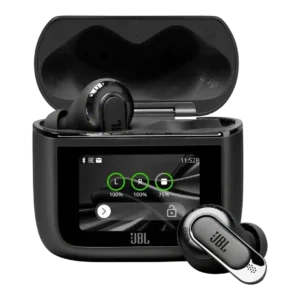
Across reviews, ANC is consistently strong and competitive at the flagship tier, especially with a solid seal and the included foam tips. Several reviewers still place Bose or AirPods Pro 2 a step ahead for the most cocooned, best-in-class quiet. Noise canceling is highly tunable, with adaptive modes and manual strength steps/sliders available in the app and often from the case screen. Most reviewers found it easy to dial in more reduction or more awareness depending on environment.
Wired playback on Android phones works well with the right USB-C adapter or DAC, according to the reviews that tested it.
Android users get the most obvious upside through LDAC support and Fast Pair-style conveniences, and several reviews specifically cite Android phones during testing. Compatibility is generally smooth, and features feel most complete on Android.
The JBL Headphones app is viewed as central to the experience, enabling firmware updates, mode switching, and deeper personalization. Most find it well organized, though a minority report occasional crashes or flaky connections.
A/V sync is typically fine for video, but Bluetooth gaming latency can be noticeable for some reviewers. Using the case as a transmitter is repeatedly framed as the lower-latency workaround for flights, TVs, and certain gaming setups.
Bass is generally controlled, punchy, and well-balanced rather than bloated, but seal sensitivity can thin it out and bassheads may want more weight or texture.
Bass is punchy and deep with strong slam, and many reviewers highlight it as a core strength. A few find the stock low end a bit thick for vocals or podcasts, but EQ presets make it easy to trim or boost.
Battery life is consistently strong, commonly cited around 7-8 hours with ANC and up to about 11 hours without, with the case extending totals into the 32-44 hour range. Long-term impressions suggest only modest degradation after heavy use.
Bluetooth performance is generally stable with fast pairing and modern conveniences like Fast Pair/Swift Pair depending on platform. A few long-term or multipoint users mention occasional reconnect hiccups, but dropouts are not a dominant complaint.
Build quality is usually viewed as solid and functional for the price, but the plastic shells feel less premium than higher IE models.
Build quality is generally reported as solid and durable, with good materials feel and hardware that holds up over time. Cosmetic wear on the case (micro-scratches, fingerprints) shows up, but functional durability complaints are rare.
The IE 200 has no inline remote or physical controls, so playback and volume changes must be handled on the source device.
The cable is the most divisive part: some like the light braided design, but many criticize tangling, microphonics, cheap feel, or proprietary fit frustrations.
The included pouch is serviceable for storage, but reviewers often describe it as basic, soft, and not especially protective or premium.
The smart charging case is a defining feature, offering a touchscreen control center and useful shortcuts without pulling out a phone. The main downsides are physical size and occasional reports of UI lag or brightness quirks, but overall sentiment is strongly positive.
Charging is convenient and fast, with USB-C plus Qi wireless charging and a quick-charge feature that can deliver several hours from a short top-up. The case provides multiple full recharges, though heavy screen use can draw additional power.
Codec support is broad for the category, covering SBC/AAC plus hi-res LDAC and, in some coverage, LE Audio/LC3 in transmitter mode. This flexibility is frequently cited as a reason these feel future-proof.
Comfort is a major strength, with many reviewers calling the small shells easy to wear for hours, even in bed or during long sessions.
Comfort and fit are mixed and highly ear-dependent: many find them comfortable for long sessions, but multiple sources note the buds are physically large/deep and can be tricky for smaller ears. Tip choice (including foam) is often the difference between secure comfort and constant readjustment.
Reviewers like the compact, understated black design and discreet fit, even if it lacks the luxury feel of metal-bodied siblings.
Design is widely seen as premium and distinctive, with a stemmed look and modern finishes, but size is a consistent theme. Both the earbuds and especially the case are larger than many rivals, which can affect small-ear comfort and pocketability.
Removable MMCX cables improve repairability, but the recessed connector design limits easy aftermarket replacements and reduces convenience.
Using the case as a transmitter (USB-C or 3.5mm/aux via included cables) is repeatedly praised for flights, treadmills, TVs, and older sources. Reviewers treat it as more than a gimmick because it adds flexibility and can improve latency behavior.
The package includes both silicone and foam tips in multiple sizes, but several reviews say seal quality is highly tip-dependent and stock silicone tips can be finicky.
The included tip selection is generous, usually featuring multiple silicone sizes plus foam, and reviewers frequently credit it for improving seal and ANC. Most see the variety as a practical advantage for dialing in fit.
EQ and tuning tools are among the strongest in-class, with multiple presets plus advanced multi-band EQ and Personi-Fi hearing personalization. Reviewers frequently cite these controls as the key to tailoring bass, brightness, and overall balance.
Find My-style locating features are present through the app and case controls, and reviewers generally find them useful for locating earbuds. A few note limitations around locating or pinging the case itself compared with the earbuds.
The tuning is commonly described as balanced, mildly V-shaped, or reference-leaning, with strong overall coherence even if it is not perfectly neutral.
Accessory coverage is good for the class with multiple ear tips and a pouch, though the case and cable quality keep it from feeling especially generous.
Instrument separation and imaging are standout traits, making individual lines easy to place, though a few reviews find layering flatter than top competitors.
Instrument separation and imaging are repeatedly called out as clear and well-defined for true wireless earbuds. A few reviewers say it is not the most surgically accurate staging available, but it remains easy to place elements in the mix.
These earbuds do not include an integrated microphone.
LDAC is widely appreciated by Android users for higher-quality wireless audio and is treated as a premium advantage. Tradeoffs show up in a few reviews: higher drain/latency and, in some implementations, disabling certain extra processing features.
Limited evidence says the IE 200 stays composed at higher playback levels without turning muddy or congested.
Noise reduction for calls, including background and wind suppression, is frequently praised and often highlighted as best-in-class or close. Edge cases include echo handling or very windy, chaotic environments where voices can wobble slightly.
Because there is no mic, the IE 200 is a poor fit for calls unless you use another microphone.
Call microphone quality is a consistent strength, with many reviewers describing clear, intelligible voice capture across calls and meetings. A few note mild Bluetooth artifacts or voice coloration depending on app and conditions.
Mids and vocals are usually clear, natural, and well-positioned, though some reviewers hear slightly lean lower mids or a cooler tone on guitars.
Midrange and vocal clarity are typically strong, though some note a mild V-shape or mid dip that can make certain instruments feel less forward. Personalization tools (EQ/Personi-Fi) are frequently recommended to bring mids up if desired.
The 3.5mm connection works broadly across laptops, music players, and phones with appropriate adapters, making the IE 200 flexible across devices.
Multi-platform support is strong across Android, iOS, and computers, helped by standard Bluetooth features and platform pairing options. The case transmitter further improves flexibility for devices without reliable Bluetooth audio.
Multipoint and device switching are a major feature and usually work smoothly once set up. Some reviewers experienced occasional wrong-source switching or needed to toggle Bluetooth settings to recover, especially in multi-device workflows.
Passive isolation is generally good with a proper seal and improves with foam tips, though silicone tips can leak more and it is not close to ANC silence.
Portability is the recurring compromise: the case is often described as chunky or less pocketable than typical earbud cases. Many reviewers still accept the bulk because the screen and transmitter functions add real utility.
Wear detection and related sensors are usually reliable for auto pause/resume and convenience features. Some smart automation features (like auto talk/voice-aware behaviors) can be overly sensitive depending on the user and environment.
Reviewers consistently praise clear, balanced, high-fidelity sound with strong detail and musicality, though a few say it lacks some technical finesse or excitement versus stronger rivals. Across laptops, phones with adapters, DACs, and desktop gear, the IE 200 sounds notably clean and revealing, and several reviews say it scales up with better sources.
Sound quality is a standout: most reviews describe an energetic, polished tuning with plenty of detail and broad appeal from the hybrid drivers. The default voicing can lean bass-forward, but EQ, Studio-style presets, and Personi-Fi help balance it to taste.
The stage is unusually spacious for the price, often described as wide and sometimes tall, though depth and layering are less impressive than on pricier IEMs.
Soundstage is commonly described as wider than expected for sealed in-ears, with good left-right spread. Spatial processing can make it feel larger still, though the perceived benefit varies by listener and content.
Spatial audio support is robust and often praised, especially with head tracking for movies and immersive listening. Opinion is mixed for music: some love the effect, while others find it changes timbre or feels inconsistent and prefer it off.
Once fitted correctly, the over-ear design and secure seal keep the earbuds stable for long listening or light movement.
Stability in motion is generally good for many users (running and gym use are commonly mentioned), especially with the right tips and seal. A smaller subset report dislodging or needing frequent fit corrections during activity.
Touch controls are broadly functional and responsive, but multiple reviews criticize the control scheme tradeoffs and limited customization. A few users mention occasional mis-taps or delays, and some prefer using the case screen or app instead.
Transparency and TalkThru/Ambient modes are generally clear and usable for quick conversations, but a few note hiss or a slightly digital character. Multiple reviews say it is good rather than the very best, with AirPods Pro 2 often cited as more natural.
Treble is widely seen as crisp and detailed without being brutally harsh, but it can sound bright, spicy, or a touch sibilant on some material.
Treble is usually described as crisp and controlled, delivering detail without harshness for most listeners. Some report a touch of brightness or occasional coherence/timing quirks versus top audiophile picks, but EQ can tame sibilance if it appears.
USB-C is used for both charging and for the case’s wired-input transmitter feature, which many reviewers find genuinely practical. Cable-based connectivity is frequently highlighted as a differentiator versus most competitors.
Power demand is mixed: some find it easy enough to drive, while others report limited headroom from weaker phone outputs and better dynamics from DACs or amps.
Volume output is described as having ample headroom and getting loud without obvious breakup for most listening. Some reviewers note it reaches satisfying levels well below max volume, and volume limiting options exist in software.
One review explicitly says there is no water resistance, and no review presents it as a workout-focused model.
Earbuds carry an IP55-level water and dust resistance rating in most coverage, making them suitable for sweat and light rain. The case is typically not described as water resistant, so it benefits from more care.
The tiny 4-gram earpieces are repeatedly praised for disappearing in the ear and reducing fatigue.