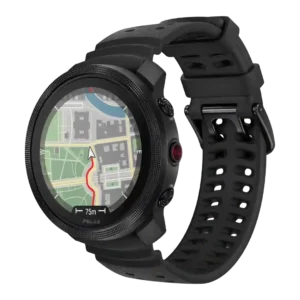
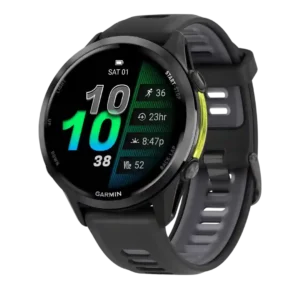
Polar Flow offers depth and web access, but the broader app ecosystem feels narrow because expansion and third-party tooling are limited.
ConnectIQ is highlighted as a large marketplace for extra apps and watch faces, with many free options.
The stock band is serviceable and often comfortable, but multiple reviewers complain that the buckle-and-loop setup is fiddly.
The band gets a positive note for micro-adjustment-like stretch and stable wear.
Battery life is respectable rather than class-leading, commonly landing around five to seven days depending on display mode and training load.
Battery life is the main hardware compromise: acceptable to good with sensible settings, but clearly worse than some Garmins or rivals when brightness and always-on display are pushed.
SpO2 support is a clear feature add across reviews, usually mentioned positively as part of the M3’s broader health sensor package.
PulseOx support is present for overnight breathing-related data, and one reviewer found its overnight battery impact minimal.
Bluetooth support is broad enough for external sensors and accessories, with no major complaints in the cited review.
Brightness is a standout strength, with repeated praise for the 1,500-nit class output and easy readability.
Brightness is a standout upgrade and among the most frequently praised hardware changes.
Build quality is solid for the price, but several reviewers note that the plastic-heavy construction softens the premium feel.
The overall construction feels premium, with sapphire and titanium helping the watch feel like a true flagship.
Physical controls are useful and often appreciated, though some reviewers wanted more tactile, less mushy buttons.
Physical buttons remain a strength, giving reliable control alongside the touchscreen.
Call handling is very limited, with reviewers explicitly noting that you cannot really take or manage calls from the wrist.
On-wrist calling works and is convenient, but speaker volume or overall call quality is not universally praised.
Charging is straightforward, but it relies on Polar’s proprietary cable rather than a more universal solution.
Charging speed gets positive marks, with reviewers describing it as quick enough or pleasantly painless.
Coaching and guidance features are a major plus, especially FitSpark, Training Load Pro, FuelWise, and workout suggestions tied to recovery.
Garmin Coach and triathlon planning are consistently praised for building detailed, adaptive training plans.
Comfort is a strong point, with the light case and soft strap making it easy to wear for long stretches.
Reviewers consistently find the watch comfortable enough for all-day wear.
Polar Flow is a recurring weak point: detailed and capable, but dated, cluttered, and harder to navigate than it should be.
Garmin Connect is described as comprehensive, but not consistently elegant, with one reviewer criticizing layout while another praises data presentation.
Contactless payments are not supported, which reviewers frequently call out as a missing convenience.
Garmin Pay is available and described as easy or useful where banks are supported.
The watch supports both Android and iOS, so basic cross-platform use is not a concern.
Compatibility across Apple and Android phones is present, but capabilities differ and iOS remains more limited.
Customization is decent around watch faces and some on-watch visuals, but deeper workout-field flexibility is more limited than rivals.
Customization is extensive, from sport-profile behavior to data fields and watch-face choices.
Display quality is excellent for the class, with reviewers repeatedly praising the AMOLED panel for sharpness, color, and overall visual appeal.
The AMOLED display is repeatedly praised for looking bright, sharp, and premium.
Durability looks acceptable for normal use, but some reviewers remain wary of the plastic parts and the lack of a tougher premium build.
Sapphire protection and tougher materials are repeatedly credited with improving scratch resistance and day-to-day durability.
ECG is widely noted as included on the watch, but reviewers also point out that it is limited compared with more medical-style implementations.
The watch adds manual ECG support and reviewers consistently present it as a meaningful upgrade, though one notes it is still a manual snapshot tool rather than continuous monitoring.
Fit is generally praised, especially on smaller wrists, where the lighter and more compact body helps the watch sit well.
Despite the 47 mm case, multiple reviewers say the watch sits well and feels manageable on the wrist.
General fitness tracking is viewed positively, with reviewers saying runs and core workout metrics usually painted an accurate overall picture.
In multisport and gym use, one reviewer says the watch tracked indoor training sessions reliably.
GPS is one of the M3’s strongest traits: most reviewers call it accurate or reliable, though some note small drifts in dense urban areas or tougher conditions.
GPS performance is one of the clearest strengths, with multiple reviewers calling it impeccable, highly accurate, or spot-on across varied conditions.
Health tracking is generally viewed as useful and solid overall, though the strongest evidence is broader than lab-grade and sits alongside some sensor caveats.
Heart rate performance is mixed: several reviewers found it good enough or consistent in steady efforts, but interval, cycling, and some harder sessions produced clear misses.
Across runs and workouts, reviewers repeatedly describe optical heart rate as close to chest straps and generally reliable.
There is no cellular or LTE-style independence here; the watch depends on the phone for fuller connected use.
The watch lacks built-in cellular and still depends on a nearby phone for calls or assistant functions.
Materials are a sensible mid-range mix of Gorilla Glass, steel accents, and plastic, giving decent quality without matching premium cases.
Materials are premium for the category, especially the titanium bezel and sapphire protection, even if the body remains polymer.
Menu navigation benefits from both touchscreen and buttons, and reviewers generally found it workable once learned.
Voice tools and interface choices can reduce menu digging, making common actions quicker.
Music controls work for phone playback and are seen as serviceable, but they are basic rather than rich.
Offline or onboard music storage is missing, and several reviewers treat that omission as a real tradeoff versus rivals.
Offline music storage is a clear strength, with support for downloaded playlists and ample storage.
The operating system experience is functional but dated, with reviewers liking the focus but wanting a more modern feel.
Garmin's software experience is generally praised as polished and strong, with reviewers describing it as among the best in sports watches.
Outdoor visibility is excellent, and multiple reviewers say the screen stays easy to read in bright sun.
The screen remains easy to read outdoors, including in bright sunlight.
Pairing and setup are inconsistent across reviews: some found quick connection, while others hit slow, glitchy setup behavior.
Pairing is mostly stable once connected, but one reviewer noted setup friction with the app.
Recovery features are a standout, with Recovery Pro, Nightly Recharge, VO2 Max, orthostatic tests, and related tools repeatedly described as genuinely useful.
Recovery tools such as Training Readiness, Acute Impact Load, and Running Tolerance are widely described as genuinely useful for judging load and avoiding overtraining.
Overall reliability is good enough that reviewers generally trust the watch, even if a few quirks and edge-case misses remain.
A few reviewers encountered crashes or notable bugs, especially around routing or call-related features.
Safety tools like incident detection, emergency alerts, and location sharing are a meaningful plus.
Case sizing is limited because the watch comes in a single body size, though strap sizing is a bit more accommodating.
Only one case size is available, which limits choice for smaller wrists.
The one direct sleep-stage accuracy test was not flattering, with sleep tracking viewed as useful for general sleep monitoring but weak for precise staging.
Sleep timing and general sleep scoring were viewed as good to very good, though one review notes Garmin is less reliable on sleep quality details than Oura.
Phone notifications are present and useful for glanceable alerts, but they are basic and do not turn the watch into a full smart companion.
Notifications are well supported, with alerts, calendar items, and message visibility noted positively.
Smartwatch features are sparse overall: the M3 handles fitness far better than day-to-day smart tasks and feels limited beside broader rivals.
Smart features such as calls, voice commands, music, notifications, reports, and payments are broader than typical sports watches, though still short of full smartwatch ecosystems.
Day-to-day software performance is usually smooth and snappy, even though a few quirks still show up.
Lag when saving activities, loading screens, or moving around maps is a recurring complaint.
Step counts lean high in multiple reviews, with repeated reports of overcounting versus other devices.
One reviewer specifically praised stress tracking for catching a severe migraine and adjusting training recommendations accordingly.
Style is one of the M3’s wins: most reviewers call it attractive, mature, or more wearable day to day than many sports watches.
The design is broadly viewed as sleek, sporty, and attractive, though one reviewer still sees it as a large performance-first watch.
Third-party app support is a clear weakness, with repeated notes that there is no app store or meaningful way to extend the watch.
Support for services and ecosystems such as Strava, Apple Health, and ConnectIQ add-ons is a notable plus.
Touch response is generally quick and pleasant, with reviewers describing the screen as responsive and intuitive.
Touch interaction is mostly responsive and easy to use, though some reviewers mention sensitivity quirks.
The user interface is improved versus older Polar models but still draws criticism for awkward flows, small annoyances, and limited polish.
The interface is feature-rich and generally easy to use, but some reviewers still find it click-heavy or overwhelming in places.
Value is one of the clearest positives: reviewers repeatedly say the M3 packs strong training features, maps, and display quality for the money.
Value is mixed: several reviewers say the watch earns its premium performance position, while others argue the price and extras make it harder to justify.
Voice assistant support is absent, and that lack is repeatedly framed as a notable smartwatch gap.
Voice tools are generally described as useful and workable, especially for quick commands, though they are not positioned as class-leading smart assistant replacements.
Watch face options are acceptable and improving, though opinions vary on how attractive or plentiful they feel today.
Watch-face choice is a strength, with many downloadable and customizable options.
Water resistance is only middling for an adventure-leaning sports watch, with 50 meters seen as adequate rather than exceptional.
The 5ATM/50m rating is sufficient for swimming and general sport use, but it is not positioned as a dive watch.
Wellness readouts like sleep quality, Boost from Sleep, and broader day-to-day guidance add helpful context beyond raw workout stats.
Morning and Evening Reports, sleep guidance, training previews, and broader daily insights are repeatedly described as useful and informative.
Workout coverage is broad, with 150-plus sport profiles and multisport support repeatedly highlighted as a strength.
Reviewers describe a massive activity list, with new sport profiles and broad support for running, swimming, cycling, gym work, and more.