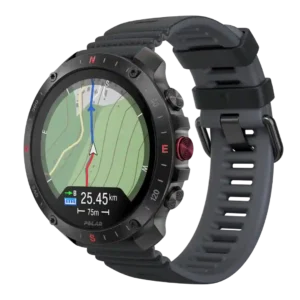
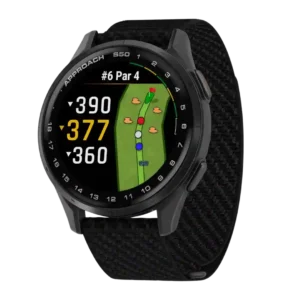
The watch can automatically recognize at least some activities and add them if you forget to start tracking manually.
The watch ecosystem feels limited compared with rivals, with reviewers specifically pointing to restricted customization and a thinner app offering.
Reviewers liked Garmin's broader ecosystem, especially easy switching between Garmin devices and shared value across Garmin products.
Band quality is good overall, with the included strap described as soft, flexible, and secure.
The nylon ComfortFit band is a clear differentiator: reviewers liked its light, stylish feel, but others found it sweaty, awkward, or less premium-looking than silicone.
Battery life is solid and often close to claims, but it is not class-leading and can drop faster with heavier features enabled.
Battery life was consistently strong in review use, with reports of roughly a week of wear and enough endurance for multiple rounds, though it is still behind higher-end Garmin models.
SpO2 is onboard and presented with baseline and altitude context, but reviews focused more on feature availability than deep validation.
Pulse Ox support is included, with blood oxygen tracking described as part of the S50's broader health feature set.
Bluetooth support is broad enough for sensors and broadcasting, but some workflows feel more finicky than they should.
Bluetooth connectivity supports accessory pairing, including direct rangefinder integration.
Screen brightness is excellent, with reviewers repeatedly saying the display stayed easy to read across lighting conditions.
The AMOLED screen is generally described as bright and crisp, though one reviewer wanted more brightness for smaller details in harsh sun.
Build quality feels impressively rugged and substantial, with one reviewer flatly describing it as built like a tank.
Build impressions were mostly positive thanks to durable glass and a slim, useful design, but one reviewer said the light case felt a bit plasticky.
The physical buttons are a plus, offering good grip and easy operation even with gloves.
The two-button layout is easy enough to use, but reviewers noted it offers fewer physical controls than pricier Garmin models.
Call handling is basic; you can answer or reject calls, but functionality stops there.
Calorie and fuel-use feedback is present and the energy usage breakdown was considered handy, though it is still an estimate rather than a precision tool.
Calorie burn tracking is present as part of the health dashboard, but reviewers did not provide deep evidence on how actionable it is.
Charging is reasonably convenient thanks to the USB-C cable setup, even if it still relies on a proprietary watch connection.
Charging is easy for existing Garmin owners because it uses Garmin's familiar cable, but the proprietary connector is less convenient than USB-C.
Charging speed was seen as a plus, with quick top-ups restoring a meaningful chunk of battery in a short session.
Charging speed was described as reasonably quick, with one reviewer ready to go after only a few hours of initial charging.
Coaching tools are strong, with FitSpark-style workout suggestions, fueling prompts, and broader training guidance standing out.
Guided breathing tools and Garmin health coaching add useful coaching beyond raw stat collection.
Comfort is mixed: some reviewers found it wearable and comfortable, while others said the size and strap hurt all-day comfort.
Comfort is one of the S50's biggest strengths, with repeated praise for the light, low-profile case, though the band can feel less ideal once sweaty.
Polar Flow offers lots of data, but the companion app experience was repeatedly described as dated, buggy, and cumbersome.
The Garmin Golf app pairing and day-to-day connection were repeatedly described as simple, seamless, and reliable.
The watch lacks built-in NFC payments, which reviewers repeatedly flagged as a missing premium feature.
Garmin Pay is supported, but usefulness depends heavily on bank compatibility and was described as limited in at least one market.
Cross-platform support is functional but uneven; one reviewer specifically found iPhone notification control restrictive.
There is useful customization for sport profiles, data pages, and watch faces, even if the platform is not endlessly flexible.
Customization is strong, with support for custom photos and broad watch-face personalization.
Display quality is a strong point, with reviewers praising the AMOLED panel for clarity, punch, and overall visual appeal.
Display quality is a standout, with repeated praise for the crisp, vibrant AMOLED panel.
Durability is a major strength, backed by MIL-STD-style construction and repeated praise for the watch's ruggedness.
Durability looks solid from review evidence, especially the Gorilla Glass lens.
The watch offers non-medical ECG checks that reviewers found useful for intentional HRV-style spot checks rather than medical screening.
Fit is more polarizing on smaller wrists because the 48 mm case size makes the watch wear noticeably large.
Fit is generally praised thanks to the flat profile and flexible strap adjustment, though one reviewer found the band loop tight when putting the watch on.
Broad fitness tracking was viewed positively thanks to consistent GPS and heart-rate performance in many sessions, though it was not flawless across all scenarios.
One reviewer said the body battery and related fitness tracking felt true to how they actually felt day to day.
GPS accuracy was one of the stronger areas, with several reviewers reporting solid routes, small variance, and accurate maps, though not every test was perfect.
Golf GPS accuracy was consistently strong, with distance readings reported within a couple of yards and quick satellite acquisition.
Health tracking impressions were generally positive, with one review calling the sleep features quite good and useful for nightly energy feedback.
Review evidence points to credible health insights, with one reviewer saying the watch's body battery matched their real fatigue levels well.
Heart rate performance was good overall and often close to chest straps, but multiple reviewers still saw occasional spikes, misses, or mixed interval results.
Materials feel premium, with sapphire protection and rugged hardware choices reinforcing the flagship positioning.
Materials are solid for the price, with anodized aluminum and Gorilla Glass called out positively.
Menus are usable once learned, but the navigation flow still takes some getting used to.
Once the key gestures and long-press actions are learned, menu navigation is described as straightforward.
Phone media controls are available and useful for basic playback control, but the experience does not go beyond that.
Music controls are available, but the experience is more utility-focused than polished and does not always surface controls automatically.
There is no onboard music storage or playback, leaving users dependent on phone-based audio.
The watch can store music locally for direct playback from the device.
The core software experience works, but it was described as dated rather than meaningfully refreshed.
Core navigation is easy and intuitive, but some smartwatch interactions feel less refined than Apple Watch-style experiences.
Outdoor visibility is very good, with the bright AMOLED screen remaining readable outside and on maps.
Outdoor visibility is good for main yardage data, but small on-screen details can get harder to read in very bright sunlight.
Pairing and syncing are a recurring frustration, with reviewers mentioning re-pairing hassles and regular phone reconnection issues.
Pairing reliability is excellent in review use, with setup described as seamless and stable afterward.
Recovery guidance is a strong point, with daily workout suggestions and recovery-linked ideas repeatedly called out as useful.
Recovery features are useful, with reviewers calling out nightly recovery insight and hours-to-recover guidance.
Operational reliability was generally good, with at least one long-term reviewer saying it recorded every workout without crashing.
Reliability is a major strength, with one reviewer calling Garmin golf watches totally dependable.
Safety support includes fall detection and emergency contact options when set up.
Size choice is limited compared with Garmin's pricier alternatives, and reviewers who prefer larger watches may find the S50 too small.
Sleep timing was reported as reliable, with one long-term reviewer saying fall-asleep and wake-up detection worked the majority of the time.
Sleep tracking was well regarded, with reviewers praising the detail and overall usefulness of the sleep scoring system.
Phone notifications work for viewing and dismissal, but the experience is basic because replies and actions are missing.
Notifications work for triage and golf-mode quality-of-life features, but replies and granular app control are limited.
Smartwatch features trail the competition, offering the basics but lacking the breadth expected at this price.
Beyond golf, the S50 adds meaningful smartwatch and health functionality, which several reviewers saw as its main differentiator.
Performance is generally smooth and snappy thanks to the faster processor, with only occasional caveats around other software rough edges.
General software behavior feels smooth once the basic control scheme is learned.
Step counting was a clear weak point, with reports of inflated totals and non-step activities being converted into steps too aggressively.
Stress-related wellness tools exist, but the dedicated Serene breathing coach was described as simple rather than especially advanced.
Stress tracking is included as part of the watch's everyday wellness toolkit.
Design is one of the watch's biggest positives, combining rugged hardware with a premium look that several reviewers really liked.
Reviewers repeatedly described the S50 as sleek, slim, and stylish.
Third-party support is mixed: routing and exports to services like Strava and Komoot are helpful, but missing TrainingPeaks workout support remains a notable gap.
Third-party media support exists, with named support for services like Amazon Music and Spotify.
Touch interaction was described as predictably responsive, with swipes and taps generally behaving well.
Touch input was praised as very responsive.
The user interface was widely criticized as clunky and less fluid than similarly priced rivals.
The interface is broadly intuitive and easy to learn, though one reviewer still found the golf side a bit complicated at first.
Value for money is the biggest weakness, as multiple reviewers felt the watch asked premium money without matching rival feature depth.
Most reviewers saw strong value in the S50's mix of golf and health features, though the subscription model and overlap with cheaper or pricier Garmin models complicate the value story.
Voice assistant support is effectively absent in review use; one reviewer noted you cannot use the watch to talk to Siri.
The stock watch faces are decent and lightly customizable, but the selection does not feel especially deep.
Reviewers liked the stock face aesthetics and noted plenty of additional face options.
Water protection is strong, with reviewers calling out the 100-meter rating as a meaningful upgrade for swim and water use.
Reviewers treated the S50 as suitable for swimming or shower use, with the main caveat being that the nylon band dries more slowly.
Wellness features are rich, especially around sleep and recovery, with SleepWise-style data and other overnight insights highlighted as useful.
Wellness insights are a clear strength, with sleep coach, nap tracking, reminders, breathing tools, and body battery called out repeatedly.
The watch has no Wi-Fi, which makes map management more cumbersome because downloads require a wired computer transfer.
Wi-Fi connectivity is available for updates and related syncing.
Workout coverage is extensive, with more than 150 sport profiles and support for everything from trail sports to niche activities like baseball.
Workout support extends well beyond golf, with multiple sports modes and activity profiles available.