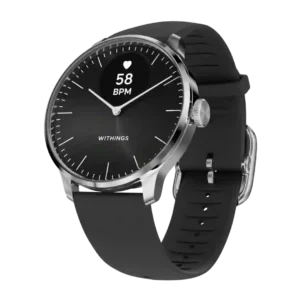
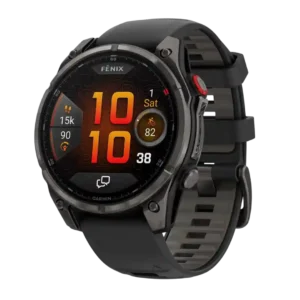
Automatic detection is a real strength for basic activities like walking, running, cycling, and swimming, though one reviewer said auto-tracked sessions sometimes needed manual cleanup.
Reviewers like the broader Withings ecosystem, especially the ability to collect watch data alongside other Withings health devices in one app.
Garmin’s broader app stack and ConnectIQ store expand apps, watch faces, routes, and connected features.
Band comfort is strong, with positive notes on all-day wear, soft material, secure fit, and low skin irritation.
Battery life is usually a standout, with many reviewers seeing multi-week endurance, but results vary sharply depending on settings like Quicklook, notifications, and workout use.
Battery life is generally strong and sometimes excellent, but usage mode matters and LTE or heavier use can cut endurance sharply.
Reviewers repeatedly note that the ScanWatch Light lacks SpO2 monitoring, leaving blood-oxygen tracking to higher-end alternatives.
Screen brightness is mixed: one reviewer found it too dim in use, while another found wake behavior too bright at night.
Higher screen brightness is one of the clearest upgrades, with repeated praise over the standard Fenix 8.
Build impressions are strong, with repeated praise for the solid-feeling case and overall hardware execution.
Reviews repeatedly describe the watch as solid, premium, and especially high-end in construction.
Physical controls are the norm here, and reviewers say the crown or dial works well once you adapt to it.
Physical buttons and haptics earn positive comments for feel and ease of use.
Calling is workable but mixed: some reviews say voices are clear or good enough, while others mention middling clarity or app-related limitations.
Calorie data is present but basic, and reviewers describe it as more of a simple estimate than a standout training metric.
The proprietary charger is a recurring complaint for feel and convenience, even though some reviewers liked its secure grip or compact shape.
Charging speed is consistently reported around two hours for a full top-up, with some reviewers noting meaningful recovery in 30 minutes.
Coaching is light but present through guided breathing and premium-app guidance rather than deep on-watch training features.
Strength plans, Garmin Coach, and adaptive suggested workouts give the watch strong built-in coaching support.
Comfort is a major positive, with reviewers repeatedly calling the watch light, slim, unobtrusive, and easy to wear to bed or during exercise.
Comfort is mixed: one review says it wears better than expected, while another reports wrist pinch.
The Health Mate app is generally seen as detailed and easy to navigate, though not every reviewer liked its layout.
Companion app impressions are split: one review says setup is unusually easy, while another calls activation a faff.
Payments are absent, and reviewers explicitly say to look elsewhere if contactless pay is important.
One review explicitly includes NFC payments among the core smart features.
The watch is consistently described as working with both Android and iPhone, and reviewers also note app availability across mobile platforms.
Customization is modest but useful, covering screen order, watch behavior, and shortcut setup rather than deep personalization.
Reviews highlight quick watch-face changes and extensive data-field customization.
The small monochrome/OLED display is functional for basics, but reviewers repeatedly describe it as tiny and limited for dense information.
Reviews praise the sharp AMOLED display and improved clarity and viewing angles.
Durability looks good in early testing, with scratch resistance and resistance to sweat or rain called out positively.
The watch is widely framed as rugged and suited to adventurous use.
ECG is not included on the ScanWatch Light, and reviewers point to that omission as a clear gap versus pricier models.
Multiple reviews note onboard ECG support for rhythm checks through Garmin’s sensor and app setup.
Fit is best for smaller wrists, and multiple reviewers caution that the 37mm case may feel too small or less ideal for some users.
Fit is a frequent concern because the case is large and bulky, especially on smaller wrists.
General fitness tracking is serviceable and often close enough for casual use, but auto-detected sessions can need editing and this is not framed as a serious sports watch.
Workout data is described as spot-on and trustworthy during training.
There is no built-in GPS, but connected GPS through the phone was repeatedly described as accurate enough for distance and pace comparisons against Garmin devices.
GPS performance is a clear strength, with spot-on tracks, no notable errors, and strong race accuracy.
Broader health readings come across as useful and directionally solid, but at least one reviewer found Oura more precise for sleep timing and staging.
Heart-rate performance is generally strong, with close comparisons to Garmin and Polar in several tests, though one reviewer found average daily readings ran too high.
Reviewers consistently describe heart rate readings as close to chest straps, with only minor lag noted during sudden changes.
LTE is the headline upgrade and usually works well for calls, texts, LiveTrack, and phone-free use, but not every reviewer found it fully dependable.
Materials are consistently framed as premium for the price, especially the stainless steel and Gorilla Glass construction.
Titanium and sapphire construction is repeatedly cited as hardy and premium.
Crown-based navigation takes adjustment but is generally easy once learned, and several reviewers say scrolling through screens becomes natural.
One review praises quick access to key information without extra swiping, suggesting efficient menu flow.
Music control is a clear omission, with reviewers calling out the inability to manage playback from the wrist.
Reviews confirm onboard music storage and offline downloads, including linked streaming-service support.
One reviewer found the overall system experience less seamless than a Pixel Watch because watch and phone settings are not deeply synchronized.
One reviewer says the watch can be tuned into an experience that serves them well, suggesting a mature overall software experience.
Outdoor readability is a weakness, with direct-sun visibility called out as poor.
Multiple reviews say the screen stays legible in full sun or from awkward angles outdoors.
Phone pairing and syncing were described as smooth and stress-free in the reviews that directly discussed setup reliability.
In the positive reviews, setup and pairing are described as painless and straightforward.
Training Readiness and related recovery guidance are repeatedly described as useful and standout.
Core functionality is generally reliable, with one reviewer explicitly calling it solid and another praising battery endurance as dependable.
Reliability feedback is mixed, with one review praising it and another reporting restarts and inconsistency.
Safety-oriented features are mixed: high and low heart-rate alerts are included, but reviewers criticize the lack of AFib detection.
LiveTrack, SOS, and emergency contact tools add meaningful safety value, though subscription requirements and some limits temper enthusiasm.
Size flexibility is limited because the ScanWatch Light comes only in a single 37mm case.
Size choice is a weak point because there is no 43mm Pro and the available models run large.
Sleep duration, stages, and scores were often similar to Garmin, Oura, or other reference devices, but some reviewers saw less precise wake or sleep-time detection.
Phone notifications work, but the tiny screen makes longer messages slower to read and the experience varies from acceptable to genuinely good depending on expectations.
As a smartwatch, the ScanWatch Light is intentionally basic: notifications, timers, and alarms are present, but richer smart features are limited.
One review calls it Garmin’s smartest watch yet, largely because cellular adds more phone-free functions.
Software polish looks uneven: one reviewer calls daily use smooth, while another reports bugs and restarts.
Step counts were directionally useful, but several reviewers saw daily totals run about 1,000 steps away from comparison devices.
Style is one of the clearest strengths: reviewers repeatedly praise the analog look, elegant feel, and ability to pass as a real watch.
Despite the rugged build, reviews also describe the design as stylish and premium-looking.
Third-party syncing is a plus, with repeated mentions of Apple Health, Google Fit, Strava, and Samsung Health integration.
One review explicitly points to ConnectIQ access, indicating some third-party extensibility.
There is no touchscreen at all, so touch responsiveness is effectively absent by design.
Interface impressions are mixed: some reviewers praise a clean, simple UI, while others found the app busy or cluttered.
One reviewer strongly praises the interface for surfacing a lot of information at a glance.
Value depends on priorities: reviewers think the price makes sense for the design and battery life, but some still see it as expensive for a basic smartwatch.
Price is the main drawback; reviewers regularly frame it as expensive enough that only users needing its connectivity extras will justify it.
The analog face looks elegant and the hands smartly move aside for the display, but readability can suffer in some lighting.
Multiple reviewers treated the 5ATM rating as genuinely useful, reporting normal operation after pools, sea use, showers, and swims.
Multiple reviews explicitly mention 100m water resistance or dive-ready capability.
The watch and app add trend views, HRV, respiratory context, cycle tools, and broader wellness insight, though deeper guidance can sit behind a subscription.
Morning and Evening Reports plus broader training insights are presented as rich and useful.
Reviewers consistently highlight broad workout coverage, with roughly 30 to 40-plus activity modes and both manual and some automatic workout support.
Reviews say the watch covers a very wide range of sports and offers many customizable activity modes.