- Similar: run tracking consistency The ScanWatch Light produced run results close enough to the Apple Watch Ultra 2 for the reviewer not to worry.
Withings ScanWatch Light Review
Bottom Line
Choose the ScanWatch Light if you want an elegant analog-style tracker with strong comfort, basic health tracking, and standout battery life. Skip it if you need a full smartwatch display, onboard GPS, payments, music controls, ECG, or blood oxygen data.
It fits people who want a discreet analog-style watch with basic fitness, sleep, heart-rate, cycle, and wellness tracking. It is especially appealing for smaller wrists and users who value comfort, style, and long battery life over a full smartwatch.
It is not ideal for users who want a large touchscreen, built-in GPS, payments, music controls, wrist calls, ECG, blood oxygen, or deep sports metrics. Reviewers also warn that notification reading and detailed workout use are limited by the tiny display.
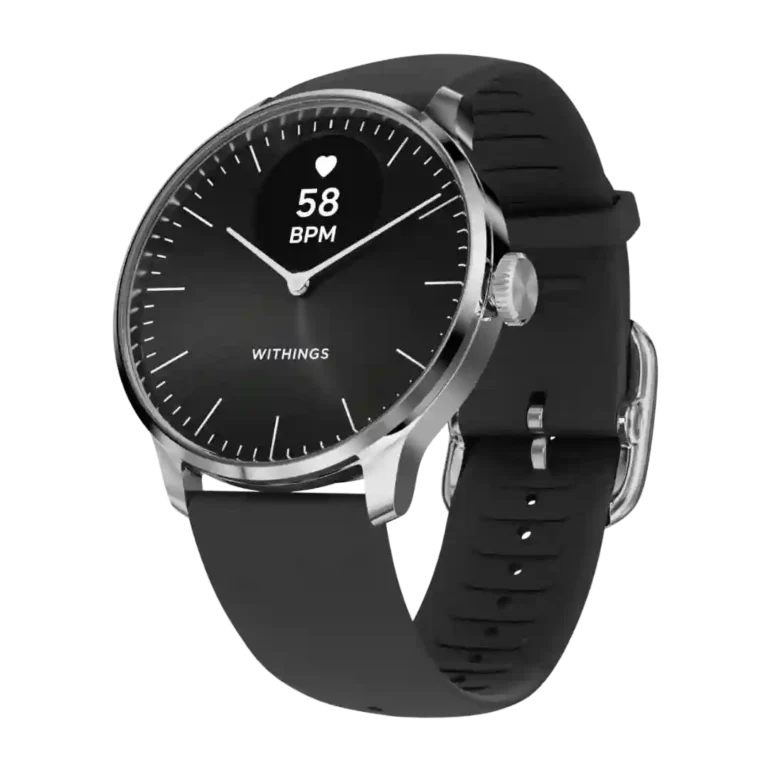
Reviews present the Withings ScanWatch Light as a stylish hybrid watch first and a basic tracker second. It earns its strongest praise for the analog design, slim comfort, stainless-steel feel, water resistance, and battery life that can last far longer than full smartwatches. The tradeoff is that its tiny OLED and crown-based controls keep notifications, workout views, and smartwatch functions intentionally limited. Fitness and sleep tracking are useful for casual monitoring, and connected GPS often performs well, but step counts, heart-rate readings, and auto-tracked workouts are not consistently sports-watch precise. It also omits ECG, blood oxygen, payments, music controls, onboard GPS, and richer safety features, making it best understood as a fashionable wellness watch with selective smarts.
Compared in Reviews
Products reviewers directly compared with this model, grouped into quick takeaways.
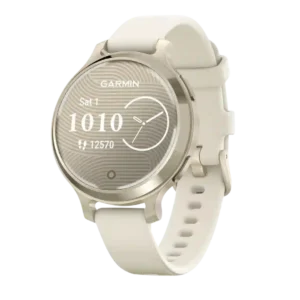
- Better: navigation and on-watch fitness information The Garmin Lily 2 was described as easier to navigate and more informative on the watch itself.
- Better: smartwatch and fitness feature depth The Garmin Vivomove Style was described as offering richer smartwatch and fitness features.
Feature Scorecards
Pros
-
Style and design are the product's clearest strength, with reviewers repeatedly praising the analog, elegant, watch-like look.
-
Build quality is praised through comments about hardware, high-quality analog feel, and the sturdy watch construction.
-
Materials quality is a strength, with stainless steel, Gorilla Glass, and well-crafted watch materials repeatedly noted.
-
Band quality is generally strong, with comfort, secure wear, and soft silicone or fluoroelastomer materials praised.
-
Water resistance is consistently supported by the 5ATM rating and real swimming or shower use.
-
Comfort is one of the strongest positives, especially due to the slim, light body and non-irritating bands.
-
Durability evidence is positive, including scratch-free glass, 5ATM confidence, and shower or swim use without issues.
-
Cross-platform compatibility is strong for a hybrid, with Android, iOS, Apple Health, and Google Fit support mentioned.
-
Workout variety is broad for a hybrid, with reviews citing around 30 to more than 40 activities, though some modes remain basic.
-
Charging speed is solid, with several reviewers reporting a full charge in about two hours or meaningful gain in 30 minutes.
-
The user interface evidence is strongest in the companion app, where one review praised a clean, straightforward UI.
-
Pairing and syncing were generally reliable in the tested evidence, with no setup problems and stress-free iPhone syncing reported.
-
Battery life is mostly strong versus full smartwatches, though real-world results varied sharply by settings and one reviewer saw only a week.
-
The Withings app ecosystem is a strength for users with other Withings health devices and centralized health data.
-
Fit works best for smaller wrists and many users, though reviewers noted the one-size body may not suit everyone.
-
Menu navigation through the crown was easy for reviewers after adjustment, despite the small display.
-
Activity auto-detection is a recurring strength for basic workouts, but one review found auto-tracked sessions less transparent than manual tracking.
-
Sleep tracking was generally useful and comfortable, with several reviewers finding duration or scores broadly similar to Garmin, Oura, or other references.
-
Software behavior was described as smart within the device limitations, though the broader smartwatch experience remains simplified.
-
Wellness insights include trends, sleep scores, heart-rate variability, respiratory information, and app-based progress views, though some premium insights cost extra.
-
The companion app drew mixed-to-positive reactions, from easy and well-designed to busy or cluttered depending on reviewer expectations.
-
Fitness tracking accuracy was mostly acceptable for casual use, with connected GPS and run data often close enough, but sports-watch credibility remained mixed.
-
Button and crown controls work well enough, but they add steps compared with touchscreen-based smartwatches.
-
Value is context-dependent: reviewers liked the design-and-battery package, but noted it is not cheap for a basic tracker.
-
Heart-rate evidence is mixed: one review found it close to Garmin and Polar devices, while another saw unreliable daily averages.
-
Watch-face impressions are mixed: reviewers liked the analog style, but thin hands and visibility issues reduced practicality.
-
Reliability evidence is split between praise for battery endurance and a YouTube review where the promised battery life failed badly.
-
GPS depends on a phone rather than onboard hardware; connected GPS was often accurate enough, but the lack of built-in GPS is a tradeoff.
-
Third-party support is mainly sync-based, with evidence for Google Fit, Strava, and Samsung Health rather than on-watch apps.
Cons
-
General health data was described as useful rather than medical-grade, with strongest support around basic trend and wellbeing tracking.
-
Coaching features exist mostly through Withings+ content such as daily guidance and wellness libraries, not as deep on-watch coaching.
-
Safety features are basic, mainly high and low heart-rate alerts, and lack the emergency features highlighted on some competitors.
-
Calorie tracking received limited direct evidence and was discussed mainly as another estimate that differed from comparison devices.
-
Charging convenience is mixed: the proprietary charger can work securely, but multiple reviewers called it cheap, flimsy, or awkward.
-
Display quality is the biggest compromise: the tiny monochrome OLED works for basics but limits notifications, data views, and readability.
-
Customization is modest, focused on screen organization and limited settings rather than rich watch-face or interface personalization.
-
Phone notifications work, but the tiny display makes reading messages slow and several reviewers found the experience limited.
-
Step counting was inconsistent across references, with multiple reviews reporting roughly 1,000-step differences versus Fitbit or other trackers.
-
Size options are limited because the Light comes only in 37mm, which helps compactness but hurts broader fit flexibility.
-
Smartwatch features are intentionally basic, covering simple alerts, alarms, timers, and tracking rather than a full app-rich smartwatch.
-
Brightness is uneven, with one reviewer finding it not very bright and another finding it disruptive at night.
-
Outdoor visibility is weak based on direct sunlight complaints about the small OLED display.
-
Music controls are a notable missing smart feature, especially for reviewers used to controlling playback from a smartwatch.
-
Call handling is minimal; reviewers treated calls as notifications rather than a wrist-based calling experience.
-
Contactless payments are absent, and reviewers repeatedly framed payments as a feature found on competitors rather than the Light.
-
ECG and Afib-related features are missing on the Light, pushing heart-health-focused buyers toward other ScanWatch models.
-
Blood oxygen tracking is a clear omission; reviewers explicitly noted that the Light lacks SpO2 or blood oxygen monitoring.
-
Onboard music is not supported; one review explicitly states that music cannot be played from the watch.
-
Touchscreen responsiveness is effectively absent because the watch has no touchscreen.
Compared With Category Average
Compared with other Smart Watch, this product is below average in touchscreen responsiveness, blood oxygen tracking, outdoor visibility.
| Attribute | This product | Category average | Difference |
|---|---|---|---|
| touchscreen responsiveness | 1.0 | 3.7 | -2.7 |
| blood oxygen tracking | 1.0 | 3.6 | -2.6 |
| outdoor visibility | 2.0 | 4.3 | -2.3 |
| music controls | 1.5 | 3.5 | -2.0 |
| brightness | 2.4 | 4.2 | -1.9 |
| onboard music storage | 1.0 | 2.9 | -1.9 |
| call handling | 1.5 | 3.1 | -1.6 |
| contactless payments | 1.3 | 2.9 | -1.5 |
FAQ
Does the Withings ScanWatch Light really last 30 days?
Reviewers generally praised battery life, with some seeing weeks of use or near the advertised claim. Results were not uniform, because Quicklook, notifications, respiratory scans, and GPS-linked workouts could shorten runtime sharply.
Is the ScanWatch Light a full smartwatch?
No. Reviewers describe it as a basic hybrid that handles simple notifications, alarms, timers, and health tracking, but not apps, payments, music controls, wrist calls, or a large interactive display.
How good is it for workouts?
It can track many activities, supports automatic detection for core exercises, and uses connected GPS through a phone. Reviewers found it useful for casual exercise, but not a replacement for a dedicated sports watch.
Is sleep tracking accurate?
Sleep tracking was one of the better-reviewed health features, with duration and sleep scores often lining up reasonably with Garmin or Oura references. Some reviewers still found Oura more precise or said the ScanWatch could overestimate sleep.
Does it have ECG or blood oxygen tracking?
No. Reviewers repeatedly noted that the ScanWatch Light lacks ECG, Afib detection, and blood oxygen tracking, which are reasons to consider higher ScanWatch models.
Is it comfortable to wear?
Yes, comfort is one of the strongest positives in the reviews. The small 37mm body, light feel, and soft bands made it easy for several reviewers to wear all day and during sleep.
Consider This Instead
If you want better touchscreen responsiveness
Choose Fitbit Sense 2. It scores 4.9 vs 1.0 for touchscreen responsiveness, with a 3.5 overall score.
If you want better onboard music storage
Choose Huawei Watch Fit 4. It scores 4.7 vs 1.0 for onboard music storage, with a 4.1 overall score.
If you want better contactless payments
Choose Apple Watch SE 3. It scores 4.8 vs 1.3 for contactless payments, with a 4.1 overall score.
If you want better call handling
Choose Apple Watch Ultra 3. It scores 4.6 vs 1.5 for call handling, with a 4.2 overall score.
Overall Top Smart Watch Alternatives
Good if you want the most rugged Apple Watch, brighter outdoor screen, better battery, LTE, and top apps. Skip it if you need Garmin-like mapping, recovery analytics, smaller sizing, or...
Pros: display quality, heart rate accuracy
Cons: cross-platform compatibility, recovery insights
Choose the Galaxy Watch 6 for a polished Android smartwatch with a bright screen, strong apps, and broad health tracking. Skip it if battery life, iPhone support, or full non-Samsung...
Pros: outdoor visibility, workout tracking variety
Cons: cross-platform compatibility, battery life
Good if you need a rugged Garmin with deep outdoor, tactical, GPS, training, and battery features. Skip it if you want a cheaper lifestyle watch or do not need the...
Pros: materials quality, durability
Cons: LTE connectivity, value for money
Good if you want premium golf maps, virtual caddie tools, health metrics, music, notifications, and long battery life in one watch. Skip it if you only need basic yardages or...
Pros: pairing reliability, brightness
Cons: software smoothness, user interface