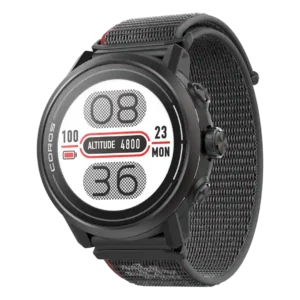
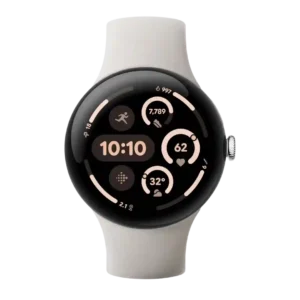
Reliable auto-workout detection was praised in multiple reviews, especially for catching walks automatically without much manual input.
The broader Coros ecosystem benefits from the companion app plus training materials and planning resources on the website.
Reviews consistently praised Wear OS app breadth and the watch’s tight integration with Google services and apps.
The nylon band is comfortable and adjustable, but not everyone liked its feel or styling.
The included band was comfortable and secure, but some reviewers found the default/first-party strap options plain or pricey.
Battery life is one of the Apex 2's biggest advantages, with multiple reviews reporting very strong daily endurance and long GPS runtimes.
Battery life was a meaningful improvement, with the 45mm often reaching about two days, while the 41mm remained good rather than class-leading.
The watch includes SpO2 tracking, mainly surfaced through wellness-style checks rather than heavily tested standalone blood-oxygen performance.
SpO2 tracking is present, and one reviewer said the sleep-related oxygen data matched expected baseline patterns.
Bluetooth setup is straightforward, with easy pairing called out for phones and accessories.
Bluetooth behavior was stable in use, and Google’s Bluetooth 5.3/connectivity refinements were called out positively.
Brightness is adequate for readability, but indoor dimness is a recurring complaint.
The jump to a brighter 2,000-nit screen was one of the most consistently praised upgrades.
Build quality is one of the watch's clearest strengths, with reviewers repeatedly describing it as robust and well made.
Reviewers said the watch feels more refined and better built than earlier Pixel Watches, even if it is not meant for rough abuse.
Physical controls are a strong point, with the extra backlight button and crown/button feel earning praise.
The crown/button setup was generally praised for smooth scrolling, good feel, and useful shortcuts.
Call support is limited to notifications; reviewers explicitly note you cannot answer calls or texts from the watch.
Call-handling extras such as hold/screening features add convenience, though this is more about ecosystem utility than speakerphone quality.
Calorie data was considered useful enough for general training context, but at least one reviewer questioned how accurate the burn estimates felt.
Charging is a mixed story because some reviewers liked the secure connection while others criticized the bundled cable.
Charging works securely, but the proprietary pin puck and lack of wireless charging reduce convenience.
Charging is fast, with reviews citing full charges in roughly 98 minutes to 1 hour 33 minutes.
Charging speed was widely seen as improved, making quick top-offs easy.
Coaching and training support centers on Coros EvoLab, which reviewers describe as increasingly comprehensive for running-focused analysis.
Guided runs, workout builder tools, AI suggestions, and live cues were among the strongest new fitness additions.
Comfort is a standout, with multiple reviews emphasizing the light, compact fit and easy all-day wear.
The watch and stock band were regularly described as comfortable for all-day wear and overnight tracking.
The companion app is consistently praised for being polished, clear, and easy to use.
Fitbit app presentation and dashboards were repeatedly praised as clean, useful, and rich in data.
Contactless payments are absent, and at least one review explicitly calls this out.
Google Wallet/contactless payment support was widely treated as a standard, useful smartwatch feature.
It works broadly with Android phones, but reviewers repeatedly noted the lack of iPhone support and some Pixel-only extras.
Customization is a notable strength, especially for watch settings, workout screens, and other setup options through the app and device.
Watch faces, complications, and tiles offer substantial customization, especially on the larger screen.
Display quality is solid but not exceptional: reviewers like the usability, yet repeatedly mention a dimmer, less vivid screen.
Display quality was one of the watch’s clearest strengths, with sharp OLED visuals and more usable screen space.
Durability is praised across long-term use, with reviewers noting the watch handled knocks and rough use with little visible wear.
Durability remains a tradeoff: some owners avoided scratches, but others reported scratching and noted the lack of rugged protection.
Reviewers note the addition of an ECG-based sensor workflow for deliberate HRV-style readings, treating it as a useful health addition.
ECG support is present and treated as a meaningful health feature, though it was not a major focus of deep testing.
Fit is good for many wrists thanks to the adjustable band, though fit discussion centers more on strap comfort than multiple case sizes.
Both sizes were said to sit well on the wrist, with the 45mm adding space without becoming unwieldy.
Fitness tracking is capable for general workouts, but at least one review said strength and weight training logging was poor.
General fitness tracking accuracy was viewed positively overall across multiple reviewers.
GPS accuracy is good but inconsistent across reviews: several found it solid, while others called it only so-so or noted misses in tougher conditions.
GPS was the weakest fitness metric, with repeated notes about wobble, drift, or distance errors versus stronger rivals.
Health tracking looks mixed overall: sleep timing was praised, but sleep-stage data was described as untrustworthy.
Reviewers generally trusted the broader health stack for exercise and sleep tracking.
Heart-rate performance is generally decent to strong, but several reviews note lag, occasional misses, or larger BPM gaps during harder efforts.
Heart-rate tracking was one of the product’s standout strengths, often matching chest straps or top rivals closely.
LTE support is available across the lineup, though few reviews deeply evaluated LTE performance itself.
Materials punch above the segment, with titanium and sapphire repeatedly highlighted as premium touches.
Gorilla Glass and aluminum materials give the watch a polished, premium-feeling finish.
Menu navigation is generally easy once you learn the layout, even if some submenus or mapping flows need work.
The grid app launcher and simple navigation flow made moving around the watch easier than before.
Music controls are available and at least one reviewer found the touchscreen music controls worked well.
Music and playback controls were easy to access during workouts and from the general UI.
Onboard audio is limited to locally stored MP3 files, with no streaming support mentioned in the reviews.
The watch supports offline music/maps and some standalone streaming, making onboard storage meaningfully useful.
Day-to-day software experience is mixed: one reviewer disliked the interface at first, though others found it usable after time.
Wear OS on the Pixel Watch 3 was widely described as polished and mature.
Outdoor visibility is good thanks to the display's clarity, though it lacks the pop of brighter AMOLED rivals.
Sunlight readability was repeatedly singled out as a big improvement over earlier models.
Pairing reliability is strong, with reviewers reporting no issues connecting sensors or syncing with the app.
Pairing/connection behavior was stable, including better persistent Bluetooth pairing and smooth phone transfers.
Recovery guidance is a recurring strength, with fatigue, recovery timing, and optimal-load style feedback described as useful and often spot-on.
Readiness and load guidance were generally seen as useful and fairly true to how reviewers actually felt.
Overall reliability is good, with reviewers describing it as dependable in regular use.
Day-to-day reliability looked solid overall, but software update bumps prevented a spotless verdict.
Safety-related utility exists through features like storm alerts, which add practical outdoor awareness.
Fall/crash detection and Loss of Pulse were viewed as genuinely valuable safety additions.
Size choice is limited because the new Apex 2 is sold in just one case size.
The new 45mm option was one of the generation’s biggest upgrades and broadened the watch’s appeal.
Sleep start and wake times were praised, and one reviewer also found the sleep tracking strong enough to help spot nighttime wakeups.
Sleep timing and stage estimates were generally reported as closely matching real-world experience.
Smartphone notifications work and are useful, but they are basic rather than standout.
Notifications were prompt and remain a core strength of the smartwatch experience.
Smartwatch features are present but limited: notifications, camera control, and simple utilities exist, yet the watch is still framed as fitness-first.
Smart-home controls, Google TV remote, Recorder, camera controls, and other wrist utilities make the watch feel feature-rich.
Software smoothness is a plus, with one review highlighting a fast interface and no loading delays.
App loading and general UI movement were frequently described as smooth and lag-free.
Step counting was described as fairly consistent, though not deeply benchmarked across reviews.
Step counting tested very well in at least one direct comparison.
Stress appears as part of the watch's wellness data, but reviews discuss it more as an included metric than as a deeply validated tool.
Stress sensing/cEDA showed promise, but opinions were mixed on how actionable it feels versus rival platforms.
Styling lands well overall, with reviewers calling it a decent-looking or impressive design, even if it is understated.
The pebble-like design was frequently called stylish, elegant, and distinctive.
Third-party support is strong, with reviews explicitly naming services such as Strava, Apple Health, Nike Run Club, and adidas Running.
Third-party app support is good by Wear OS standards, though not entirely flawless.
Touch input works, but the smaller screen can make touch navigation feel finicky.
Touch response is strong in normal use, but sweaty or wet interactions can suffer.
The interface is usually described as easy or intuitive, though some reviews still note a learning curve or limited sophistication.
The interface was commonly described as intuitive and easy to learn.
Value is review-dependent but often positive: several reviewers call it a better buy or bargain, while one argued the price is too close to stronger rivals.
Reviewers liked the overall experience, but price came up often as a drawback versus Samsung and some other rivals.
Assistant performance was fine and responsive, but the absence of Gemini kept it from feeling cutting-edge.
Watch face quality is weak in at least one review, which called the available faces ugly.
Watch faces are flexible and usable, but several reviewers wanted more variety or deeper customization.
Water resistance is adequate for typical fitness use, and reviewers reported no issues with showers or surface-water exposure.
IP68/5ATM protection makes it suitable for swimming and everyday water exposure.
Wellness views are a plus, with check-ins and dashboards bundling metrics like HRV, SpO2, stress, recovery, and readiness into useful daily snapshots.
Morning Brief, Readiness, and load metrics were widely seen as genuinely useful wellness additions.
Wi-Fi is included and described as easy to connect during setup, though it is not presented as a major headline strength.
Wi‑Fi support is standard and Google also highlighted faster 5GHz connectivity on this model.
The Apex 2 covers a broad set of sport modes and activity profiles, making it versatile for multisport and outdoor use.
The watch supports many workout types, but reviewers noted that Google still prioritizes runners over some other athletes.