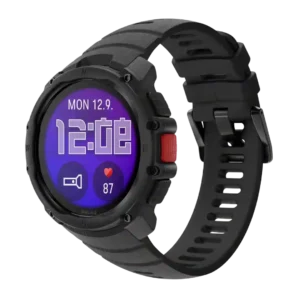
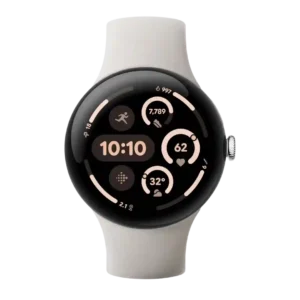
Reliable auto-workout detection was praised in multiple reviews, especially for catching walks automatically without much manual input.
One comparison-heavy review says Garmin still has the stronger ecosystem, so the Street X competes more on simplicity and value than platform depth.
Reviews consistently praised Wear OS app breadth and the watch’s tight integration with Google services and apps.
The strap setup looks solid, with easy swapping and a texture one reviewer specifically liked.
The included band was comfortable and secure, but some reviewers found the default/first-party strap options plain or pricey.
Battery life is one of the headline strengths, with claims and testing clustering around roughly a week-plus of heavy use or up to 10 days in smartwatch mode.
Battery life was a meaningful improvement, with the 45mm often reaching about two days, while the 41mm remained good rather than class-leading.
Multiple reviews explicitly note that the Street X does not include SpO2 hardware, making blood-oxygen tracking a clear omission.
SpO2 tracking is present, and one reviewer said the sleep-related oxygen data matched expected baseline patterns.
Bluetooth behavior was stable in use, and Google’s Bluetooth 5.3/connectivity refinements were called out positively.
Brightness lands in the solid-not-exceptional range: around 1,000 nits and generally good enough, but not class-leading.
The jump to a brighter 2,000-nit screen was one of the most consistently praised upgrades.
Build quality gets favorable comments for its rugged, protective construction, even if it is not luxurious.
Reviewers said the watch feels more refined and better built than earlier Pixel Watches, even if it is not meant for rough abuse.
Button controls are a strength, with large, textured, easy-grip hardware repeatedly called out.
The crown/button setup was generally praised for smooth scrolling, good feel, and useful shortcuts.
Call-handling extras such as hold/screening features add convenience, though this is more about ecosystem utility than speakerphone quality.
Calorie data was considered useful enough for general training context, but at least one reviewer questioned how accurate the burn estimates felt.
Charging is convenient for existing Polar owners because it uses the same USB-C-based charger as newer siblings.
Charging works securely, but the proprietary pin puck and lack of wireless charging reduce convenience.
Charging speed was widely seen as improved, making quick top-offs easy.
Coaching is built around training analysis, Training Load Pro, and a daily suggested workout rather than just passive data collection.
Guided runs, workout builder tools, AI suggestions, and live cues were among the strongest new fitness additions.
Comfort is a recurring strength because the watch stays light enough for all-day wear despite its rugged look.
The watch and stock band were regularly described as comfortable for all-day wear and overnight tracking.
The companion app is a recurring complaint, described as outdated and not great for quick health and fitness overviews.
Fitbit app presentation and dashboards were repeatedly praised as clean, useful, and rich in data.
Google Wallet/contactless payment support was widely treated as a standard, useful smartwatch feature.
It works broadly with Android phones, but reviewers repeatedly noted the lack of iPhone support and some Pixel-only extras.
Customization is decent through quick-release straps, swappable bands, and configurable widgets or complications.
Watch faces, complications, and tiles offer substantial customization, especially on the larger screen.
Display quality is a consistent plus, with the AMOLED screen repeatedly described as nice, crisp, sharp, and easy to read.
Display quality was one of the watch’s clearest strengths, with sharp OLED visuals and more usable screen space.
Durability is one of the clearest strengths thanks to rugged construction, MIL-STD testing, and WR50 protection.
Durability remains a tradeoff: some owners avoided scratches, but others reported scratching and noted the lack of rugged protection.
ECG is repeatedly listed as missing, so buyers wanting wrist-based electrocardiogram features will need a different watch.
ECG support is present and treated as a meaningful health feature, though it was not a major focus of deep testing.
Fit is mixed: the low weight helps, but there is only one case size.
Both sizes were said to sit well on the wrist, with the 45mm adding space without becoming unwieldy.
The one detailed hands-on accuracy review says overall fitness-tracking accuracy was good across the sports it tested.
General fitness tracking accuracy was viewed positively overall across multiple reviewers.
GPS looked very good in the hands-on testing, though the same review still notes a few minor exceptions in certain route scenarios.
GPS was the weakest fitness metric, with repeated notes about wobble, drift, or distance errors versus stronger rivals.
Health readouts seem directionally useful, but the hands-on review warns not to treat the watch's sleep analysis as something to fully rely on.
Reviewers generally trusted the broader health stack for exercise and sleep tracking.
Heart-rate performance is generally described as good, with one detailed test review finding it accurate and other reviews calling the sensor pretty good or more consistent during workouts.
Heart-rate tracking was one of the product’s standout strengths, often matching chest straps or top rivals closely.
LTE support is available across the lineup, though few reviews deeply evaluated LTE performance itself.
Materials keep weight down but feel less premium, since the case leans heavily on plastic or composite parts and skips metal accents.
Gorilla Glass and aluminum materials give the watch a polished, premium-feeling finish.
Menu navigation appears straightforward enough for scrolling through widgets and daily/training details without much friction.
The grid app launcher and simple navigation flow made moving around the watch easier than before.
Music controls are included, but only as part of the basic smart-feature bundle.
Music and playback controls were easy to access during workouts and from the general UI.
The watch supports offline music/maps and some standalone streaming, making onboard storage meaningfully useful.
The proprietary Polar operating system is described as solid overall, though not especially refreshed or modernized.
Wear OS on the Pixel Watch 3 was widely described as polished and mature.
Outdoor visibility is mostly positive, though one reviewer warns it may not be ideal in the brightest sunlight.
Sunlight readability was repeatedly singled out as a big improvement over earlier models.
Pairing/connection behavior was stable, including better persistent Bluetooth pairing and smooth phone transfers.
Recovery guidance is one of the stronger themes, with reviews highlighting workout-load feedback, Nightly Recharge, and prompts about whether training is on track.
Readiness and load guidance were generally seen as useful and fairly true to how reviewers actually felt.
One review positions the Street X around reliable tracking and dependable everyday use rather than feature overload.
Day-to-day reliability looked solid overall, but software update bumps prevented a spotless verdict.
Safety utility centers on the integrated flashlight, with repeated mentions of better visibility after dark and both white and red light modes.
Fall/crash detection and Loss of Pulse were viewed as genuinely valuable safety additions.
Choice is limited here because the Street X is sold in only one case size.
The new 45mm option was one of the generation’s biggest upgrades and broadened the watch’s appeal.
Sleep tracking can reflect better and worse nights, but one reviewer still calls Polar's sleep-stage performance mediocre compared with the best sleep-focused devices.
Sleep timing and stage estimates were generally reported as closely matching real-world experience.
Phone alerts for calls and messages are present, but reviews frame them as basic smartphone support rather than a headline feature.
Notifications were prompt and remain a core strength of the smartwatch experience.
Smart features cover the essentials, but the watch is still presented as fitness-first and somewhat limited on the broader smartwatch side.
Smart-home controls, Google TV remote, Recorder, camera controls, and other wrist utilities make the watch feel feature-rich.
Software smoothness is a weak point, with one reviewer explicitly calling the experience sluggish.
App loading and general UI movement were frequently described as smooth and lag-free.
Step counting tested very well in at least one direct comparison.
Stress sensing/cEDA showed promise, but opinions were mixed on how actionable it feels versus rival platforms.
Styling is widely seen as a positive if you like the rugged G-Shock or Instinct-like look, though it is bulkier than Polar's usual aesthetic.
The pebble-like design was frequently called stylish, elegant, and distinctive.
Third-party app support is good by Wear OS standards, though not entirely flawless.
Touch response is strong in normal use, but sweaty or wet interactions can suffer.
User-interface feedback is mixed: it is simple and easy to understand, but several reviews still describe it as dated or not ideal for quick overviews.
The interface was commonly described as intuitive and easy to learn.
Value is a major selling point across nearly every review, which repeatedly calls the Street X affordable, competitive, and one of the best-value options in its class.
Reviewers liked the overall experience, but price came up often as a drawback versus Samsung and some other rivals.
Assistant performance was fine and responsive, but the absence of Gemini kept it from feeling cutting-edge.
Watch-face selection is described as numerous, giving users a fair amount of choice even if it is not treated as a signature feature.
Watch faces are flexible and usable, but several reviewers wanted more variety or deeper customization.
Water resistance is consistently listed at WR50 or 50 meters, enough for common sports-watch use but not pitched as a dive tool.
IP68/5ATM protection makes it suitable for swimming and everyday water exposure.
Wellness coverage goes beyond raw sleep logs, with repeated mentions of HRV, skin temperature, recovery metrics, and alertness/readiness-style insight.
Morning Brief, Readiness, and load metrics were widely seen as genuinely useful wellness additions.
Wi‑Fi support is standard and Google also highlighted faster 5GHz connectivity on this model.
Workout variety is a clear strength, with repeated mentions of 170-plus sport profiles and extras such as multisport and open-water swimming.
The watch supports many workout types, but reviewers noted that Google still prioritizes runners over some other athletes.