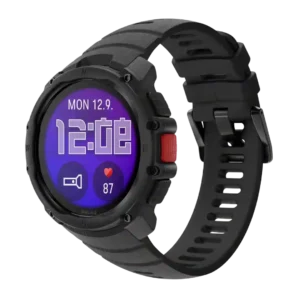
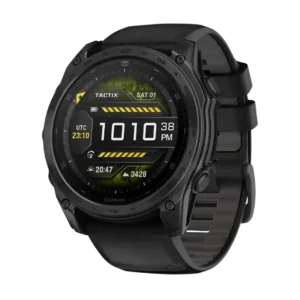
One comparison-heavy review says Garmin still has the stronger ecosystem, so the Street X competes more on simplicity and value than platform depth.
Reviews describe a broad app selection, including over 50 applications and a vast widget/app list, indicating a feature-rich built-in software ecosystem.
The strap setup looks solid, with easy swapping and a texture one reviewer specifically liked.
Band impressions are modestly positive. Reviews mention the stock silicone band, an upgraded silicone strap, and comfort that suits sports use.
Battery life is one of the headline strengths, with claims and testing clustering around roughly a week-plus of heavy use or up to 10 days in smartwatch mode.
Battery life is one of the product’s strongest themes. Reviews cite roughly 16 days on some AMOLED use, 20 days in comparison testing, and 29-30 days on larger or solar-focused scenarios.
Multiple reviews explicitly note that the Street X does not include SpO2 hardware, making blood-oxygen tracking a clear omission.
Reviews repeatedly list blood oxygen or oxygen saturation as part of the health suite, but they stop short of detailed validation beyond feature inclusion.
Bluetooth support is directly referenced through Bluetooth calling and voice-assistant use, indicating core wireless audio/phone connectivity is present.
Brightness lands in the solid-not-exceptional range: around 1,000 nits and generally good enough, but not class-leading.
Brightness feedback is favorable, with reviewers describing the screen as easy to read and slightly brighter than earlier models.
Build quality gets favorable comments for its rugged, protective construction, even if it is not luxurious.
Build quality comes through as premium and rugged, with reviews repeatedly centering the titanium construction and hard-use intent.
Button controls are a strength, with large, textured, easy-grip hardware repeatedly called out.
Button feedback is generally positive because the controls are textured and easy to feel in the dark, though one reviewer preferred the older click feel.
Call features are well supported. Multiple reviews say the watch can make, receive, or answer calls when paired with a nearby phone.
One review specifically credits the watch with accurately calculating calorie consumption for weighted hiking, making the calorie data more useful for rucking-style training.
Charging is convenient for existing Polar owners because it uses the same USB-C-based charger as newer siblings.
Charging convenience is only lightly covered, but one review explicitly notes magnetic charging.
Charging speed receives one clear positive mention: a full recharge is said to take about one hour.
Coaching is built around training analysis, Training Load Pro, and a daily suggested workout rather than just passive data collection.
Coaching support is described through workout suggestions, visual guidance, and daily training suggestions that help structure sessions and recovery decisions.
Comfort is a recurring strength because the watch stays light enough for all-day wear despite its rugged look.
The companion app is a recurring complaint, described as outdated and not great for quick health and fitness overviews.
Garmin Connect is described positively, with reviewers highlighting personalized dashboards and easy route/app syncing into the watch experience.
Contactless payments are clearly supported through NFC and Garmin Pay mentions across several reviews, with no major caveats called out.
Customization is decent through quick-release straps, swappable bands, and configurable widgets or complications.
Customization is a strength. Reviews mention custom strength plans, flexible submenus/settings, and the ability to swap band colors and looks.
Display quality is a consistent plus, with the AMOLED screen repeatedly described as nice, crisp, sharp, and easy to read.
Display quality is a major highlight. Reviews describe a high-definition or bright AMOLED screen with better contrast, color, and clarity.
Durability is one of the clearest strengths thanks to rugged construction, MIL-STD testing, and WR50 protection.
Durability is one of the clearest positives, with reviewers pointing to military-grade claims, harsh-condition use, and a like-new state after rough outings.
ECG is repeatedly listed as missing, so buyers wanting wrist-based electrocardiogram features will need a different watch.
Reviews confirm ECG support and mention it alongside other advanced sensors, but they do not provide deep testing beyond availability and general inclusion.
Fit is mixed: the low weight helps, but there is only one case size.
The one detailed hands-on accuracy review says overall fitness-tracking accuracy was good across the sports it tested.
GPS looked very good in the hands-on testing, though the same review still notes a few minor exceptions in certain route scenarios.
GPS performance is a standout. Reviews describe precise location tracking, precise route recording, multi-band accuracy, and strong mapping/navigation support.
Health readouts seem directionally useful, but the hands-on review warns not to treat the watch's sleep analysis as something to fully rely on.
Heart-rate performance is generally described as good, with one detailed test review finding it accurate and other reviews calling the sensor pretty good or more consistent during workouts.
Across multiple reviews, heart rate tracking is described as more accurate in motion and very close to chest-strap results, with only minimal deviations noted.
Materials keep weight down but feel less premium, since the case leans heavily on plastic or composite parts and skips metal accents.
Materials quality is strongly supported by repeated mentions of sapphire crystal or sapphire lens protection and titanium hardware.
Menu navigation appears straightforward enough for scrolling through widgets and daily/training details without much friction.
One reviewer specifically calls the updated map/navigation flow more user friendly, suggesting menu navigation is easier to work through than before.
Music controls are included, but only as part of the basic smart-feature bundle.
One review explicitly says you can control your phone’s music, confirming basic music-control functionality from the watch.
Offline listening is well supported. Reviews mention internal storage plus the ability to load music or podcasts directly onto the watch.
The proprietary Polar operating system is described as solid overall, though not especially refreshed or modernized.
Outdoor visibility is mostly positive, though one reviewer warns it may not be ideal in the brightest sunlight.
Outdoor visibility is repeatedly praised. Reviews say the screen remains clear in bright sunlight and is easy to read outside.
Setup and pairing are lightly but positively covered, with one reviewer calling initial smartwatch setup literally a breeze.
Recovery guidance is one of the stronger themes, with reviews highlighting workout-load feedback, Nightly Recharge, and prompts about whether training is on track.
Recovery is a recurring strength, with reviews citing recovery tracking, remaining recovery time, suggested recovery times, and training-readiness style guidance.
One review positions the Street X around reliable tracking and dependable everyday use rather than feature overload.
Reliability is not widely stress-tested in detail, but one review directly frames the watch around reliability, precision, and durability.
Safety utility centers on the integrated flashlight, with repeated mentions of better visibility after dark and both white and red light modes.
Safety and security features are a defining differentiator, with repeated mentions of stealth mode and a kill switch that erases stored data.
Choice is limited here because the Street X is sold in only one case size.
Reviews confirm multiple size options, with several sizes/styles available and repeated mention of two primary case sizes.
Sleep tracking can reflect better and worse nights, but one reviewer still calls Polar's sleep-stage performance mediocre compared with the best sleep-focused devices.
One long-term reviewer says the sleep results were consistent with lived experience, which supports the watch’s sleep tracking as directionally reliable.
Phone alerts for calls and messages are present, but reviews frame them as basic smartphone support rather than a headline feature.
One review explicitly mentions smart notifications for messages, emails, and calendar alerts, supporting the watch’s everyday phone-connected utility.
Smart features cover the essentials, but the watch is still presented as fitness-first and somewhat limited on the broader smartwatch side.
Reviewers frame the Tactix 8 as more than a niche tactical device, with one calling it an everything watch and another noting standard smartwatch capabilities.
Software smoothness is a weak point, with one reviewer explicitly calling the experience sluggish.
Software smoothness trends positive but not perfect. One reviewer says lag concerns did not materialize, while another noticed slightly weaker touch pickup than the prior model.
One review says the watch includes stress monitoring with personalized relaxation suggestions, framing it as a practical daily wellness tool.
Styling is widely seen as a positive if you like the rugged G-Shock or Instinct-like look, though it is bulkier than Polar's usual aesthetic.
Styling is a real draw, with reviewers emphasizing the rugged outdoor look and distinctive blacked-out tactix design.
Third-party support is explicitly backed by Spotify and Amazon Music mentions, showing that outside services are part of the watch experience.
Touch response is directly praised by one reviewer, who says the touchscreen feels quite nice during everyday use and setup.
User-interface feedback is mixed: it is simple and easy to understand, but several reviews still describe it as dated or not ideal for quick overviews.
User-interface commentary is modest but positive, with reviewers noting a slightly different UI and consistent interface behavior across versions.
Value is a major selling point across nearly every review, which repeatedly calls the Street X affordable, competitive, and one of the best-value options in its class.
Value for money is the main weak point. Multiple reviews call out the hefty price, making the watch easier to justify for niche or demanding users than for casual buyers.
Voice support is presented as useful rather than deeply reviewed: reviewers mention built-in voice commands and access to the phone’s voice assistant.
Watch-face selection is described as numerous, giving users a fair amount of choice even if it is not treated as a signature feature.
Water resistance is consistently listed at WR50 or 50 meters, enough for common sports-watch use but not pitched as a dive tool.
Water resistance is broadly supported, with reviews citing 100-meter resistance and dive readiness down to 40 meters depending on use case.
Wellness coverage goes beyond raw sleep logs, with repeated mentions of HRV, skin temperature, recovery metrics, and alertness/readiness-style insight.
Reviews mention body battery, respiration, jet-lag guidance, and light/sleep/exercise suggestions, showing that wellness insights go beyond raw training stats.
Workout variety is a clear strength, with repeated mentions of 170-plus sport profiles and extras such as multisport and open-water swimming.
Workout coverage is exceptionally broad. Reviews mention rucking plus dozens of built-in workout programs and roughly 80 or more sports modes and profiles.