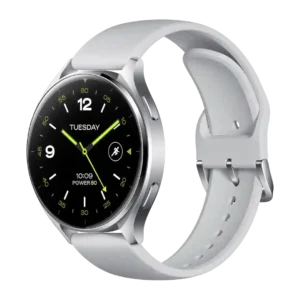
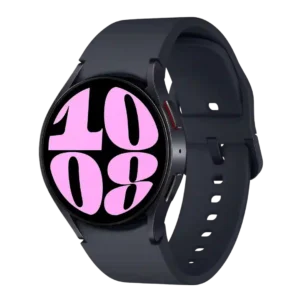
Automatic workout detection is weak: one reviewer said it is absent, while another found the prompts overly eager and inconsistent.
Auto workout detection is repeatedly described as reliable and quick for common activities like walking, running, rowing, cycling, and elliptical sessions.
Wear OS gives the Watch 2 broad app access, including Google services and a bigger app selection than Xiaomi’s non-Wear OS models.
Reviewers consistently praise the Play Store support and broad selection of downloadable apps, noting a deeper ecosystem than most Android smartwatch rivals.
The included TPU band works for workouts but is only average overall, with reviewers calling it cheap-feeling or merely okay.
The included band is described as soft and secure, and Samsung’s updated band system makes swaps easier even if it is not a dramatic usability leap.
Battery life is the main tradeoff. Depending on settings and use, reviewers saw anything from about one day to roughly two days, with lighter use stretching it further.
Battery life is the clearest tradeoff: some reviewers saw roughly 18–25 hours with heavier use or always-on display, while lighter-use testing stretched closer to two days.
Blood oxygen tracking is available as part of the all-day health suite, and one reviewer’s spot check lined up well with an external reading.
Blood oxygen support is available on-watch, but multiple reviewers found overnight SpO2 readings lower than expected or unusually low compared with other devices.
Bluetooth 5.2 support is present and treated as a core connection feature.
Bluetooth performance appears solid in real use, including stable headphone pairing and streaming from the watch during workouts.
The display gets impressively bright, with reviewers specifically calling out strong peak brightness.
Brightness is a standout strength, with multiple reviews emphasizing the 2,000-nit peak and excellent readability in bright conditions.
Build quality is solid for the price, with a light aluminum case that generally feels premium even if it is not ultra-premium.
Build quality earns positive marks for its light but solid feel, combining aluminum construction with a durable overall finish.
The two-button setup is easy to use, though navigation depends more on touch because there is no rotating crown.
The physical buttons are useful for navigation and workout control, though they are not as versatile as a full rotating input system.
Bluetooth calling works well, with reviewers praising clear speaker and microphone quality for on-wrist calls.
Calling and replying from the wrist are generally smooth, with clear audio and intuitive controls in testing.
Calorie data is available, but one reviewer found the synced workout calorie figures glitched and less trustworthy.
Calories are easy to surface during daily activity and workouts, making the watch helpful for quick effort snapshots rather than deep coaching on their own.
The proprietary magnetic charger is a weak point because alignment matters and it is less convenient than standard wireless pucks.
Charging is straightforward thanks to the included magnetic puck and support for reverse wireless top-ups from compatible Galaxy phones.
Charging is a standout strength, with reviewers consistently seeing a full or near-full charge in about 35 to 45 minutes.
Charging speed is consistently praised, with several testers seeing about 50% in 30 minutes and a full charge in roughly 45–90 minutes.
Basic coaching exists through detailed sport analysis and coaching tips, but it is not positioned as advanced training guidance.
Samsung’s sleep coaching and sleep score analysis add guided nudges, multi-week plans, and clearer recovery-focused feedback than past generations.
The watch is widely described as light and comfortable for all-day wear, sleep, and workouts despite its large case.
Comfort is repeatedly highlighted, with reviewers calling the watch light, easy to wear all day, and surprisingly manageable for sleep tracking.
Mi Fitness is functional for setup, watch faces, and basic stats, but reviewers disagreed on polish and some found data review frustrating.
Samsung Health and the companion software are generally seen as polished, easy to use, and rich enough to make sense of the watch’s health data.
Google Pay and Wallet support are strong features, and reviewers generally found tap-to-pay convenient and reliable.
NFC payments through Samsung Wallet are easy to use and add practical convenience when leaving the phone or wallet behind.
Android support is the clear focus. Some reviewers say it is Android-only, while another says iPhone use is possible but limited by Mi Fitness.
Compatibility is limited compared with more open rivals: the Watch 6 works with Android phones only, and some features remain Samsung-phone-specific.
Customization is strong thanks to interchangeable 22mm bands, editable tiles, and lots of watch-face and complication options.
Customization is broad, from text sizing and watch appearance to workout setups and strap choices.
Display quality is a major highlight, with reviewers repeatedly praising the sharp, bright AMOLED screen.
The display is one of the watch’s best features, repeatedly described as bright, sharp, colorful, and more immersive thanks to slimmer bezels.
Durability seems acceptable in normal use, but reviewers note the lack of military-grade protection and some uncertainty about long-term toughness.
Durability is a strong point, with IP68/5ATM protection, scratch-resistant sapphire, and positive wear reports after knocks and daily use.
ECG is not offered here, and reviewers explicitly list it among the missing advanced health features.
ECG support is present, but several reviews note that access is restricted by Samsung Health Monitor and is best within Samsung’s phone ecosystem.
Fit depends on wrist size: one reviewer said it works best when worn snugly, while another said the case runs on the large side.
With light case sizes and a compact shape, the Watch 6 is generally described as easy to fit and non-bulky on the wrist.
Fitness tracking is serviceable but not class-leading, with one reviewer calling the experience rudimentary rather than deeply differentiated.
General workout tracking is viewed as good overall, with several testers reporting close matches for pace, distance, calories, and overall workout logging.
GPS is a strength in several reviews, especially with dual-band support, though one reviewer still wanted better exactness.
GPS results are mixed: some reviews call mapping excellent or route accuracy good, while others report corner-cutting and occasional spotty tracks.
Health tracking is useful for trends rather than clinical precision, with reviewers describing the data as good enough but not professional-grade.
Core health tracking is broadly useful, with sleep and body-composition data often landing in the right ballpark even if some metrics are not lab-grade.
Heart-rate performance is mixed. Some reviewers found it close to trusted devices, while others saw erratic readings during workouts or daily use.
Heart rate accuracy is good at rest and often close to chest straps, but interval spikes and some workouts still show lag or inconsistency.
There is no LTE on the Watch 2, so phone-free connectivity is one of the main features you give up.
LTE models add real standalone usefulness, letting the watch handle calls, texts, and data away from the phone.
Material quality is decent rather than luxurious, with TPU and aluminum helping keep weight and cost down.
Materials feel premium for the price, especially the sapphire crystal, while the standard model’s aluminum build still feels well finished.
Menu navigation is generally intuitive, but the lack of a crown means touch input does more of the work.
Navigation is easy to learn and usually efficient, helped by the touch bezel and straightforward layout.
At least one reviewer highlighted direct on-watch media control, including volume adjustment.
Spotify support gives the watch basic but useful on-wrist music controls rather than a full media-management experience.
With 32GB of storage, reviewers say there is enough room for offline playlists, podcasts, audiobooks, and apps.
The watch’s 16GB storage is enough for apps and offline music or podcast downloads, which adds phone-free flexibility.
Wear OS 3.5 gives the watch a full smartwatch experience with Google features, even if it is not running the newest version.
Wear OS 4 with Samsung’s One UI skin delivers one of the best Android smartwatch software experiences, with strong integration and feature depth.
Outdoor visibility is strong, with reviewers saying the screen stays readable in bright conditions.
Outdoor readability is excellent, with reviewers repeatedly saying the screen stays easy to read in direct sunlight and low glare.
Pairing and syncing were described as straightforward, with automatic syncing called out positively.
Setup and pairing are generally smooth, with reviewers reporting easy device detection and little trouble during onboarding.
Recovery suggestions are present, but one reviewer found them unrealistic enough to ignore.
Sleep analysis includes explicit physical and mental recovery factors, giving the watch more actionable recovery framing than a simple sleep total.
Reliability looks improved over Xiaomi’s rougher earlier efforts, though one reviewer still noticed graphical glitches.
Across longer use, reviewers generally describe the Watch 6 as dependable day to day, even if battery behavior can still vary.
One reviewer explicitly surfaced emergency SOS in the settings, but broader safety tools were not discussed.
Safety coverage is solid, including emergency dialing and fall detection, though not every advanced safety feature is enabled by default.
There is only one case size, and reviewers call the lack of size options a real downside for smaller wrists.
The standard Watch 6 offers two easy-to-shop sizes, making it simpler to match the watch to wrist size and preference.
Sleep tracking is generally one of the better health features, with reviewers calling it detailed, precise, or reasonably close to reference devices.
Sleep tracking is one of the stronger health tools, with good agreement on time in bed and wake detection even if sleep stages are not perfect.
Notifications are capable and reply-friendly, but delivery can be inconsistent on some apps according to one review.
Notifications work well as part of the everyday smartwatch experience, with wrist-based viewing and replies reducing the need to grab a phone.
Core smartwatch features are strong for the price, including Google apps, notifications, calls, and health tracking.
The Watch 6 covers the smartwatch basics well, combining notifications, apps, health tools, connectivity, and safety features in one polished package.
Software performance is mostly smooth, but reviewers still mention occasional sluggishness or stutters.
Software performance is a clear strength, with reviewers regularly describing the interface as smooth, quick, and low on lag.
One reviewer said everyday step tracking worked very well in regular use.
Step tracking appears dependable in general-use testing, with one reviewer specifically saying results matched competing watches well.
Stress tracking is part of the standard health package and can run throughout the day.
Stress monitoring is available as part of Samsung’s broader daily health tracking suite, though it is not a centerpiece feature in most reviews.
The design is clean and minimal, though several reviewers also describe it as plain or simple-looking.
The design lands well for most reviewers, balancing a sporty everyday look with a clean, minimalist shape.
Third-party support is one of the big advantages here, with reviewers specifically naming apps like Spotify and WhatsApp.
Third-party app support is strong for Wear OS, with reviewers calling out WhatsApp, Spotify, Strava, and the broader Play Store advantage.
One reviewer described the display as responsive and easy to use.
Touch response is usually quick and lag-free, though some reviewers still prefer the Classic’s physical bezel over the standard model’s touch navigation.
The interface is easy to learn and feels slick by smartwatch standards.
The interface is easy to understand and well organized, making the watch approachable even for people new to Samsung Health or Wear OS.
Value is one of the Watch 2’s strongest themes, with reviewers repeatedly framing it as an affordable way into Wear OS.
Value is generally strong thanks to the display, apps, and health features, though the battery and Samsung-only limitations keep it from feeling unbeatable.
Google Assistant support is solid overall, with voice access working well even if recognition can occasionally take a moment.
Google Assistant support adds useful voice control, and at least one long-term reviewer called it notably fast on the watch.
Watch faces look good and come in a broad selection, with both built-in and downloadable options.
Watch face options are plentiful and visually improved by the larger screen, giving the watch more personality than past generations.
5ATM water resistance is enough for swimming and daily water exposure, though some reviewers still wanted stronger protection credentials.
Water resistance is a practical strength, with formal swim-ready protection and repeated confidence that the watch can handle everyday wet conditions.
Wellness insights cover basics like breathing guidance and spot health readings, but one reviewer found the guidance fairly shallow.
Beyond raw metrics, the watch gives digestible sleep and wellness insights that help translate data into more understandable daily guidance.
Wi-Fi is present, but one reviewer noted that some tasks, like Maps navigation, still leaned heavily on the phone.
Wi-Fi support is present and useful for extending notifications and connected features when the phone is not nearby.
Workout variety is excellent, with roughly 150 to 160+ sport modes repeatedly mentioned.
Workout variety is excellent, with reviewers repeatedly pointing to the very large list of supported activities and niche exercise modes.