Gemini features are a major draw for this doorbell, with richer descriptions, search, and familiar-face tools, but reviews were split on how consistently accurate the AI felt.
Across reviews, the doorbell's on-device AI is repeatedly praised for distinguishing people, packages, animals, and vehicles with fewer false alerts than many competitors, especially when paired with well-drawn zones.
The Google Home app is a clear strength thanks to intuitive controls, guided setup, and smooth firmware/setup handling.
The experience is centered on the Google Home app (not the Nest app). Most reviewers like the cleaner UI and setup flow, but some criticize missing customization (like notification tones) and occasional app hiccups or reconnect delays.
Two-way audio is consistently usable, with clear visitor voices and reliable conversation quality across reviews.
Two-way talk is generally clear, with strong microphone clarity in multiple tests. The most common audio complaint is the speaker being quiet or distorting at higher volumes compared with the best doorbells.
Google Home automation adds practical flexibility, including motion-triggered actions with other smart devices.
Google speakers and Nest Hub displays integrate well for announcements, live view, and voice interaction.
Integration with Nest/Google hubs and speakers is repeatedly cited as a major benefit, including announcements and quick viewing on compatible displays.
The doorbell works with existing wired chimes and Google speakers/displays, though there is no included standalone chime.
Chime support is flexible: reviewers report compatibility with an existing wired chime (using included hardware) and the option to use Google/Nest speakers and displays for announcements, plus quiet-time style options in-app.
Buyers get three finish choices, and reviewers consistently noted the available color options.
Multiple reviews highlight the four color finishes as a practical advantage for matching home exteriors, with generally positive impressions of the available choices.
Multiple reviews say the box includes the core mounting and wiring accessories needed for installation.
Several reviews call the in-box hardware complete, commonly noting included wedge mounts, chime hardware, and mounting parts that reduce the need for extra purchases.
Status LEDs and button lighting provide clear visual feedback for setup and recording states.
Controls and indicators like the status light and illuminated button ring are referenced as helpful for showing activity and recording state, with some reviews noting brightness/indicator settings in-app.
The app exposes at least a basic low-bandwidth mode, giving some control over data use.
Bandwidth impact is noted as potentially significant with continuous cloud recording. Reviewers recommend event-only recording or lowering quality if your ISP has data caps.
Package monitoring is a real feature here, with reviewers noting package detection and accurate delivery callouts.
Package alerts are consistently described as accurate, including detection of deliveries and (in some tests) pickups. Some reviews distinguish basic package detection from more advanced tracking capabilities behind paid tiers.
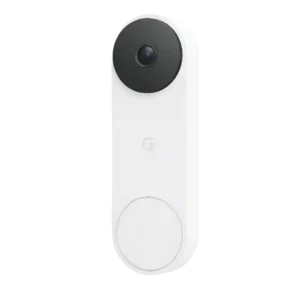
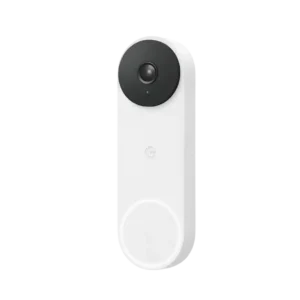
Design is one of the most consistently praised aspects, with reviewers describing the doorbell as especially attractive and premium-looking.
Design is frequently praised as sleek, minimal, and modern, though at least one review describes it as more utilitarian than premium-looking for the price.
Included wedges, mounting plates, and install accessories help adapt the doorbell to different mounting situations.
Familiar-face detection can be impressive when it works, but at least one review still saw recognition misses.
Familiar face recognition is repeatedly described as a paid feature and can be constrained by local regulations in some areas. When available and properly trained, reviews suggest it can work well but needs a clear view.
The square 1:1 framing and wide field of view give a broad head-to-toe porch view, with several reviewers praising better left-right coverage and package visibility.
The 3:4 portrait framing is valued for head-to-toe views and package coverage, but many note it feels narrow side-to-side. Several reviewers recommend using the included wedge mount to better capture the porch and doorway.
Installation is widely praised, especially the app guidance and the easy upgrade path for existing Nest owners.
No summary yet.
Wired responsiveness is a real upgrade in use, with one reviewer calling the faster screen load a major improvement.
Live view latency is generally reported as low, with quick loading compared to some rivals. A few reviews mention minor delays due to standby behavior or occasional brief reconnects.
Reviewers noted only mild barrel or fisheye distortion, and generally treated it as an acceptable tradeoff for wider framing.
At least one review calls out minimal fisheye-style distortion compared with ultra-wide alternatives, though this comes with the tradeoff of less horizontal coverage.
The status light can be adjusted between high, auto, and low.
Night performance is a strong point, with good contrast and visibly better low-light clarity than older Nest models.
Night performance is described as good overall but inconsistent across scenarios. Some reviewers call it crisp, while others report limited IR reach or softer detail without porch lighting and rate it below the best night-vision doorbells.
Motion alerts were described as quick and accurate in testing.
Motion detection is widely described as reliable and responsive, with fewer missed events when properly positioned and configured, and strong performance in everyday porch activity. Customization is a core strength. Reviews highlight granular toggles for what gets recorded versus what triggers notifications, allowing users to reduce noise while still capturing important activity.
Alerts are usually fast and detailed, but one review found Gemini-written descriptions inaccurate enough to weaken trust.
Alerts are often fast, but multiple reviewers mention a cooldown period that can delay repeated push notifications for back-to-back events, and limited options for custom notification sounds.
Recognition of people, pets, vehicles, and packages is treated as one of the standout detection strengths.
Object classification is a standout: reviewers repeatedly report accurate person and package identification, plus useful filtering for animals and vehicles, helping keep alerts relevant.
Ongoing ownership cost is a weak point because the best Gemini and history features push buyers toward pricey monthly plans.
Ongoing costs are mainly the cloud plan if you need retention beyond the short free window. Several reviews debate value depending on how many cameras you run and whether 24/7 recording is truly needed.
At least one review directly frames the doorbell as a strong home-security device that adds reassurance.
Users can personalize zoom defaults, themes, and other behavior more than with a bare-bones video doorbell.
Being wired limits flexibility somewhat, but reviewers confirm compatibility with standard doorbell transformers and even plug-in adapters.
Being wired brings stable power and enables optional 24/7 recording, but it also limits placement and requires a compatible doorbell transformer. Some reviews note brief recording resilience during short connectivity interruptions.
One review explicitly notes some pre-recording before detected motion events.
Pre-roll is repeatedly called out as highly useful, with some reviewers observing longer pre-roll than advertised, helping capture lead-up moments before the main trigger.
Hardware value is generally good for buyers who want a premium Google doorbell, but subscription pricing weakens the value story.
Value is typically rated as solid at around the mid-price tier due to strong alerts and image processing. However, multiple reviews note the price feels less attractive if you also need a subscription for meaningful history.
The app includes straightforward privacy control such as turning the camera off when needed.
Privacy controls are discussed in terms of being able to disable the camera or recordings and the presence of indicator lights. Some reviews note audio recording is off by default and can be enabled if desired.
Pre-recorded replies are handy and easy to trigger, but the fixed message set is limited because custom responses are not available.
Quick replies and pre-recorded responses are seen as convenient for meetings or when away. Some reviews note limited customization and mixed enthusiasm depending on how often you talk through the doorbell.
Quiet time is easy to set and can mute ringing for up to three hours.
Quiet time or do-not-disturb style controls are repeatedly mentioned as useful for sleeping babies, pets, or reducing disruptive chime behavior at specific times.
Reviewers broadly recommend it for buyers who want a premium Google-first video doorbell, with clear caveats around subscriptions and ecosystem fit.
Multiple sources explicitly recommend it as a top overall wired doorbell option, especially for first-time buyers investing in smart home security and users already in the Google ecosystem.
Free event history is more generous than some rivals, and premium tiers add longer clips and 24/7 history, but local recording is absent.
Recording is positioned around event clips on the free tier, with optional subscription tiers enabling longer history and 24/7 cloud recording on the wired model.
Core operation felt dependable in testing, with quick detection and working voice/display integrations.
Overall reliability is described as strong for detection and day-to-day use. A few reviews mention specific quirks like notification cooldown timing or occasional brief app delays, but not frequent failures.
The doorbell fits best inside Google’s ecosystem, but reviewers note Google’s broader security stack is less complete than some rivals.
Reviewers frame it as a strong fit within a broader Google/Nest security stack, especially if you already use Google Home as your primary smart-home control layer.
The wired third gen is relatively slim and slightly smaller than the battery model it resembles.
Reviews commonly describe the wired model as compact and lower-profile than many competitors, and smaller than the battery version, with a generally favorable footprint for most door frames.
Integration is strongest with Google and basic Alexa support, while HomeKit-style flexibility is absent.
Smart-home integration is strongest inside the Google ecosystem. Reviews also mention Alexa compatibility in certain scenarios, but cross-platform depth is generally described as more limited than Google-first setups.
Rich preview notifications can surface the event visually without needing to open the app first.
Snapshot or preview features like short clip previews and GIF-style notifications are frequently mentioned as helpful for quickly understanding what happened without opening full playback.
Cloud-only storage and the lack of local storage are repeated complaints across reviews.
Storage is a recurring tradeoff: reviewers repeatedly cite limited free cloud history and no local expandable storage. Some note a short resilience buffer for brief connectivity issues, but meaningful retention requires cloud plans.
Subscriptions unlock many of the most appealing features, and several reviews call the pricing expensive or frustrating.
Subscriptions are framed as optional for core smart alerts, but strongly recommended if you want longer event history, familiar face features, or 24/7 cloud recording and timeline scrubbing.
As a doorbell it can feel like a complete package, but Google’s missing wider sensor and monitoring pieces keep the broader system from feeling fully rounded.
Included security hardware adds a basic tamper-resistance step during installation.
At least one review highlights a theft replacement guarantee as a confidence booster, though this is not a dominant theme across all sources.
The third gen looks like a worthwhile upgrade mainly for better video, wider framing, and an easy swap-in installation path.
Upgrade value is mixed: multiple reviews suggest it is most compelling if you want the newer design, Google Home workflow, and reduced dependence on paid plans, but less compelling if you already like older models and their wider framing or higher resolution.
Reviews consistently describe sharp, detailed 2K footage, with meaningful clarity gains over prior Nest models.
While the on-paper resolution is modest, multiple reviews say HDR processing makes daytime detail and faces look better than expected. A few note softness at distance, and some prefer older/high-res models on pure pixel detail.
Users can save or download clips, with longer exports available on premium plans.
Reviewers mention downloading or saving clips from the app as a practical feature, especially when reviewing events inside the limited free history window.
The hardware is built for outdoor use, with IP65 protection and a defined cold-to-hot operating range.
Review evidence points to fast loading and stable live access, though range itself was not deeply tested.
Motion and activity zones are available and easy to configure.
Activity zones are consistently described as effective at restricting alerts to intended areas. Several reviews call this a major reason the doorbell feels less spammy than competitors.