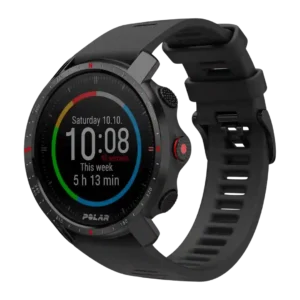
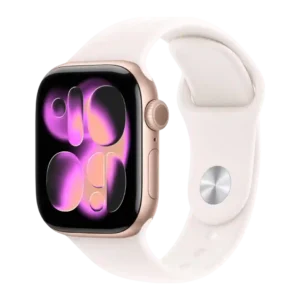
The watch can automatically start tracking activity after several minutes, which adds convenience for casual workouts.
Polar Flow is available on phone and web and syncs with services like Strava, TrainingPeaks, and Komoot, but the ecosystem is selective rather than wide open.
One review emphasizes the App Store's huge variety, reinforcing Apple's lead in smartwatch app breadth.
The strap is repeatedly praised for feeling stretchy, secure, and better than many generic silicone-style bands.
At least one reviewer says the sport band held up well over time.
Battery life is a real strength for a training watch, usually landing around 4–7 days or about 40 hours GPS, but reviewers repeatedly say it is not class-leading and can drain faster with heavy features enabled.
Battery life is the biggest upgrade: reviews repeatedly cite longer runtimes, with many seeing about a day to a day and a half and some closer to two days.
Reviews highlight that blood oxygen sensing is back, restoring a health feature reviewers considered important.
Bluetooth support is useful for phone syncing, external straps, and heart-rate broadcasting, though the overall connectivity story is limited by the lack of ANT+.
Bluetooth 5.3 support is present, giving the watch a modern baseline for wireless accessories.
Brightness and backlight options are helpful, but the display is clearly tuned more for battery efficiency than punchy brilliance.
The screen's improved brightness earns specific praise, helping it stand out within the lineup.
Reviewers consistently describe the watch as solid, premium-feeling, and well thought out in its construction.
Build quality looks solid overall, with reviewers praising the scratch-resistant glass and neat, polished construction.
The physical buttons are a highlight for feel and grip, though some reviewers still experienced lag after pressing them.
Physical controls are well executed, with responsive hardware buttons and practical shortcuts from the side button.
Call handling is basic: the watch can surface call-related phone interactions and silence calls, but it is not a full call-management smartwatch.
Call handling is strong, with call screening features and clear voice pickup even in noisy environments.
The charging setup is easy to connect and practical to use, especially compared with fussier port-based designs.
The improved endurance and fast top-ups make charging easier to fit around daily routines.
Charging speed is respectable rather than exceptional, with a full recharge taking about 1 hour 45 minutes.
Fast charging is another strong point, with quick top-ups restoring meaningful battery in short sessions.
FitSpark and the guided tests are standout strengths, giving users useful workout suggestions and coaching-oriented training guidance.
Workout Buddy adds motivation and spoken guidance, but reviewers see it as helpful in spots rather than a must-have coaching tool.
Comfort is a clear positive, with reviewers saying it wears well and avoids feeling bulky in normal use.
Comfort is a consistent plus, with reviewers calling the watch slim, light, and easy to wear for long stretches or overnight.
Polar Flow is rich and informative, but several reviews say it can feel intimidating, cluttered, or clunky for newcomers.
The companion experience is functional but fragmented, with one reviewer disliking the need to manage features across three apps.
The watch does not offer contactless payments, and reviewers treat that omission as a clear smartwatch limitation.
Apple Pay is explicitly praised as a favorite everyday convenience on the watch.
It works across Android, iPhone, and Polar Flow on mobile and desktop, giving it solid cross-platform coverage.
Cross-platform compatibility is poor because the watch is framed as a better fit for iPhone users than Android users.
Sport profiles, dashboards, watch-face views, and settings are all highly customizable for different preferences and activities.
Watch faces can be customized with different looks and complications.
The MIP display is functional and efficient, with good utility outdoors, but multiple reviews say it looks dull, low-contrast, or less vibrant indoors.
Display quality is a standout, with a bright wide-angle OLED panel and strong readability.
Durability is one of the strongest recurring themes thanks to sapphire glass, rugged construction, and repeated praise for scratch resistance.
Durability improves meaningfully with the tougher glass, and several reviewers report little to no scratching during testing.
Reviews consistently note ECG support and explicitly mention that the watch can perform ECG checks.
Fit is consistently described as snug and secure, helped by strap sizing and a wrist-friendly shape.
Fit gets positive marks thanks to balanced sizing and case proportions that work well for day-and-night wear.
General fitness tracking is dependable enough for serious training, especially for multisport and power-based use, though no reviewer presents it as flawless.
One review directly says fitness tracking is accurate, continuing Apple's strong baseline for everyday workout metrics.
GPS accuracy is generally good and reliable, but it is not the sharpest in class and occasional drift or limitations versus newer dual-band rivals are noted.
GPS performance is described as excellent overall, with strong real-world tracking for most runners despite the lack of dual-frequency GPS.
Health-related tracking is strongest around HRV, sleep, and recovery data, which reviewers repeatedly describe as especially accurate and useful.
One review says the watchOS 26 health updates are useful and clinically validated, supporting confidence in the overall health-tracking package.
Heart-rate accuracy is mostly good to very good, but interval sessions and higher-intensity efforts still expose some inconsistency.
Multiple reviews describe heart-rate tracking as a standout, with lab praise, near-matched comparison results, and only minor warm-up variance.
Cellular connectivity improves with the move to 5G on supported models, giving faster and more capable untethered use.
Sapphire glass, stainless steel, and other premium materials noticeably elevate the watch’s perceived quality.
Case material choices include recycled aluminum and titanium, giving the watch premium-feeling material options.
Navigation through the interface can be simple in concept, but several reviewers say lag makes menus and dashboards slower than they should be.
Navigation is described as straightforward, with crown and screen controls making core menus easy to learn.
Music controls work well for controlling phone audio during workouts and are one of the more genuinely useful smartwatch additions.
Music handling is flexible during workouts, including options to set media or let Apple choose it for you.
There is no onboard music storage or local playback, so audio control depends on having a phone nearby.
The quoted 64GB storage gives the watch enough onboard space for apps and media.
The daily software experience is more competitive than older Polar watches, but it still falls short of the polish offered by top smartwatch rivals.
watchOS 26 is described as polished, seamless, and feature-rich, giving the Series 11 a refined day-to-day software experience.
Outdoor readability is generally strong, especially in sunlight, though some reviewers wanted more contrast, larger text, or better bike-at-a-glance clarity.
Direct-sunlight readability is strong thanks to the 2,000-nit display.
Pairing is mixed: some sensors connect without issue, but finicky broadcasts and unsupported pairings show up often enough to matter.
Setup and pairing are described as quick and easy.
Recovery Pro, Nightly Recharge, HRV tracking, and leg-recovery tools are some of the watch’s biggest reasons to buy into Polar’s platform.
Recovery guidance is a weak spot, with reviewers calling out the lack of a daily readiness or recovery score.
Overall reliability is viewed positively, with reviewers often calling performance solid or reliable even when they point out individual weaknesses.
Reviewers describe the Series 11 as stable, dependable, and reliable for regular use and run tracking.
Back-to-start routing, TrackBack-style tools, and daylight/navigation aids add real practical value for outdoor safety and getting home.
Safety tools like Fall Detection, Crash Detection, and other watch-based protections remain an important part of the package.
Size flexibility comes more from small/large strap sizing and fit options than from multiple case sizes.
The Series 11's 42mm and 46mm sizes give shoppers useful choice for different wrist sizes and preferences.
Sleep tracking is widely praised and regularly singled out as one of the best parts of the Polar experience.
Reviews say sleep tracking aligns reasonably well with comparison devices and remains one of the stronger parts of the Apple Watch experience.
Notifications are useful and easy to read, but they remain basic and mostly read-only rather than interactive.
Notification handling is flexible, with wrist gestures making alerts easier to manage from the watch itself.
Smartwatch features are decent and improving, but the watch is still clearly a sports-first device rather than a full smartwatch replacement.
Reviews describe a wide feature set spanning calls, apps, vitals, and phone-centric tools like Hold Assist and screening.
Laggy performance is a recurring complaint, affecting screen changes, button responses, and general smoothness.
Reviewers say performance is buttery smooth, with fast app launches and fluid swiping.
Style is a major selling point, with multiple reviewers calling it attractive, subtle, rugged, and easy to wear outside workouts.
The design is widely liked for its clean, familiar, and refined look, even if it changes very little from Series 10.
Third-party support is good enough for key fitness services like Komoot, Strava, and TrainingPeaks, but it is not especially broad or universal.
Third-party sports app support is a strength, with reviewers specifically calling out capable apps like WorkOutDoors.
Touch response is one of the clearest weak points, with repeated complaints about sluggish or frustrating responsiveness.
One review says the touchscreen experience feels smooth and fluid.
The interface is relatively simple and approachable, though simplicity does not fully make up for the watch’s slower feel.
The interface is praised for being clean and attractive, while larger buttons improve everyday usability.
Build, recovery tools, and outdoor features help justify the price for the right buyer, but many reviewers still see the value as only fair unless it is discounted.
Value is mixed: some reviewers call it a strong middle-ground buy, while others say the SE 3 or discounted older models can make more financial sense.
The watch faces and dashboards are useful, especially the outdoor-oriented ones, though some reviewers wanted more visual variety or flair.
Reviews like the new Flow and other faces, noting strong visual style even if some faces are less practical at a glance.
WR100/100-meter water resistance is a clear positive and supports swimming and rough outdoor use.
Water resistance remains solid for everyday exercise and sweat exposure, with WR50 and IP-rated protection still in place.
Nightly Recharge, sleep breakdowns, HRV, and related recovery metrics give the watch genuinely useful wellness context beyond raw workout logs.
Reviews highlight sleep score and hypertension alerts as useful wellness additions that surface clearer, more actionable health feedback.
Reviews note dual-band Wi-Fi support and 2.4GHz/5GHz compatibility, which improves wireless flexibility.
Workout variety is excellent thanks to extensive sport profiles, multisport support, and strong options for customizing training use.
The workout app supports dozens of workout types, giving the Series 11 broad exercise coverage.