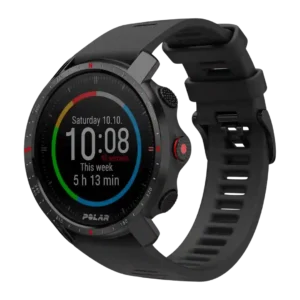
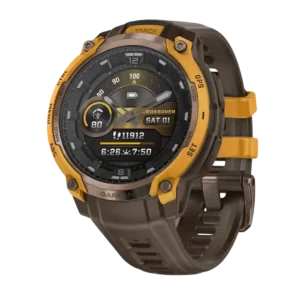
Polar Flow is available on phone and web and syncs with services like Strava, TrainingPeaks, and Komoot, but the ecosystem is selective rather than wide open.
The strap is repeatedly praised for feeling stretchy, secure, and better than many generic silicone-style bands.
The included silicone strap is simple but well executed, with little left to complain about.
Battery life is a real strength for a training watch, usually landing around 4–7 days or about 40 hours GPS, but reviewers repeatedly say it is not class-leading and can drain faster with heavy features enabled.
Battery life is strong by smartwatch standards, but the AMOLED model loses some of the Instinct line’s extreme endurance, especially under long GPS use.
The oximeter is mentioned as one of the metrics that could provide helpful insights, but it was not explored in depth.
Bluetooth support is useful for phone syncing, external straps, and heart-rate broadcasting, though the overall connectivity story is limited by the lack of ANT+.
Brightness and backlight options are helpful, but the display is clearly tuned more for battery efficiency than punchy brilliance.
Brightness is strong enough for direct sunlight according to the hands-on video.
Reviewers consistently describe the watch as solid, premium-feeling, and well thought out in its construction.
The case construction combines fiber-reinforced polymer and steel, giving it a rugged feel.
The physical buttons are a highlight for feel and grip, though some reviewers still experienced lag after pressing them.
Physical buttons suit the rugged design, but not everyone found them ideal; some praise the setup while others call the buttons fiddly.
Call handling is basic: the watch can surface call-related phone interactions and silence calls, but it is not a full call-management smartwatch.
Call handling is basic but useful: incoming calls can be viewed on the wrist.
The charging setup is easy to connect and practical to use, especially compared with fussier port-based designs.
Charging is helped by Garmin’s familiar cross-compatible cable and easy top-off routines.
Charging speed is respectable rather than exceptional, with a full recharge taking about 1 hour 45 minutes.
A full charge from zero takes less than two hours.
FitSpark and the guided tests are standout strengths, giving users useful workout suggestions and coaching-oriented training guidance.
Garmin includes coaching-oriented tools such as sleep coaching, training load focus, and daily recommendations tied to sleep and Body Battery.
Comfort is a clear positive, with reviewers saying it wears well and avoids feeling bulky in normal use.
Despite its bulk, reviewers say the watch is fairly light and wearable once adjusted.
Polar Flow is rich and informative, but several reviews say it can feel intimidating, cluttered, or clunky for newcomers.
Garmin Connect is described as expanding the watch into a more capable performance tool.
The watch does not offer contactless payments, and reviewers treat that omission as a clear smartwatch limitation.
Garmin Pay is available, giving the watch workable tap-to-pay support.
It works across Android, iPhone, and Polar Flow on mobile and desktop, giving it solid cross-platform coverage.
Sport profiles, dashboards, watch-face views, and settings are all highly customizable for different preferences and activities.
The watch offers a customizable screen and dynamic watch-face behavior that repositions complications around the hands.
The MIP display is functional and efficient, with good utility outdoors, but multiple reviews say it looks dull, low-contrast, or less vibrant indoors.
The AMOLED upgrade is one of the product’s biggest wins, with multiple reviews praising readability, color, and the step up from the older screen.
Durability is one of the strongest recurring themes thanks to sapphire glass, rugged construction, and repeated praise for scratch resistance.
Durability is a consistent strength, with scratch resistance, rugged materials, and positive feedback after rough use.
Fit is consistently described as snug and secure, helped by strap sizing and a wrist-friendly shape.
The standard strap offers broad wrist accommodation through generous sizing holes.
General fitness tracking is dependable enough for serious training, especially for multisport and power-based use, though no reviewer presents it as flawless.
Activity tracking was described as pristine in real-world testing, even across long remote hikes.
GPS accuracy is generally good and reliable, but it is not the sharpest in class and occasional drift or limitations versus newer dual-band rivals are noted.
GPS is described as multiband and very accurate in use, with quick locks and pristine tracking during remote hikes.
Health-related tracking is strongest around HRV, sleep, and recovery data, which reviewers repeatedly describe as especially accurate and useful.
During 24/7 wear, sleep tracking and Body Battery lined up with real-world experience, suggesting the broader health readouts felt trustworthy in use.
Heart-rate accuracy is mostly good to very good, but interval sessions and higher-intensity efforts still expose some inconsistency.
Heart rate readings were described as working brilliantly and generally staying beat-for-beat with other premium watches.
Sapphire glass, stainless steel, and other premium materials noticeably elevate the watch’s perceived quality.
Sapphire over the display and the upgraded case materials make the hardware feel premium and scratch resistant.
Navigation through the interface can be simple in concept, but several reviewers say lag makes menus and dashboards slower than they should be.
Navigation is workable and can become second nature, but multiple reviews still describe it as slower and less intuitive than the best alternatives.
Music controls work well for controlling phone audio during workouts and are one of the more genuinely useful smartwatch additions.
You cannot store music locally, but phone music controls are available.
There is no onboard music storage or local playback, so audio control depends on having a phone nearby.
One review explicitly says you cannot load music onto the watch, so onboard storage is missing.
The daily software experience is more competitive than older Polar watches, but it still falls short of the polish offered by top smartwatch rivals.
The software presentation is praised for showing data in a non-overwhelming way.
Outdoor readability is generally strong, especially in sunlight, though some reviewers wanted more contrast, larger text, or better bike-at-a-glance clarity.
The display remained easy to read in rain, sun, dawn, dusk, and night.
Pairing is mixed: some sensors connect without issue, but finicky broadcasts and unsupported pairings show up often enough to matter.
Recovery Pro, Nightly Recharge, HRV tracking, and leg-recovery tools are some of the watch’s biggest reasons to buy into Polar’s platform.
Recovery guidance was useful enough to flag missed training balance, including advice that the tester was short on high-aerobic work.
Overall reliability is viewed positively, with reviewers often calling performance solid or reliable even when they point out individual weaknesses.
Reviewers describe the watch as dependable in use, with impact correction for the hands and no issues reported in field testing.
Back-to-start routing, TrackBack-style tools, and daylight/navigation aids add real practical value for outdoor safety and getting home.
Safety-related tools include abnormal heart-rate alerts and a bright flashlight that was described as strong enough to help navigate trails.
Size flexibility comes more from small/large strap sizing and fit options than from multiple case sizes.
Sleep tracking is widely praised and regularly singled out as one of the best parts of the Polar experience.
Sleep tracking was described as spot-on during long-distance hiking use.
Notifications are useful and easy to read, but they remain basic and mostly read-only rather than interactive.
Notifications are supported, with reviewers noting the hands move aside for them and that texts and calls can be viewed on the wrist.
Smartwatch features are decent and improving, but the watch is still clearly a sports-first device rather than a full smartwatch replacement.
Across all reviews, the watch is portrayed as a full-featured smartwatch with health metrics, GPS navigation, training tools, and everyday connected features.
Laggy performance is a recurring complaint, affecting screen changes, button responses, and general smoothness.
The hybrid system is said to work seamlessly, helping the analog-digital concept feel polished.
Stress tracking is present as part of Garmin’s stress and energy management tools, alongside related health alerts.
Style is a major selling point, with multiple reviewers calling it attractive, subtle, rugged, and easy to wear outside workouts.
The hybrid analog look is a major draw, with reviewers repeatedly calling it cool, premium, and visually distinctive.
Third-party support is good enough for key fitness services like Komoot, Strava, and TrainingPeaks, but it is not especially broad or universal.
Touch response is one of the clearest weak points, with repeated complaints about sluggish or frustrating responsiveness.
There is no touchscreen here, so touch response is absent rather than merely mediocre.
The interface is relatively simple and approachable, though simplicity does not fully make up for the watch’s slower feel.
The analog-digital interface is widely praised for keeping the hands out of the way and making the hybrid concept feel coherent.
Build, recovery tools, and outdoor features help justify the price for the right buyer, but many reviewers still see the value as only fair unless it is discounted.
Multiple reviews say the watch feels expensive for what it offers, even if its unusual hybrid design softens the blow for the right buyer.
The watch faces and dashboards are useful, especially the outdoor-oriented ones, though some reviewers wanted more visual variety or flair.
Watch-face options are a highlight, with multiple designs and custom graphics that make good use of the hands and AMOLED screen.
WR100/100-meter water resistance is a clear positive and supports swimming and rough outdoor use.
At 100 meters, water resistance is solid for swimming and general adventure use, though not pitched for scuba.
Nightly Recharge, sleep breakdowns, HRV, and related recovery metrics give the watch genuinely useful wellness context beyond raw workout logs.
Body Battery and the morning report were highlighted as useful wellness cues that matched how the tester actually felt.
Workout variety is excellent thanks to extensive sport profiles, multisport support, and strong options for customizing training use.
Reviewers repeatedly say the activity list is huge, covering standard sports, niche modes, and numerous water options.