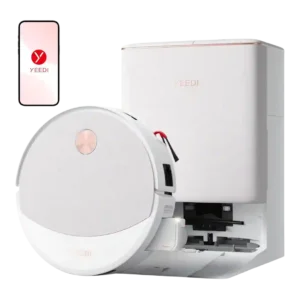
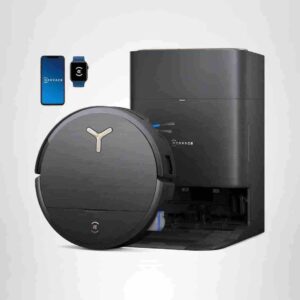
Unboxings typically include the robot, dock, ramp, cord, and manuals, with a dust bag preinstalled. Multiple reviewers note that extra consumables (spare bags or detergent) may not be included.
Threshold and barrier crossing are repeatedly described as strong, helping the robot move between rooms and surfaces with less assistance.
Reviewers repeatedly praised the textured, refined design and said the robot and dock look more premium than budget-oriented.
Design and finish are consistently praised, with multiple reviewers calling the robot and dock premium-looking (brushed/metal-like textures and a sleeker base). Even reviewers with performance complaints tend to like the aesthetics.
App automation, smart-home integrations, Matter support, and voice control are recurring strengths in the reviews.
The Ecovacs app is widely praised for organization and depth (routines, maps, barriers, dock controls), and multiple sources mention Matter and voice features (including Yiko). A few note that some settings are buried or that the robot can be overly chatty.
BLAST airflow is described as stabilizing suction while also helping hair move off the brush instead of wrapping.
Multiple reviewers note reduced debris scattering compared with earlier models, sometimes crediting a slowed or redesigned side brush. Conversely, some negative experiences describe debris drops around thresholds or during return-to-dock events.
The robot can climb onto and maintain area rugs, but thicker rugs were described as more mixed than low-pile surfaces.
Carpet detection is described as competent, but thick rugs and thresholds are recurring pain points in negative reviews. The robot is also described as limited to standard threshold heights rather than newer advanced climbing systems.
Setup is consistently described as easy, with straightforward docking, app pairing, and quick start-to-map workflows.
Setup is often described as straightforward, but several reviews mention initial firmware updates, mapping hiccups, or time spent editing room divisions. Planning a little extra time for first-run mapping improves the experience.
Fast charging and recharge/resume behavior were praised across several reviews, especially the short top-up time at the dock.
Battery impressions are mixed: official low-power runtimes are strong, but measured testing and higher-power settings can look below average for efficiency and coverage per charge. Recharge-and-resume helps, and some reviewers still find it sufficient for typical homes.
One review said the dock dust bag should last weeks in an average household, suggesting reasonable bag capacity.
Several reviews note the robot’s internal bin is small for a flagship, increasing dependence on the dock. The dock’s disposable bag is described as large-capacity, but spare bags aren’t always included.
Build impressions were sturdy and refined overall, though one review also noted some top-cover scratching after use.
Deep high-pile carpet cleaning is the clearest weakness, with mixed or below-average results in the review set.
Low-pile rug cleaning was reported as strong in routine use, including embedded hair pickup.
Carpet performance is frequently rated near the top, with strong deep-clean results and above-average pickup on rugs. Some comparisons still argue the X8 is close enough on most tests that the X9’s premium is hard to justify.
Anti-tangle and scraper elements helped prevent hair jams and other brush-related clogs in testing.
This is a key split point: multiple reviews report clogs with medium/large debris, pet hair, or messy mixtures, sometimes without timely alerts. Others report strong day-to-day debris handling with reduced scattering, suggesting performance depends on debris type and home layout.
In roundup-style coverage it’s presented as a top performer and award winner, but some side-by-side comparisons conclude the less expensive X8 (or other flagships) can be a better overall buy. The X9’s strengths are usually framed as best-in-class mopping and very strong all-around cleaning.
App control was described as clean and easy to use, with room, schedule, zone, and no-go controls, though one reviewer noted weaker overall app polish.
App controls are generally seen as excellent, but physical controls and map-editing workflows get criticism in some reviews (sluggish button response or tedious confirmation steps). After setup, day-to-day control is usually straightforward.
Corner cleaning is improved versus simpler robots but still not among the strongest areas of performance.
Some reviews call out a dirty-water sensing feature in the dock that can adjust washing based on how dirty the pads are. It’s consistently described as a higher-end automation feature rather than a must-have.
One firsthand review specifically reported no clogging or auto-empty failures during testing.
The OMNI dock is broadly viewed as full-featured and convenient, combining auto-empty, refill, and mop washing/drying. A minority of reports mention a one-off auto-empty clog/failure or debris dropping on the way back to the dock, so reliability is strong but not flawless.
The dock empty cycle is short, but it is clearly loud.
Multiple reviewers said the roller system handled dried footprints, sticky residue, or dried drink messes well.
Reviewers cite exceptional performance on dried-on messes, including lab-style scoring that places it near the top of recorded results. Real-home testers also report it can scrub sticky spots that older robot mops often leave behind, though not always perfectly.
Reviewers repeatedly framed the M16 as easy to live with because automation cuts manual effort.
When everything is dialed in, reviewers describe an almost set-and-forget experience with strong automation. Negative experiences typically stem from clogs, threshold issues, or mapping inaccuracies that demand more intervention.
Edge and baseboard cleaning are better than basic robot mops thanks to extend/reach features, though not every reviewer thought it was class-leading.
Edge cleaning is typically a strength thanks to extending brush/mop behavior, with several reviewers noting good wall-hugging and baseboard coverage. A common caveat is that the roller shape may miss a strip near certain appliances or toe-kicks.
Wall-following and edge-first behavior were described as orderly and accurate.
Automatic dust handling reduces direct contact with mess and extends time between emptying tasks.
The sealed bag and filter setup were described as a more hygienic way to contain dust during emptying.
Floors were described as only slightly damp and quick to dry after mopping.
Lower water left behind and hot-air drying are commonly noted, which can help floors dry faster and reduce lingering dampness. Some owners still mention long deep-clean cycles that may include recharge breaks, but drying performance is generally praised.
Reviewers highlighted the conical anti-tangle brush and enlarged roller mop as key hardware upgrades.
At least one liquid test showed fast cleanup of spills without much fuss.
Several sources emphasize that the roller design can handle small wet spills by separating dirty water rather than dragging a damp pad across the floor. Demo-style testing (e.g., spilled milk) suggests it can clean quickly with minimal smearing compared with traditional pad mops.
Hair pickup on carpet and rugs was good in routine use, even if deep carpet extraction was not best-in-class.
Carpet hair pickup is widely reported as strong, including high pet-hair percentages in testing and positive real-home pet results. Performance can drop if debris clogs the airflow path or during tricky threshold transitions.
Pet hair pickup on hard floors was repeatedly described as strong.
Anti-tangle performance is one of the clearest strengths, with several reviewers reporting little or no hair wrapping.
Many sources highlight anti-tangle brush features (ZeroTangle/active hair removal) with lab tests showing near-zero tangling. At least one reviewer still experienced significant hair wrapping during problem runs, so it’s excellent but not guaranteed.
Fine dust pickup on hard floors was a clear strength in everyday testing.
Hard-floor dust pickup is consistently described as strong, with reviewers noting reliable capture of micro debris and fine dust. Some negative reviews still credit it for routine dust pickup even when larger-debris clogs occur.
Multiple reviews said it handled larger hard-floor debris well, often in one pass.
Large-debris handling is generally good, but multiple reviews note edge cases where larger particles, thresholds, or entering/exiting the dock can lead to drops. Very large debris can also contribute to clogs on some floors.
The dock’s heated washing system is presented as a meaningful part of the automated cleaning experience.
Heated mop washing and heated-air drying are frequently highlighted, with some reviews noting adjustable wash/dry behavior. This is repeatedly framed as a premium feature that improves hygiene and reduces damp odors.
Reviewers repeatedly framed the M16 as unusually feature-rich for its price and as a meaningful step up versus earlier or pricier models.
Reviewers frequently call out the roller self-washing concept and BLAST airflow path as meaningful advances over older hybrids. It’s still in a competitive field (other brands have strong threshold handling or alternative mop designs), but the X9’s implementation is often viewed as one of the more complete packages.
Larger dry debris such as crumbs, coffee grounds, or snacks were generally handled well.
The low 95 mm profile helps the robot reach low-clearance areas more easily.
Internal LiDAR is positioned as a design win for getting into tighter spaces compared with tower designs. Measured height is still around the high-3-inch range, so ultra-low furniture may remain out of reach.
Ownership is lower-effort than many robots, but it still requires periodic brush, filter, roller, and sensor checks.
Routine upkeep is generally reduced thanks to dock automation and app reminders, but several reviewers still recommend periodic tank cleaning and occasional brush/roller clearing. Sticky, paste-like messes can create a bigger cleanup burden.
Mapping was described as quick and accurate, with neat pathing and sensible room segmentation.
Some reviewers describe fast, efficient coverage and strong navigation once maps are set. Others report inaccurate initial mapping (especially in larger rooms) and more manual tweaking than expected for a flagship.
The mop-lift system was repeatedly noted as effective for protecting carpets and thicker rugs during mopping.
Multiple reviews mention automatic lifting behavior to protect carpets (mop lift, and in some descriptions additional component lifting). This generally helps with mixed-floor homes, though the robot is still limited on very tall thresholds or very thick rugs.
Mopping is one of the strongest parts of the package, especially for everyday grime, sticky spills, and more active scrubbing.
The self-washing roller mop is repeatedly called the standout feature, delivering strong scrubbing and excellent day-to-day hard-floor cleaning. A few tests found minor limitations (toe-kicks/appliances it can’t slide under, or slight stickiness/residue on messy stress tests), but it still ranks among the best.
Regular cleaning is usually described as quiet or manageable, but dock emptying and higher-power cleaning are noticeably louder.
Operational noise is generally described positively (quiet or unobtrusive), and some coverage suggests BLAST aims to improve performance without a big noise penalty. Few reviews provide direct measurements, so perceptions dominate.
Obstacle avoidance is a frequent strength, especially around furniture and smaller floor objects, though not flawless in every test.
Obstacle avoidance is generally rated above average, with good performance around common household items. Still, multiple reviewers report occasional real-world snags (chair legs, protrusions, or clutter), so it’s not consistently flawless.
Warm-air drying and self-cleaning were repeatedly credited with reducing musty smells and odor buildup.
Hot-air drying and regular mop washing are repeatedly credited with preventing the damp, mildew-like smell that some robot mops develop. A few owners still clean the dirty-water tank regularly to avoid odors.
Bags, filters, and brushes add ongoing cost, but one review did not find the ownership costs unusually high for the category.
Ongoing costs can include disposable dust bags and detergent, and some reviews cite specific replacement pricing. This contributes to the sense that the X9’s total cost of ownership is premium, especially versus the X8.
A major theme across reviews is that the M16 removes routine floor care from the owner’s to-do list.
Early durability impressions were positive, but the review evidence is still short-term rather than long-term.
Overall sentiment is strongly positive, with multiple reviewers explicitly recommending the M16 despite some tradeoffs.
One firsthand review specifically called the M16 ideal for homes with pets and mixed flooring because it keeps up with pet-related debris.
Pet-focused commentary is largely positive: tests show strong pet-hair pickup and many highlight pet-oriented app features. The main pet-related downside raised is that heavy hair and larger debris can still contribute to clogs in certain homes.
Value was framed positively when reviewers considered the feature set against the asking price.
Value is polarized: some reviewers say the performance and automation justify the splurge, while others recommend it only on sale or prefer the cheaper X8/competitors at full MSRP. The $200+ gap to close siblings is a recurring theme.
Coverage is solid for larger homes, but maximum-power carpet runs reduce runtime and area coverage.
The self-wash and self-dry cycle was repeatedly praised for reducing hands-on upkeep.
Both the robot and dock emphasize self-cleaning: the roller refreshes during runs, and the dock can wash and dry the mop and clean its basin. Reviewers still report occasional manual cleanup after unusually sticky or heavy messes.
A dedicated cleaning-solution system and active water delivery were repeatedly treated as meaningful upgrades for mopping and self-cleaning.
A detergent reservoir/auto-dispensing system and adjustable water output are noted across several reviews, enabling hands-off mopping. A few sources mention proprietary-solution recommendations or smaller solution tanks, which can increase refills or cost.
The dock is slimmer or more compact than some competitors, but it can still feel large for cramped placements.
Residue control was consistently positive, with repeated claims of low streaking and cleaner mopping passes.
Many reviews report low water left behind and good streak control, and some highlight adjustable moisture settings. However, a few stress tests (jelly or flour-and-water paste) left mild residue or streaks, indicating outcomes depend on mess type and settings.
The robot generally avoids getting stuck on common obstacles better than older designs, though cords still need some caution.
Reports vary from near trouble-free operation to frequent help alerts depending on home layout. Thresholds and odd obstacles can cause wedging or debris drops in some tests, while careful mapping/no-go zones improves reliability for others.
Across reviews, suction is consistently described as strong for daily cleaning, though one measured test found deep-carpet extraction less impressive than the specs suggest.
Most reviews describe very strong pickup driven by Ecovacs’ BLAST airflow approach, with top-tier results on both hard floors and carpet. A few reviewers say the real-world improvement over the X8 is modest and that large debris can still trigger drops or clogs.
The M16 is repeatedly positioned as a good fit for busy, high-traffic homes that need strong daily upkeep.
The dock is more apartment-friendly than some competitors, but extremely tight spaces are still not ideal.
Its slim body and good clearance help it reach under sofas, cabinets, beds, and other low furniture.
The internal LiDAR approach avoids a tall turret and helps it reach under more furniture than tower-based bots. Still, reviewers note the roller mop can’t slide under some low-clearance areas the way flat pads can.
Discounted launch pricing made at least one reviewer especially enthusiastic about the overall value-for-money case.
Reviewers treated the M16 as a flexible all-rounder that can vacuum, mop, and handle mixed-surface household cleaning.
The clean and dirty water tanks were described as easy to manage, with refill and empty cycles every few days in one home.
The clean/dirty tank setup is commonly described as easy to use, but there are tradeoffs: some miss transparent or externally visible tanks, some describe smaller/hidden tanks requiring more frequent refills, and dirty tanks can have corners that trap grime.