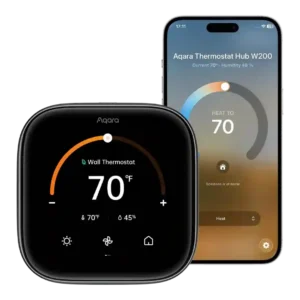
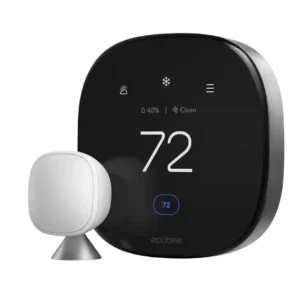
Average score
P1
Product 1: Aqara Hub W200
3.8
P2
Product 2: Ecobee Smart Thermostat Premium
4.4
adaptive recovery intelligence
P1
Product 1: Aqara Hub W200
4.9
Adaptive recovery intelligence was a standout because Apple Adaptive Temperature anticipates returns and improves comfort.
P2Product 2: Ecobee Smart Thermostat Premium
No score yetAlexa support
P1
Product 1: Aqara Hub W200
4.0
Alexa/Amazon support was described as solid for app and voice control, though Apple support received more enthusiasm.
P2
Product 2: Ecobee Smart Thermostat Premium
4.4
Alexa support is viewed positively, with reviewers praising built-in Alexa, easy pairing, and voice-assistant compatibility.
Apple Home/HomeKit support
P1
Product 1: Aqara Hub W200
4.7
Apple Home and HomeKit support stood out as a major advantage, especially because of Apple-only thermostat features.
P2
Product 2: Ecobee Smart Thermostat Premium
4.5
HomeKit support is mostly praised as useful and seamless, though one reviewer found the initial HomeKit pairing process unclear.
app usability
P1
Product 1: Aqara Hub W200
3.0
The app was praised as robust overall, but heat-pump and auxiliary-heat wording created real confusion.
P2
Product 2: Ecobee Smart Thermostat Premium
4.8
The app is a major strength across reviews, with praise for intuitive controls, remote access, schedule setup, and consistent design with the thermostat UI.
away mode effectiveness
P1
Product 1: Aqara Hub W200
4.5
Away mode worked well in review testing, with automatic temperature adjustments after leaving home.
P2
Product 2: Ecobee Smart Thermostat Premium
3.6
Away mode evidence is mixed, with reviewers praising occupancy-based adjustment but one reviewer saying the thermostat falsely treated the home as empty.
C-wire requirement flexibility
P1
Product 1: Aqara Hub W200
2.8
C-wire flexibility is limited because no-C-wire systems need an adapter rather than working cleanly out of the box.
P2
Product 2: Ecobee Smart Thermostat Premium
4.5
The power extender support was viewed positively because it helps installs where a common wire is not already present.
comfort consistency
P1
Product 1: Aqara Hub W200
5.0
Comfort consistency was a high point, with a reviewer reporting a more comfortable home after switching.
P2
Product 2: Ecobee Smart Thermostat Premium
4.6
Reviewers generally found comfort consistent and easy to maintain, with praise for fewer manual changes and dependable operation.
conventional HVAC compatibility
P1
Product 1: Aqara Hub W200
4.0
General 24V conventional compatibility came across as suitable for common household systems.
P2
Product 2: Ecobee Smart Thermostat Premium
5.0
One reviewer credited Ecobee with making a furnace work properly after a previous thermostat failed with the system.
design and finish quality
P1
Product 1: Aqara Hub W200
4.3
Design and finish were generally praised as clean, compact, and attractive.
P2
Product 2: Ecobee Smart Thermostat Premium
4.8
Design and finish quality are among the strongest positives, with repeated praise for the premium feel, zinc/metal body, and modern look.
display readability
P1
Product 1: Aqara Hub W200
3.8
The display is bright and sharp, but glossy fingerprints and limited visual options keep impressions from being uniformly excellent.
P2
Product 2: Ecobee Smart Thermostat Premium
4.8
Reviewers consistently praised the larger, brighter, higher-quality display for being easier to see and read.
DIY installation ease
P1
Product 1: Aqara Hub W200
4.5
Installation was consistently described as easy, especially for swaps from an existing smart thermostat.
P2
Product 2: Ecobee Smart Thermostat Premium
4.4
Most reviewers found installation easy or straightforward, though one warned that the app missed an important power switch in their home and another said wiring can be tricky for newcomers.
energy-saving recommendations
P1
Product 1: Aqara Hub W200
4.3
Energy-saving guidance was generally viewed as useful for saving money or energy without harming comfort.
P2
Product 2: Ecobee Smart Thermostat Premium
4.6
Energy-saving recommendations and automation are praised for reducing runtime, saving energy costs, and keeping the home comfortable economically.
energy reports quality
P1
Product 1: Aqara Hub W200
2.2
Energy reports lag behind competitors because the runtime presentation was judged too simple.
P2
Product 2: Ecobee Smart Thermostat Premium
4.6
Energy reports are a standout strength for data-minded reviewers, helping explain bills, track usage, and identify energy patterns.
equipment diagnostics usefulness
P1
Product 1: Aqara Hub W200
2.5
Equipment/runtime diagnostics were considered less detailed than Ecobee-style reporting.
P2Product 2: Ecobee Smart Thermostat Premium
No score yetfan control options
P1Product 1: Aqara Hub W200
No score yet
P2
Product 2: Ecobee Smart Thermostat Premium
4.5
Fan controls are considered useful and easy to access, with one reviewer emphasizing that turning the fan on or off takes only a couple of taps.
filter reminders
P1
Product 1: Aqara Hub W200
3.0
Filter reminders are present, but one reviewer disliked the minimum alert interval.
P2Product 2: Ecobee Smart Thermostat Premium
No score yetgeofencing reliability
P1
Product 1: Aqara Hub W200
4.8
Geofencing reliability was praised for consistently recognizing when the reviewer left home.
P2Product 2: Ecobee Smart Thermostat Premium
No score yetGoogle Home support
P1
Product 1: Aqara Hub W200
4.0
Google support was described as solid for app and voice control, but not as differentiated as Apple Home integration.
P2
Product 2: Ecobee Smart Thermostat Premium
4.5
Google Home support is part of the praised broad assistant compatibility in one review.
heat pump compatibility
P1
Product 1: Aqara Hub W200
2.0
Heat pump support drew the strongest compatibility criticism because compressor and auxiliary heat controls felt unclear or inadequate.
P2Product 2: Ecobee Smart Thermostat Premium
No score yethumidifier/dehumidifier compatibility
P1Product 1: Aqara Hub W200
No score yet
P2
Product 2: Ecobee Smart Thermostat Premium
4.0
The Premium model is recommended for users with HVAC accessories such as humidifiers or air purifiers, suggesting added value for those systems.
humidity sensing
P1
Product 1: Aqara Hub W200
4.0
Humidity support earned a positive note because the W200 can use an external humidity source.
P2
Product 2: Ecobee Smart Thermostat Premium
4.4
Humidity sensing is viewed as a useful input for comfort and energy behavior, with reviewers calling it handy and effective.
HVAC system compatibility depth
P1
Product 1: Aqara Hub W200
2.5
Coverage is broadly positioned, but one reviewer warned that heat-pump-specific control depth needs research before buying.
P2
Product 2: Ecobee Smart Thermostat Premium
4.7
Reviewers describe broad HVAC compatibility as a strength, including one case where Ecobee solved a furnace problem and another noting expanded wiring capability for more systems.
included C-wire adapter
P1
Product 1: Aqara Hub W200
2.2
Reviewers noted the box is nearly complete, but the C-wire adapter is not included.
P2
Product 2: Ecobee Smart Thermostat Premium
4.4
Reviewers liked that Ecobee includes a power extender/C-wire adapter option, especially for setups without a common wire.
learning/auto-schedule effectiveness
P1
Product 1: Aqara Hub W200
4.9
Auto-adjustment and learning-style behavior were praised as smarter and more accurate than typical reactive thermostats.
P2
Product 2: Ecobee Smart Thermostat Premium
3.8
Auto-schedule evidence is mixed: one review praises seamless adaptation, another describes pattern-based scheduling, and one says Nest's learning schedule is smarter.
manual hold/override flexibility
P1
Product 1: Aqara Hub W200
2.5
Manual override flexibility is limited by the absence of temperature set-limit controls.
P2Product 2: Ecobee Smart Thermostat Premium
No score yetMatter support
P1
Product 1: Aqara Hub W200
4.6
Matter support was praised both as a compatibility bridge and as part of the thermostat's hub role.
P2
Product 2: Ecobee Smart Thermostat Premium
3.8
Matter support is treated as a future-looking plus, with one reviewer calling the possible Thread/Matter path exciting and more future-proof.
multi-room balancing effectiveness
P1
Product 1: Aqara Hub W200
2.2
Multi-room balancing is a weakness because reviewers noted the W200 lacks simultaneous multi-sensor averaging.
P2
Product 2: Ecobee Smart Thermostat Premium
4.3
Multi-room balancing is praised when sensors are placed well, but one reviewer found it limited by sensor range and the need for more Ecobee sensors.
notifications quality
P1
Product 1: Aqara Hub W200
4.5
Notifications were praised for consistently appearing when the reviewer left home.
P2Product 2: Ecobee Smart Thermostat Premium
No score yetoccupancy detection accuracy
P1
Product 1: Aqara Hub W200
4.5
The mmWave occupancy sensor earned strong praise for detecting presence more accurately than basic motion sensing.
P2
Product 2: Ecobee Smart Thermostat Premium
3.9
Occupancy detection is split: reviewers praise the radar sensor's accuracy, but one found presence detection unreliable without enough sensors.
on-device control usability
P1
Product 1: Aqara Hub W200
3.6
On-device controls were useful as a wall controller, though one reviewer struggled with gestures and menu access.
P2
Product 2: Ecobee Smart Thermostat Premium
4.9
On-device controls are repeatedly described as simpler, more modern, and easier to navigate than older interfaces.
presence-based automation
P1
Product 1: Aqara Hub W200
4.0
Presence-based automation was broadly useful, though one reviewer found the practical value room-dependent.
P2
Product 2: Ecobee Smart Thermostat Premium
1.5
One reviewer had a poor experience using the occupancy sensors for Home automations, saying their tests did not work.
privacy controls
P1
Product 1: Aqara Hub W200
5.0
Privacy controls were praised because Apple Adaptive Temperature processing stays local/on-device.
P2Product 2: Ecobee Smart Thermostat Premium
No score yetreconnection reliability after outages
P1
Product 1: Aqara Hub W200
4.5
Local automation behavior was viewed favorably because routines can still work during an internet outage.
P2Product 2: Ecobee Smart Thermostat Premium
No score yetremote control reliability
P1Product 1: Aqara Hub W200
No score yet
P2
Product 2: Ecobee Smart Thermostat Premium
4.7
Remote control is praised as convenient and dependable, especially for changing temperature from elsewhere in the home or while away.
room prioritization controls
P1
Product 1: Aqara Hub W200
4.3
Room prioritization through Aqara sensors was seen as a useful way to heat or cool based on a preferred room.
P2
Product 2: Ecobee Smart Thermostat Premium
4.9
Room prioritization is praised by reviewers who use a bedroom sensor at night instead of relying only on the thermostat's hallway reading.
Room Sensor
P1
Product 1: Aqara Hub W200
4.3
External Aqara sensors were viewed as meaningful companions for room-based control.
P2
Product 2: Ecobee Smart Thermostat Premium
4.5
The included Room Sensor is one of the most consistently praised features, helping with room-level temperature readings and comfort control.
scheduling flexibility
P1
Product 1: Aqara Hub W200
4.0
Basic scheduling and modes were considered more than sufficient for everyday thermostat control.
P2
Product 2: Ecobee Smart Thermostat Premium
4.8
Scheduling is repeatedly praised as flexible, customizable, and easy to tune for different times, days, and energy goals.
setup instructions quality
P1
Product 1: Aqara Hub W200
4.5
The guided installation instructions were praised as clear and manageable for handy homeowners.
P2
Product 2: Ecobee Smart Thermostat Premium
4.1
Setup guidance is generally praised as clear and detailed, but one reviewer faulted the instructions for not warning about an additional switch that caused an installation mistake.
shared household access
P1Product 1: Aqara Hub W200
No score yet
P2
Product 2: Ecobee Smart Thermostat Premium
4.5
Shared household access is positively noted as a way to give additional family members control.
smart-home ecosystem compatibility
P1
Product 1: Aqara Hub W200
4.6
Smart-home ecosystem compatibility was one of the W200's clearest strengths across reviewers.
P2
Product 2: Ecobee Smart Thermostat Premium
4.8
Reviewers strongly value the broad smart-home compatibility, especially support across HomeKit, Alexa, Google, Siri, and broader smart-home ecosystems.
temperature accuracy
P1Product 1: Aqara Hub W200
No score yet
P2
Product 2: Ecobee Smart Thermostat Premium
4.6
Temperature accuracy is praised through SmartSensor control and room-specific readings that reduce mismatch between hallway and room temperatures.
touchscreen responsiveness
P1
Product 1: Aqara Hub W200
3.8
Touchscreen feedback was mixed: one reviewer found temperature changes fiddly, while others called the screen intuitive or highly responsive.
P2
Product 2: Ecobee Smart Thermostat Premium
5.0
Touchscreen feedback is strongly positive, with reviewers calling the new interface easier and more responsive.
utility demand-response support
P1
Product 1: Aqara Hub W200
2.5
Utility demand-response support is limited because provider availability was described as narrow.
P2
Product 2: Ecobee Smart Thermostat Premium
4.5
Time-of-use support is praised by one reviewer as a way to save money by shifting AC use around peak pricing.
value for money
P1
Product 1: Aqara Hub W200
4.7
Value for money was a major strength because reviewers saw premium features at a lower or competitive price.
P2
Product 2: Ecobee Smart Thermostat Premium
4.4
Value opinions are mostly positive for users who will use the premium features, but one reviewer says the added features may not justify the price for everyone.
voice control quality
P1
Product 1: Aqara Hub W200
4.0
Voice control was treated as convenient across major assistants.
P2
Product 2: Ecobee Smart Thermostat Premium
4.0
Voice control gets mixed but mostly positive feedback: reviewers like having Siri/Alexa access, while one criticizes the built-in speaker as weak.
wall-mount fit and footprint
P1
Product 1: Aqara Hub W200
2.5
Wall fit can be imperfect when replacing a larger thermostat because the smaller base may leave visible unpainted edges.
P2
Product 2: Ecobee Smart Thermostat Premium
4.5
One reviewer liked the included trim plate for covering wall blemishes behind the thermostat.
Wi-Fi stability
P1
Product 1: Aqara Hub W200
4.3
Wi-Fi connectivity was described positively, with reviewers pointing to reliable dual-band support.
P2Product 2: Ecobee Smart Thermostat Premium
No score yet