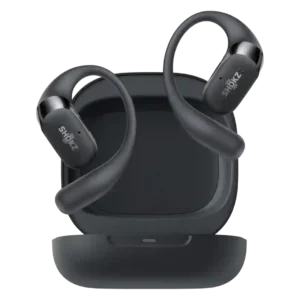
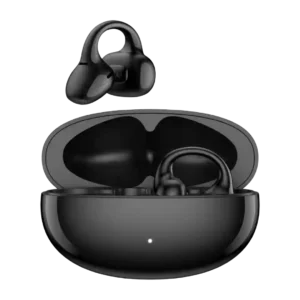
Reviews explicitly note there is no ANC on the OpenFit 2.
ANC is consistently described as limited for the category: some reviews found it modestly useful for low-level distractions, while others called it weak or poor.
At least one review explicitly notes companion-app support on Android.
Android support is helped by Google Fast Pair, which one review says recognizes the earbuds quickly.
The app is widely seen as useful for EQ, controls, and setup, though one review says it is not especially deep.
The companion app unlocks many features and is useful overall, but reviews also describe it as annoying or rough around the edges.
One review says codec support is limited to SBC and AAC, so aptX support is not indicated.
One review reports no lip-sync delay when watching video.
One review found latency pretty decent, including for video and quick-reaction games.
Bass is repeatedly described as improved, richer, and stronger for an open-ear design, but reviewers still note it cannot match the punch of good in-ear earbuds.
Bass is stronger than many open-ear rivals and can sound punchy or standout, but several reviews also note muddiness, limited sub-bass, or genre-dependent blur.
Battery life is one of the clearest strengths, with repeated 11-hour and 48-hour figures and several reviewers saying it easily lasts through long days or multiple workouts.
Battery life is one of the strongest recurring positives, with reviews repeatedly citing around 9 hours per charge and strong endurance overall.
Bluetooth 5.4 is repeatedly cited, with reviewers describing stable connections and strong behavior in busy signal environments.
Reviews explicitly mention Bluetooth 5.4 support.
One review highlights the upgraded flexible nickel-titanium ear-hook construction as a build improvement.
One review criticizes the build for feeling like cheap plastic.
High-resolution playback support is part of the appeal, with one review explicitly tying it to LDAC.
Physical buttons are one of the most praised upgrades, with reviewers repeatedly calling them easier and more reliable than touch-only controls.
Reviewers find the case functional and generally good, though it is not highlighted as a standout feature.
Case impressions are mostly negative, with complaints about plasticky materials or bulk.
Quick charging is a real plus, with reviews repeatedly citing roughly 2 hours of playback from a short top-up.
Quick charging is a real plus, with one review noting 15 minutes for about 3 hours of playback.
One review says the clip pressure is well balanced rather than too tight or too loose.
One review explicitly says codec support is limited to SBC and AAC.
One review explicitly confirms AAC, SBC, and LDAC codec support.
Comfort is one of the strongest themes, with many reviewers saying they can wear the OpenFit 2 all day or through very long workouts.
Comfort is a major strength, with reviewers saying the earbuds are easy to forget, wearable for hours, and not especially sore after long sessions.
The design gets positive marks for looking premium or refined rather than flashy.
The clip-on look is distinctive and jewelry-like, which one reviewer viewed positively.
Reviews consistently confirm app-based EQ customization, including manual adjustment and control setup.
EQ customization is a weak point, with multiple reviews saying there is no real custom EQ or that the custom option does not work properly.
Earbud-finding features exist in the app, but reviewers note the feature is limited and does not fully solve case-finding.
Multiple reviews say the app includes a lost-earbud finding feature.
Measured commentary in one review suggests the tuning tracks fairly close through the midrange, with restrained treble.
One review describes the mids as tonally accurate and decently balanced.
One review notes that a USB-C cable is included in the box, but bundled extras appear minimal.
At least one review confirms a USB-C to USB-A charging cable in the box.
Reviewers say the dual-driver approach helps vocals, instruments, guitars, and acoustics sound more defined than before.
One review found instrumental elements decently separated in better-matched material.
Reviews confirm integrated microphones and call controls are built in.
One review directly states that both ends have built-in microphones for calls.
Multiple reviews say the buds are symmetrical and can be worn or returned to the case in either orientation, with channels adapting automatically.
One review says codec support is limited to SBC and AAC, so LDAC support is not indicated.
LDAC support is repeatedly highlighted as a standout extra for an open-ear design, including confirmation in one review that it works alongside multipoint.
It can stay fairly clear at moderate to high volume, but several reviews still mention distortion or muddiness once volume is pushed too hard.
One review reports that the earbuds keep their composure well at higher volume without obvious distortion problems.
Multiple reviews say the microphones do a good job reducing background noise during calls or voice notes.
Noise reduction helps suppress surrounding sound in calls, with reviews mentioning traffic or fan noise being reduced.
Call quality is repeatedly described as clear and usable, including outdoors and during movement.
Call quality is generally usable to good, though voice tone can vary from clear to slightly metallic or distant depending on conditions.
Mids are regularly described as clearer and more detailed than before, helping vocals and general listening come through more cleanly.
Midrange and vocals are generally a strength, with reviewers noting nice mids and especially strong vocal reproduction.
The OpenFit 2 is used successfully across phones, laptops, watches, and other wearables, suggesting broad everyday compatibility.
One review specifically discusses using the buds across a MacBook and iPhone, showing practical cross-device use.
Multipoint is a major strength, with repeated praise for quick and reliable switching between two connected devices.
Multipoint works and switching is generally reliable, but playback priority and automatic takeover are limited, so users often need to pause one device first.
Passive isolation is intentionally minimal, keeping ears open rather than blocking outside noise.
Passive isolation is weak, with outside sound bleeding into the listening experience as expected from the open design.
The case is described as easy to carry or pocketable, even if open-ear designs are not ultra-compact.
The case is not especially slim, but one review still called it pocketable.
Preset EQ modes are useful, with Standard, Bass Boost, and Vocal options specifically called out, though some reviewers still preferred Standard.
Preset EQs are hit or miss: Classic is often preferred, Bass Boost can add fullness, and some of the other presets are criticized.
Multiple reviews call out the lack of wear detection, making sensor features a weak spot.
Biometric and wear-related sensors are a headline feature, with reviews repeatedly mentioning heart rate, blood oxygen, wear detection, and usable readings.
One review says the light-colored case picks up dirt quickly, though marks can be wiped away.
The glossy finish tends to attract fingerprints and smudges.
Pairing and initial setup are described as quick, easy, and friendly even for less technical users.
Setup and navigation are mixed: some reviews say menus are hidden or awkward, while others say pairing or general navigation is simple.
Leakage is improved and often limited at normal volume, but several reviews still report audible bleed at higher levels or in quieter spaces.
Leakage is present at moderate volume in quiet surroundings, which matches the open-ear design.
Reviews consistently describe the OpenFit 2 as a clear upgrade in sound, with richer, clearer audio than earlier OpenFit models, though it still does not beat strong sealed in-ear earbuds.
Across reviews, overall sound is described as strong for an open-ear model, with multiple reviewers calling it impressive or surprisingly good.
One reviewer describes the presentation as wide and open for this style of earbud.
The earbuds can produce a wide presentation for the category, with reviewers specifically calling out a wide soundstage.
One review explicitly says there is no 3D or spatial audio feature on the OpenFit 2.
Spatial audio is generally treated as a weak extra: reviews say it can sound recessed, blurred, or otherwise reduce clarity versus normal playback.
Fit security is excellent in review after review, with the buds staying put for running, workouts, and daily movement.
Fit security is a consistent strength, with reviews describing the earbuds as secure and staying in place well.
One review notes some recyclable packaging elements, while also saying Edifier still uses too much plastic overall.
Touch input is more limited than the physical buttons and can be finicky for some reviewers, though others say it works once configured.
Touch control behavior is mixed to poor overall: several reviews report finicky taps or misfires, though one found the large touch area easier to use.
A dedicated transparency mode is not present; awareness comes from the open-ear design instead.
One review says environmental transparency is excellent and preserves awareness very well.
Treble is generally described as crisper and restrained enough to avoid harshness or sibilance.
Treble is controlled enough to avoid harshness for some listeners, though another review says the highest registers lack brilliance.
USB-C charging is explicitly confirmed in reviews.
One review explicitly notes a USB-C charging port on the case.
Value is mixed: some reviewers think the performance justifies the price, while others see the regular model as harder to recommend near the 2+ or discounted rivals.
Value is a recurring positive, with reviews saying the earbuds punch above their price or feel worth the asking price.
Voice assistant support exists, but activation is button or touch based rather than truly hands-free, so the implementation feels basic.
Voice assistant actions can be assigned through the controls, based on one review.
The OpenFit 2 gets notably louder than the original and louder than many open earbuds, which helps outdoors.
Several reviews say the LolliClip gets loud, with one calling them loud and clear and another saying 50% volume was already enough.
The IP55 rating is repeatedly called out as enough for sweat, rain, and workout use.
IP56 durability is repeatedly tied to sweat, rain, and workout use.
Reviewers describe the buds as light or light-feeling on the ear, with weight distributed comfortably for longer wear.
One review specifically praises the very light feel and says you may forget you are wearing them.