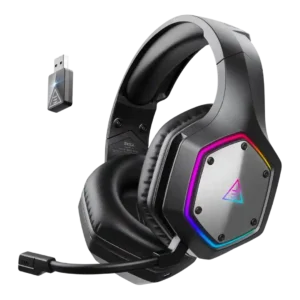
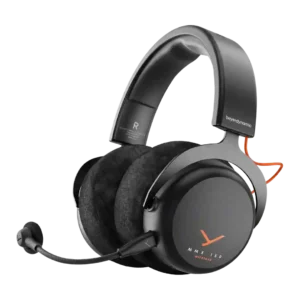
No review describes true ANC. Noise reduction is achieved through the closed-back seal (passive isolation) and an ambient/augmented mode, not active cancellation.
One WT review reports the same strong listening experience on an Android phone, indicating solid mobile compatibility when used that way.
WT reviews consistently mention an optional PC app or SoundBase software for sound tweaks, and they generally describe it as useful rather than bloated.
Wireless-focused reviews describe a companion app that manages presets, EQ, button behavior, sidetone toggles, and power settings. Other reviews describe a no-software experience, implying feature depth may vary by model or connection path.
The WT reviews that discuss lag explicitly say audio and video stay in sync, with around 30 ms latency claims and no noticeable delay in use.
Wireless-focused reviews describe the low-latency dongle as subjectively delivering negligible lag between on-screen action and audio cues.
Bass is usually presented as punchy and enjoyable for games, with several reviews calling out strong low-end impact even if it is not truly premium.
Bass is the most divisive tuning element. Several reviews describe it as subdued or under-emphasized unless EQ/presets are used, while another review characterizes bass as strong; expectations and EQ use appear to drive the experience.
Wireless battery life is mixed: several WT reviews report roughly 30 to 36 hours or acceptable endurance, while one finds real-world life shorter than hoped.
Battery life is repeatedly framed as a strength: multiple reviews cite 50 hours, and one reviewer reports real-world estimates closer to roughly 68–71 hours at moderate volume.
Bluetooth pairing and day-to-day stability are described as reliable, with quick connections and no major dropouts reported in the wireless-focused reviews.
Build impressions are mixed, with repeated comments about plastic or cheap-feeling materials alongside several notes that the headset still feels sturdy enough for everyday use.
Build impressions are split: several reviewers call the construction sturdy and dependable (often noting metal elements), while others describe the shell as lightweight or plasticky for the price.
Controls are repeatedly described as simple and easy to use, with physical wheels or buttons handling volume, mute, power, and surround without much learning curve.
The single wheel/button control scheme is viewed as intuitive (volume, mute, mode toggles), but some reviewers dislike that it feels clicky or that button/wheel noises can carry through the headset or mic.
Wired reviews generally like the thick braided cable and its durability, though one reviewer also criticizes the stock cable for being too short.
Cables are often praised as thick/braided and durable, but one reviewer reports audible cable rub/microphonics in the earcups when the cable brushes clothing.
WT charging is treated as acceptable rather than exceptional, with repeated references to roughly 2.5-hour full charges and quick-charge support in one review.
Fast charging is called out as convenient, with a commonly cited example of about 15 minutes of charge yielding around five hours of use.
Clamp pressure is a consistent drawback in the wired E1000 coverage, with reviewers describing a tight fit that presses on the head or ears.
Clamp force is commonly described as just right for staying secure without squishing, though a minority note it can feel a little tight over extended wear.
Codec support is only lightly documented in the provided reviews: SBC and LC3 are explicitly mentioned, while higher-end codecs are not confirmed.
Comfort is mixed overall. Several reviewers say the headset is wearable for hours, but just as many report pressure, digging pads, or frequent adjustments over longer sessions.
Comfort is usually rated very high thanks to plush velour/memory-foam pads and balanced weight, but at least one reviewer with larger ears reports long-day discomfort from shallow, round cups that press on the ears.
WT coverage strongly favors connectivity versatility, with repeated praise for having both low-latency wireless and 3.5 mm wired use across several devices.
WT reviews note a real console caveat: wireless mode is not universal, especially on Xbox, so some console use falls back to wired connections.
The styling is unmistakably gamer-focused, with RGB lighting and flashy accents drawing both praise for visual flair and criticism for looking kitschy or overly loud.
Aesthetics lean gamer-forward (notably orange accents). Some reviewers like the sophisticated two-tone look, while others find it not discreet enough for everyday public use.
The wired E1000 is marked down for its fixed cable, while the WT gets positive feedback because the detachable 3.5 mm cable adds flexibility.
Detachable cables make it easier to swap devices and replace worn parts. Multiple reviews note that some features and controls are reduced or unavailable when using the analog 3.5mm path.
The detachable boom mic is consistently framed as a practical win, letting you remove it for music or when using a dedicated external mic.
WT reviewers consistently describe the USB dongle as an easy, useful part of the wireless setup and a core reason the headset feels plug-and-play.
The low-latency dongle is highlighted as a strong option for gaming, with reports of easy pairing and very responsive feel in play.
Padding quality is generally decent for the money, with soft or thick cushions called out positively, though at least one review says the foam is not especially premium.
Pad material and plushness are praised, but cup depth/shape can be a comfort limiter for some users, with reports of ears touching drivers or being squeezed after long use.
The wired E1000 is specifically criticized for not letting the cups move or rotate, which limits fit flexibility.
Cups are described as tilting to help achieve a seal, but not offering full swivel in at least one review.
One WT review explicitly says the software allows custom sound profiles, giving users real EQ control instead of fixed presets only.
EQ customization is considered useful and often recommended, particularly for adding low-end presence if the stock tuning feels restrained.
Fit and seal are mixed. Some reviewers say the cups sit snugly with few gaps, while others say the angle can sit awkwardly or needs repositioning for the best seal.
Tonality is one of the shakier areas: several reviews describe the headset as muffled, indistinct, or not especially balanced, even when overall gaming use remains acceptable.
Multiple reviews characterize the tuning as balanced, neutral, or flat, emphasizing accuracy over exaggerated bass or treble boosts.
Headband adjustment is generally handled well, with reviews noting firm clicks or usable extension hardware that helps dial in fit.
Fit adjustment is described as straightforward with a wide range, making it easy to dial in height and seal even while wearing the headset.
Hinges/yokes are generally presented as solid and confidence-inspiring, with no durability failures reported in the provided reviews.
Accessory bundles are decent for the price, with repeated mentions of items like a pouch, manuals, dongle, cables, or a velcro wrap.
Included accessories are consistently described as practical for multi-device use, typically including a detachable mic and multiple cables; wireless-focused reviews also reference a low-latency dongle.
Separation and layering are described as strong, keeping dialogue, music, and effects distinct even in busy game mixes.
Reviews that mention the mic design treat the attached boom as straightforward and practical for gaming use.
One detailed review says the headset sounds fuller and performs better when pushed louder, suggesting acceptable clarity once volume is raised.
Mic quality is highly mixed across the file. Several reviewers call it clear or good for the price, but others describe it as scratchy, tinny, or only okay.
Noise handling is one of the stronger recurring points, with multiple reviews saying background noise is filtered well or that ENC meaningfully cleans up chat.
Noise reduction on the mic is repeatedly praised for rejecting keyboard clacks and room noise. A platform caveat appears in one review, where background reduction was less effective in a console test compared with PC.
Call and voice-chat quality ranges from very good for the money to disappointing, but the balance of direct call-style tests leans positive overall.
Microphone quality is a standout across reviews, with clear, natural voice capture that works well for team chat and work calls. One reviewer notes it can sound quieter on PlayStation than on PC.
Midrange clarity is only lightly covered, and the reviews that do mention it point to muddiness or an emphasis that is more serviceable than clean.
Midrange clarity is consistently a highlight, helping voices and key game cues cut through with definition and natural detail.
Across wired and WT reviews, the headset family is repeatedly described as working with multiple platforms, though exact features vary by connection type.
Across reviews, the headset is positioned as broadly compatible (PC, PlayStation, and mobile), with feature access varying by connection type. Xbox support is the least consistent in the provided reviews.
Multipoint is explicitly described as seamless in at least one review, letting the headset stay connected across devices without manual switching.
Passive isolation is mixed. Some reviewers say the headset shuts out outside noise well enough for immersive play, while others say isolation is only average or seal-dependent.
Passive isolation is generally described as good for voices and incidental noise, helped by thick pads and a solid seal, but it is less effective against constant low-frequency hum like engines or appliances.
One WT review explicitly says the headset does not fold or rotate, so portability is limited despite wired and wireless flexibility.
Positional performance is usually a strength, with many reviewers saying footsteps, enemy positions, or directional cues are easy to place, though one review wanted better depth.
WT software coverage says the built-in game and music presets are useful and meaningfully change the presentation.
Preset profiles are generally described as effective but subtle, offering practical tweaks for genres like shooters or action games rather than drastic changes.
One video review explicitly identifies the pads as replaceable, which is a plus for long-term maintenance.
Replaceable earpads/parts are repeatedly highlighted as a long-term value feature, making it easier to refresh comfort and maintain the headset over time.
RGB is more decorative than customizable. Multiple reviews say the lighting is fixed, limited, or only switchable on and off rather than truly programmable.
Mic-monitoring/sidetone-style modes are mixed: one reviewer reports a noticeable hiss when enabled, while others focus on its usefulness rather than its noise floor.
Setup is usually framed as easy or plug-and-play, but one WT review says the pairing instructions are incomplete enough to cause initial confusion.
Setup is generally described as straightforward and plug-and-play. The main complexity comes from choosing the connection type, since certain functions are reported to depend on USB power and/or the app.
Overall sound quality is mixed but generally decent for budget gaming. Reviewers often like the immersion, impact, or game performance, while more critical takes call it muddy, boxy, or merely average for music.
Overall sound is described as detailed, clear, and immersive, with a more neutral/accurate tilt than bass-boosted consumer tuning, making it strong for competitive gaming and solid for general listening. Wired USB listening is sometimes described as a bit cleaner and less prone to interference than analog, and one review suggests wired USB can slightly tame problematic treble behavior.
When reviewers discuss space, they usually describe the E1000 as wider-sounding than expected for the class, especially with surround processing engaged.
Soundstage and positional imaging are repeatedly praised for being wide and precise, helping with directional cues like footsteps and gunfire.
Virtual surround and spatial presentation are widely praised in the reviews that test them, with repeated comments that they add dimension and immersion for games.
Fit stability is inconsistent: one review says the headset can slip on the head, while another says the clamp keeps it planted well.
An ambient/augmented listening mode is described as convincing and genuinely useful for hearing the room or holding a conversation without removing the headset. Several reviews note this functionality depends on connection/power, and it is not a full-featured headphone-style transparency experience in every setup.
One detailed music-oriented review says higher frequencies are limited, so treble detail is not a strong point.
Treble is described as lively and detailed, but some reviewers report occasional harshness or distortion depending on source and settings.
WT reviews clearly mention USB-C charging, which modernizes the wireless model's charging setup.
USB-C is central to the design for both charging/power and wired audio paths, and several reviews treat the USB connection as the primary way to unlock full functionality.
Value comes across as solid but not unanimous. Several reviews like the price-to-performance balance, while others say better options exist in the same budget range.
Volume output is usually strong, with several reviews saying the headset gets plenty loud, though one PS5 test felt it was not as loud as expected.
Maximum loudness is usually adequate, but at least one review reports controller/analog output being too quiet for proper immersion on some consoles.
WT reviewers who discuss weight generally find it light enough to wear comfortably.
The headset is repeatedly described as feeling light on the head (low-to-mid 300g range cited in some reviews), which supports long-session comfort.
WT wireless latency is consistently praised, with repeated comments that lag is unnoticeable or fast enough for gaming.
WT coverage says Xbox use is supported via 3.5 mm cable, but wireless support is not presented as equally straightforward.
Xbox results are inconsistent: at least one review reports USB not working on Xbox and low volume over controller analog, while other reviews claim Xbox compatibility. Treat Xbox support as connection-dependent and verify your intended setup.