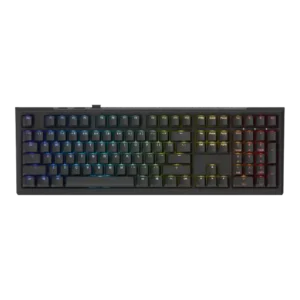
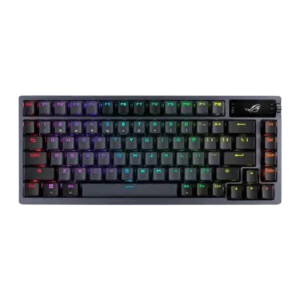
Reviews consistently praise the board for deeper, fuller sound than many analog competitors.
Reviews consistently describe the Azoth as unusually good-sounding for a gaming keyboard, with a refined, quiet, and well-controlled sound profile.
One review framed the inductive design as offering more consistent response over long periods.
Fresh units feel consistent and measured, though one long-term review reports occasional repeat presses as the board ages.
Reviews confirm support for adjustable actuation, rapid trigger, and multi-point style analog inputs.
Backlight brightness is usable, but not a standout strength across reviews.
The backlighting and OLED brightness are easy to adjust, and reviewers found the board usable even with RGB set fairly high.
Multiple reviews landed around 11 to 12 hours with RGB on, so battery life is workable but unimpressive.
Battery life is a major strength, with multiple reviewers reporting strong real-world endurance even before disabling the OLED or RGB.
Reviewers repeatedly describe the keyboard as solid, sturdy, and well-constructed despite the plastic shell.
Build quality is a standout, with reviewers repeatedly calling the board solid, premium, and unusually hefty for its size.
The included USB-C cable is presented as a nice braided, color-matched in-box extra.
The included USB cable is consistently described as a long braided cable, which supports the board’s premium feel.
Browser-based setup is limited by compatibility constraints, with one review specifically noting Chromium over Firefox.
The Azoth works across multiple platforms, with reviewers specifically noting Windows and Mac support and broader cross-platform compatibility.
Tri-mode connectivity is a clear strength, with wired, Bluetooth, and 2.4 GHz support called out repeatedly.
Tri-mode connectivity is a clear plus, giving users wired USB-C, Bluetooth, and 2.4GHz wireless options that reviewers found easy to use.
There is substantial remapping and actuation customization, but the software experience can make that flexibility harder to use well.
Customization is broad, covering key remaps, macros, OLED content, lighting, profiles, and mod-friendly hardware touches.
The compact models help mouse room, but the full-size layout leaves less space for wider sweeps.
The 75% layout saves desk space while still leaving room for mouse movement and core keys that smaller boards often drop.
Keycap wear resistance helps durability, but proprietary parts and fit concerns weaken long-term confidence.
Long-term and shorter reviews both point to durable construction, with strong materials and good aging characteristics over extended use.
Hot-swap support helps, but proprietary switches and the lack of spare parts make replacement less convenient than it should be.
Switch replacement is easy thanks to hot-swap support and included tools, making experimentation much easier than on typical gaming boards.
Comfort is decent overall, but the tall profile and missing wrist rest hurt ergonomics for some users.
Ergonomics are mixed: the feet and typing angle help, but the high profile and control design can become tiring or awkward.
Rapid trigger, multi-point inputs, and adjustable actuation are real gaming extras, even if the feature depth trails top HE boards.
Gaming extras are plentiful, including macros, Windows lock, stealth shortcuts, and other gamer-focused convenience features.
One review found little meaningful twist or bend, pointing to a rigid frame.
The chassis feels impressively rigid, with reviewers calling it solid and noting very little unwanted flex.
Gaming performance is generally fast and enjoyable, though not everyone saw it as a best-in-class esports board.
Gaming performance is a major strength, with reviewers praising responsiveness, wireless play, and all-around feel in fast-paced use.
The switches are hot-swappable, but the ecosystem is currently proprietary to Ducky’s inductive parts.
Hot-swap support is one of the Azoth’s defining enthusiast features and is repeatedly highlighted across reviews.
High-purity or thick PBT caps are one of the keyboard’s most consistently praised strengths.
The stock PBT keycaps are generally well liked for texture and durability, even if not every reviewer loved every detail.
Tap response and in-game responsiveness are consistently described as fast.
Key response is consistently described as quick and responsive, whether the board is used for gaming or general work.
Key spacing is manageable once adjusted to, but the full-size layout can feel wider if you come from smaller boards.
Key spacing is mostly praised for feeling natural on a compact layout, though the screen does force some keys closer together than ideal.
Large keys and the switches themselves are praised for low wobble and stable feel.
Stability is strong, especially on larger keys, with reviewers calling out controlled stabilizers and reduced wobble.
Wireless latency is strong enough to feel close to wired in normal use, though this is still a 1,000 Hz board.
Latency is a strength, with reviewers repeatedly describing the board as low-latency and hard to distinguish from wired use.
The lineup offers both full-size and 60% options, along with layout variety.
Layout flexibility is decent for this category, with reviewers noting the 75% format and availability beyond a single regional layout.
Standard legends are sharp and evenly lit, but some alternate caps are harder to read in low light.
Legend visibility is a weak point when the lighting is off, with multiple reviewers saying the legends are hard to see.
The web configurator supports macros, though that capability sits inside a broader software experience that still needs polish.
Macro support exists, but reviewers repeatedly note limits around secondary layers and more advanced mapping flexibility.
The material mix is not flashy, but the plastic case, PBT caps, and internal stack still come across as well chosen and solid.
Material quality is high, mixing aluminum, steel, quality plastics, and enthusiast-style components in a premium package.
You do get top-right media controls, but several reviews note that the board lacks richer dedicated playback extras.
Media control support is useful overall, though the dial and rocker implementation can be less satisfying than a traditional wheel.
Typing noise is generally kept low and muted, though one review noted light coil whine with RGB enabled.
Noise is well managed, especially with quieter switches, and several reviews call the board notably quiet for a gaming keyboard.
Settings and profile data are described as saving on the keyboard itself rather than living only in software.
Onboard profile storage is a real advantage, letting users keep multiple saved configurations on the keyboard itself.
Passthrough and extra ports are a clear weakness, because reviewers explicitly note the lack of USB passthrough and audio jacks.
Per-key RGB support exists, but at least one review found per-key editing limited in practice.
Per-key lighting control is well supported, with reviewers highlighting both per-key RGB hardware and detailed tuning options.
The 1,000 Hz polling rate is fine for most users, but it is not an aggressive headline spec versus faster rivals.
The 1,000Hz polling rate is in line with premium wireless gaming boards and was treated as fully competitive in reviews.
The full-size board is heavy enough that portability is not a strong point.
Portability is mixed: the compact layout helps with travel, but the weight makes it less convenient than lighter small boards.
Review timing matters here: early coverage criticized missing profiles, while later coverage reported dual-profile support.
Profile management is solid, with multiple stored profiles and quick switching available for different setups or tasks.
Rapid trigger is supported, but the adjustment granularity is lighter than what some competing analog boards offer.
Later coverage mentioned bug fixes and improved system stability, suggesting the platform is getting steadier over time.
Reliability is strong overall, with reviewers reporting stable wireless use, no missed inputs, and good long-term behavior.
RGB modes and settings are available through the web configurator.
RGB customization is deep, covering effects, brightness, presets, and software-driven personalization.
Lighting looks smooth and fairly uniform, but brightness is not class-leading.
Lighting quality is generally praised as attractive and useful, though it is more subtle than flashier gaming keyboards.
The product family spans compact and full-size versions, so buyers can choose between desk space and a full layout.
The 75% form factor is one of the board’s biggest strengths, balancing compact size with much better everyday usability than 60% boards.
The web configurator is the keyboard’s clearest weakness, with repeated complaints about bugs, confusion, limits, or unfinished behavior.
Software quality is the clearest drawback, with repeated complaints about Armoury Crate being bloated, slow, unstable, or frustrating.
The dense internal foam and layered dampening clearly help suppress rattle and shape the sound.
Sound dampening is excellent thanks to multiple foam and silicone layers that reduce ping, echo, and hollowness.
Stabilizers are a strength, with reviewers calling out low rattle and solid larger keys.
Stabilizers are a strength, with pre-lubed larger keys delivering smoother travel and better consistency than usual for gaming boards.
The inductive switches are widely praised as smooth and pleasant to use.
Switch feel is strong overall, with smooth stock switches and good variety, though some reviewers still preferred other switch types.
Switch choice is currently narrow because the board depends on Ducky’s proprietary inductive switch ecosystem.
Switch choice is solid, with multiple stock switch variants that cover linear, tactile, and clicky preferences.
Long sessions are generally comfortable, though the larger chassis and lack of a wrist rest can still wear on some users.
Typing comfort is very good for most users thanks to the gasket-style build and compact but still practical layout, though a full-size board can still feel easier for long writing sessions.
Typing feel is one of the clearest reasons reviewers kept reaching for this keyboard.
Typing feel is one of the Azoth’s biggest strengths, with many reviewers describing it as premium, smooth, and enthusiast-leaning.
Some reviews see the price as attractive for a wireless analog board, but the software caveats still affect the overall value story.
Value is mixed: reviewers love the hardware, but many still question whether the premium price is easy to justify.
Dedicated volume control is included rather than buried in generic function shortcuts.
Volume control works, but the dial and rocker can feel finicky enough that some reviewers found it less convenient than expected.
Wireless mode is generally stable and responsive enough for everyday gaming use.
Wireless performance is a standout, with stable 2.4GHz results, minimal lag, and behavior reviewers considered effectively wired-grade.
No wrist rest is included, so this area is a straightforward weakness.
The lack of an included wrist rest hurts long-session comfort for some users, especially given the board’s higher profile.