One direct review describes the Q3 HE 8K switches as having a soft typing sound, pointing to pleasant but not aggressively damped acoustics.
Multiple reviewers praise the K4 HE’s sound, describing it as marvellous, thocky, or simply nice, with little rattle mentioned.
The direct coverage emphasizes fine-grained actuation tuning, with 0.1mm-level adjustment and very high sensitivity.
One review explicitly describes the magnetic switches as consistent and responsive in action.
Analog-style input is explicitly supported through Analog Mode, which the review frames as controller-like variable input.
Reviews consistently note analog-style input support, including gamepad or joystick emulation and variable control based on key depth.
One direct review shows adjustable lighting brightness and notes the board can be run at full brightness.
One review says the backlight is too dim to see well in daylight.
Battery life is generally viewed as good, with evidence citing roughly 100 to 110 hours, though one reviewer notes stronger battery life exists elsewhere.
Both direct Q3 HE 8K reviews present the board as strongly built, highlighting an all-metal body and a durable, stable feel.
Reviewers repeatedly describe the board as sturdy, solid, or premium-feeling, with little or no flex reported.
One direct review calls out a nice included USB cable and adapter, suggesting the wired package feels solid rather than bare-bones.
Cable feedback is mixed: reviewers like the included cable quality or angled design, but several also call it short.
Direct Q3 HE 8K coverage supports broad cross-platform use, with Windows, Mac, and Linux compatibility mentioned across the reviews.
Reviews say the K4 HE works across Windows and macOS, and one review also mentions Linux support.
The scored Q3 HE 8K evidence points to a wired connection path, with USB Type-C and reviewer setup focused on wired mode.
Multiple reviews confirm wired, 2.4GHz, and Bluetooth support, with easy switching and multi-device use.
Both direct reviews emphasize deep tuning, from web-based controls to per-key behavior changes and actuation setup.
The K4 HE offers unusually deep customization in the evidence, especially around per-key actuation, remapping, and gaming settings.
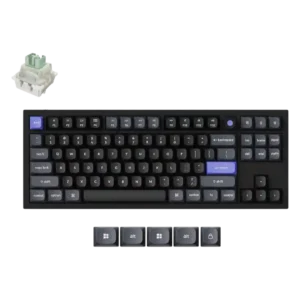
The direct evidence describes the Q3 HE 8K as an 80% board, which supports a relatively space-conscious desk footprint compared with larger layouts.
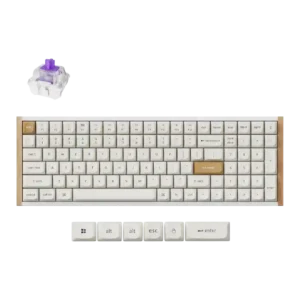
The 96% layout is repeatedly framed as saving desk space while keeping most of a full-size board’s utility.
One direct review specifically ties the aluminum body to better resistance to physical damage.
One reviewer reports the board survived a coffee spill and kept working afterward.
The direct evidence supports reasonably easy switch work because the board is explicitly described as hot-swappable.
Switch swapping is possible, but replacement is constrained to specific magnetic Gateron HE options.
One direct review says the keycap shaping gives the board a more ergonomic feel.
Ergonomics come across as decent thanks to angled rows and a posture-friendly typing stance, though nothing suggests a low-profile feel.
The direct reviews highlight a strong gaming feature set, including snap action, last-key priority, analog-style input, and multi-action keystrokes.
The review set repeatedly mentions quad-actuation, Snap Tap or LKP, dynamic keystrokes, and similar Hall Effect gaming extras.
Both direct reviews tie the metal construction to a stable, rigid overall feel.
Reviewers report no body flex and very stable behavior on the desk.
Both direct reviews frame the Q3 HE 8K as a gaming-first board that can provide a real edge in play.
Across shooter and general gaming use, reviewers consistently describe the K4 HE as fast, capable, and competitive.
Hot-swap support is present, but the direct evidence also shows that compatibility is not especially broad.
The switches are hot-swappable, but that advantage is limited by the restricted switch ecosystem.
The direct reviews point to solid keycap execution through double-shot PBT and thoughtful shaping.
Reviews praise the included PBT or OSA keycaps for feel, shape, and durability cues.
One direct review explicitly praises super-fast response times.
Magnetic switches are consistently described as quick to register and helpful in fast gameplay.
The condensed 96% layout is the most common complaint, with several reviewers calling the keys cramped or easy to mis-hit.
Double-rail magnetic switches are credited with reducing wobble and improving key stability.
One direct review explicitly describes the board as delivering ultra-low latency.
Latency is generally strong for the category, though some evidence says it is not class-leading.
The direct evidence identifies the board as an 80% layout, supporting a compact but not ultra-small format.
Legend visibility is mixed: one review praises clear legends, while others note non-shine-through caps and harder-to-see lighting on the Special Edition.
Both direct reviews describe strong macro support, from custom macro programming to bundling multiple actions into one press.
Reviews confirm robust macro support, including complex macros and flexible mapping.
Both direct reviews speak positively about the materials, especially the aluminum chassis and overall premium feel.
Materials get mixed-positive remarks: aluminum framing and real wood accents add quality, while some plastic remains in the shell.
The direct evidence points to useful knob-based media-style control, with one review also noting knob remapping in software.
Media controls are available through FN combinations rather than dedicated keys.
The only direct sound commentary says the switches have a soft typing sound, which suggests moderate noise rather than a harsh report.
One review specifically says the switches are not very loud.
One direct review says the keyboard can store up to three profiles, supporting limited onboard storage.
Reviews confirm onboard memory for saving settings or profiles on the keyboard itself.
Direct Q3 HE 8K coverage confirms per-key lighting hardware, with each key described as having south-facing backlighting.
One review explicitly says there is no per-key lighting customization for custom colors.
Both direct reviews make 8K polling a headline strength and treat it as a major performance differentiator.
Polling rate is consistently cited at 1,000Hz, which reviewers view as solid for the price but not top-tier.
One direct review measures the board at 1886g, so portability looks like a clear weakness rather than a strength.
One review highlights the relatively light weight and says it is easy to carry in a backpack.
One direct review says the board can store three profiles and switch among them from a rear toggle.
Reviews mention multiple saveable profiles, typically three, for work and gaming setups.
Both direct reviews confirm rapid trigger support and present it as part of the competitive feature set.
Rapid Trigger support is a core selling point across the review set and is repeatedly described as useful for fast inputs.
Reliability evidence is positive, with one reviewer expecting years of use and another reporting no issues after a spill.
The direct evidence supports meaningful RGB control, including multiple lighting zones and adjustable effects.
Lighting customization includes selectable effects and colors, though the evidence does not show full per-key color control.
One direct review says the lighting can produce high-contrast combinations that make a setup pop.
RGB quality is mixed: some reviewers call it vibrant or solid, while others say the Special Edition lighting looks subdued.
The direct evidence describes an 80% form factor, keeping the board compact without collapsing into a tiny layout.
The 96% form factor is repeatedly framed as near-full-size functionality in a smaller footprint.
Both direct reviews speak well of the web-based configurator, emphasizing remapping depth and the lack of software downloads.
Keychron Launcher is widely praised for being easy and flexible, though several reviews note that changing settings usually requires a wired connection and one calls the UI cluttered.
Several reviews mention foam, acoustic pads, or low rattle, suggesting effective sound dampening.
One direct review says the switches deliver a stable and responsive typing feel.
Switch feel trends positive overall, with reviewers calling the magnetic switches airy or satisfying, though one found them too soft for typing.
Hot-swap exists, but one direct review clearly says switch choice is restricted to Keychron’s own Ultra-Fast Lime Magnetic switches.
Switch choice is limited, with several reviews noting support only for specific double-rail magnetic switches.
One direct review says the keycap profile hugs the fingers, supporting comfortable longer use once adapted to the shape.
Typing comfort is generally good in the evidence, with comfortable profiles and approachable feel once acclimated.
One direct review directly praises the Q3 HE 8K typing feel as stable and responsive.
Typing feel is mostly praised for sound and smoothness, but one reviewer found it sloppy for typing out of the box.
Value is one of the clearest strengths, with multiple reviews explicitly calling the K4 HE well-priced or high value for its feature set.
One direct review explicitly shows a dedicated volume knob.
Volume control exists through function-key shortcuts rather than a dedicated knob or wheel.
Wireless use looks strong in the reviews, with easy multi-device use and quick wake behavior.