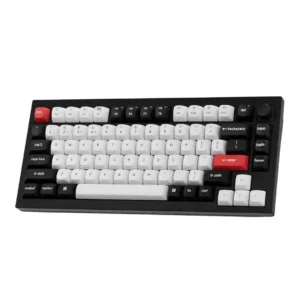
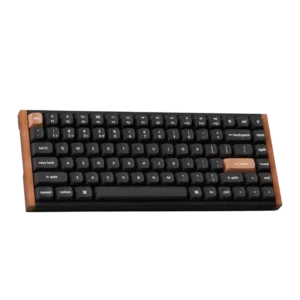
Reviewers describe the Q1 HE as acoustically pleasing, with excellent acoustics and a deeper thock-leaning presentation rather than a harsh or thin sound.
Sound character is a strong point, with recurring descriptions like muted, premium, thocky, and substantial.
Actuation behavior is praised as natural and consistent across settings, though very aggressive low-depth tuning can introduce spurious presses until recalibrated.
Adjustable Hall effect actuation is a recurring strength, with reviewers describing the keys as consistent and precisely tunable.
The Hall Effect stack supports analog-style input, including controller-like or thumbstick-style behavior, though some reviewers note it is more useful in theory than in every game.
Several reviews explicitly mention analog-style behavior, including per-key analog control, variable inputs, and gamepad-like simulation.
Backlighting is generally bright enough to look good under the caps, but at least one reviewer still wanted noticeably more brightness.
Backlight brightness is mixed. Some reviewers call it bright and attractive, while others find it dim or less useful on non-shine-through caps.
Battery life is acceptable rather than class-leading: quoted up to 100 hours with lighting off, but real-world RGB use can bring it down substantially.
Battery life is a consistent strength, with scored reviews ranging from several days to multiple weeks depending on lighting and usage.
Build quality is a standout strength, with repeated praise for the premium aluminum chassis, weight, and overall high-end execution.
Build quality is consistently strong, with reviewers describing the board as solid, sturdy, and premium-feeling.
The included cable earns mixed-to-positive feedback: reviewers appreciate the braided or angled design, but several wish it were longer.
OS support is broad across Windows and macOS, and Linux is also mentioned, but switch compatibility is notably restricted to specific magnetic options.
Compatibility is a strong point, with repeated support for Windows and Mac and positive notes about multi-device use.
Tri-mode connectivity is a major strength, with wired, Bluetooth, and 2.4GHz support repeatedly highlighted as flexible and easy to use.
Connectivity is broadly praised, with wired, Bluetooth, and 2.4GHz modes repeatedly confirmed.
Customization is one of the keyboard’s biggest selling points, covering keymaps, actuation, lighting, macros, and Hall Effect behavior in unusual depth.
Customization is one of the board’s biggest advantages, especially per-key actuation control and broader remapping or tuning options.
The 75% layout is repeatedly framed as desk-friendly, giving back space while keeping a more practical set of keys than smaller gaming layouts.
Reviewers explicitly call out the compact layout for saving desktop space.
Durability is a consistent positive, helped by the contactless Hall Effect design and robust metal construction that reviewers expect to last well.
The scored evidence suggests good durability, with durable keycap construction and at least one reviewer noting the board survived an accidental drop with only minor cosmetic damage.
The board is serviceable and mod-friendly, with included tools and accessible internals that make switch or component changes easier than on closed designs.
Switch swapping appears possible with included tools or basic effort, but it is framed more as manageable than effortless.
Ergonomics are decent but not ideal for everyone: the fixed typing angle works for some users, while others criticize the lack of adjustability.
Ergonomics are mixed. Some reviewers like the typing angle or stable stance, while others report wrist-rest needs or wrist soreness.
Beyond basic Hall Effect tuning, the board adds extras like snap/priority behavior, long-press functions, and multi-stage inputs for more advanced gaming use.
Beyond raw speed, the scored reviews repeatedly highlight features like Snap Click, last key prioritization, multiple actuation, and dynamic keystrokes.
Frame rigidity is excellent, with multiple reviewers explicitly noting the lack of flex, creak, or give in the chassis.
Frame rigidity is a clear strength, with reviewers calling out no deck flex, strong stability, and a rigid feel.
Gaming performance is widely praised, especially for responsive movement and strong Hall Effect benefits without giving up a usable everyday layout.
In actual use, reviewers report strong gaming performance, from FPS play to quicker weapon selection and movement.
Hot-swap support is present and appreciated, though its practical value is narrowed by the limited compatible magnetic switch ecosystem.
The K2 HE supports hot-swapping within its magnetic-switch ecosystem, according to multiple scored reviews.
Keycap quality is a clear positive, with thick double-shot PBT caps that feel sturdy, resist wear, and stay pleasant to type on.
The scored evidence points to solid keycap quality, particularly doubleshot PBT construction and quality finishing.
Key response is fast and lively, with reviewers calling the board more responsive than comparable non-HE options and well suited to quick gaming inputs.
Reviewers repeatedly say inputs register very quickly, with little force needed to trigger a key.
Key spacing is comfortable and practical, helping accuracy while preserving a compact footprint.
Key spacing is mixed, with several reviewers needing time to adjust to the smaller, more compressed layout.
Key stability is strong, with reduced wobble and well-controlled movement helping the keys feel steadier in use.
Key stability scores well, with repeated praise for low wobble and stable double-rail switch behavior.
Latency is one of the Q1 HE’s strengths over 2.4GHz and wired, though Bluetooth is clearly slower and less ideal for competitive use.
Gaming latency is described positively in the scored evidence, with one reviewer explicitly reporting no noticeable lag in play.
Layout flexibility is good for a ready-built board, with 75% variants, ISO availability, swappable nav caps, and multiple colorway choices.
The scored evidence notes layout variation beyond the base board, including an ISO option tied to layout changes.
Legends are mostly clear and readable, but lighting-related indicators and a few alignment details draw criticism in some reviews.
Legend visibility is mixed. Reviewers like the clear font, but several note the Special Edition legends are not shine-through.
Macro support is strong, with browser-based tools allowing macros and layered or depth-based command setups beyond simple remapping.
Macro support is present and clearly documented in the scored reviews, including both standard macros and depth-based actions.
Materials quality is consistently described as premium, centered on machined aluminum and other upscale touches rather than plasticky construction.
Materials are well regarded, especially the wood, aluminum, and specialty frame elements highlighted in the scored reviews.
Media control support is useful but not lavish, relying on the knob, function-row access, or remapped controls rather than many dedicated keys.
Media control support is serviceable rather than exceptional, usually handled through the function row instead of dedicated controls.
Noise output varies by reviewer and setup, but the dominant theme is that the Q1 HE is quieter and less harsh than many mechanical boards.
Noise level lands in a comfortable middle ground: quieter than many mechanical boards, but not silent.
Settings can be saved to the keyboard for use later, giving the board practical onboard behavior once configuration is complete.
The keyboard retains settings internally in the scored evidence, including mappings or profiles that persist across devices.
Per-key lighting control is limited in practice, with reviewers noting underglow-style presentation or the lack of true individual-key customization.
The 1,000Hz polling rate is solid for most use cases, but some reviewers still see it as less aggressive than the fastest HE competitors.
The K2 HE is repeatedly described as a 1,000Hz board over wired or 2.4GHz, with Bluetooth framed as the slower mode.
Portability is a weak point because the keyboard is unusually heavy for its size, making it much better as a fixed desk board than a travel one.
Portability is limited. The compact format helps, but reviewers still describe the board as fairly heavy or not especially travel-friendly.
Profile handling exists, including multiple HE profiles, but management is less convenient than the best gaming software because selection can be manual.
Profile handling is a strength, with stored profiles and easy switching called out in multiple reviews.
Rapid Trigger support is a major feature and is repeatedly described as customizable, effective, and meaningful for fast-paced play.
Rapid Trigger is one of the standout features in the scored reviews and is described as working very well for fast inputs.
Reliability impressions are mixed: some reviewers trust the long-term design, while others report wake or reconnect frustrations in wireless use.
Reliability is generally solid in the scored evidence, with reviewers noting stable everyday use and no major issues, though some wireless behavior elsewhere is less perfect.
RGB customization is decent but constrained, with multiple preset effects and adjustments available, yet less freedom than some mainstream gaming software.
RGB settings appear flexible in the scored reviews, with support for static colors, color shifts, and other preset effects.
Lighting quality is attractive overall, especially as underglow, but it is not universally loved and can feel too tame to RGB-focused buyers.
RGB presentation is generally liked, with reviewers praising the color and backlight effect, though it is not equally practical on every version.
The 75% form factor hits a practical middle ground, staying compact without sacrificing the function row and key essentials many users want.
The K2 HE’s 75% footprint is repeatedly framed as compact yet still practical for everyday use.
Software is powerful and often easy to use, but polish is inconsistent, with reviewers calling out rough edges, browser-only limitations, or setup friction.
Software is a major plus overall, with reviewers praising the browser-based Launcher as easy, refreshing, and highly usable.
Sound dampening is a real strength thanks to foam, gaskets, and acoustic layers that reduce ping and soften the board’s overall sound.
Multiple reviews explicitly credit foam, silicone, and other dampening layers for the keyboard’s controlled sound.
Stabilizer performance is serviceable to good overall, though some reviewers notice rattle out of the box while others praise smoother screw-in hardware or improvement with use.
Stabilizers are generally viewed positively for reducing wobble, though one scored review still sees room for improvement.
Switch feel is one of the board’s biggest strengths, with smooth, stable, premium-feeling magnetic switches that remain comfortable over long sessions.
Across the scored reviews, the magnetic switches are described as buttery smooth and among the smoothest reviewers have used.
Switch choice is the most repeated hardware limitation, with only a small compatible magnetic lineup and no broad MX-style freedom.
Switch choice is limited. Multiple reviewers note the board only supports Keychron or Gateron double-rail magnetic switches, with a small linear-only selection.
Typing comfort is consistently excellent, helped by the softer acoustics, cushioned construction, and forgiving feel during longer sessions.
Typing comfort is strong overall, though not universal; several reviewers say it stays comfortable over long sessions, while one flags the case height.
Typing feel is a headline advantage, with reviewers repeatedly describing the keystrokes as satisfying, cloud-like, or unusually pleasant.
Typing feel is a major strength, with reviewers calling it satisfying, enjoyable, and even cloud-like.
Value is polarizing: many reviewers think the experience justifies the premium, but others see the price and narrow audience as hard to overlook.
Value is viewed positively overall. Some reviewers note the price is not low, but most still judge the feature set and finish to be worth it.
Volume control is well executed, with the knob routinely praised for its feel and day-to-day usefulness.
Volume control is available, but mostly through remapping or Fn-based shortcuts rather than a dedicated knob.
Wireless performance is strong over 2.4GHz when everything behaves properly, but some reviews mention wake or standby quirks that temper the praise.
Wireless performance is good overall but not flawless. Some reviewers report seamless behavior or fast wake, while others mention slower Bluetooth or wake quirks.
Wrist-rest support is mediocre because no rest is included and several reviewers felt one would help with the board’s height.