Acoustic impressions are mixed: some reviewers appreciate the cleaner, more muted sound, while others still hear case ping or find the overall sound only improved rather than excellent.
Reviews consistently describe the Azoth as unusually good-sounding for a gaming keyboard, with a refined, quiet, and well-controlled sound profile.
Fresh units feel consistent and measured, though one long-term review reports occasional repeat presses as the board ages.
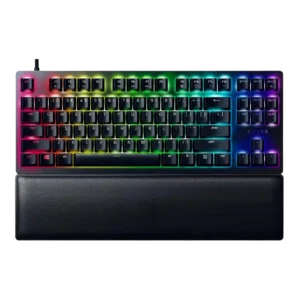
One review explicitly says the Huntsman V2 TKL is not analog, so it does not offer adjustable actuation or analog-style input behavior.
Backlighting remains usable and customizable, but at least one review finds it less bright than many competing backlit keyboards because of the PBT caps.
The backlighting and OLED brightness are easy to adjust, and reviewers found the board usable even with RGB set fairly high.
Battery life is a major strength, with multiple reviewers reporting strong real-world endurance even before disabling the OLED or RGB.
Build quality is a consistent strength, with reviews describing the board as high-quality, solidly built, and well-executed overall.
Build quality is a standout, with reviewers repeatedly calling the board solid, premium, and unusually hefty for its size.
The included USB-C cable is usually seen as a solid braided detachable cable, though stiffness or compatibility with custom cables can be a drawback.
The included USB cable is consistently described as a long braided cable, which supports the board’s premium feel.
Compatibility is good for standard keycap swapping on much of the board, but at least one review notes that the longer keys are more restrictive.
The Azoth works across multiple platforms, with reviewers specifically noting Windows and Mac support and broader cross-platform compatibility.
The wired connection is detachable and can be secure, but some reviewers report finicky behavior with third-party or high-polling cable setups.
Tri-mode connectivity is a clear plus, giving users wired USB-C, Bluetooth, and 2.4GHz wireless options that reviewers found easy to use.
Beyond lighting, the keyboard offers broad customization through programmable keys and adjustable performance settings.
Customization is broad, covering key remaps, macros, OLED content, lighting, profiles, and mod-friendly hardware touches.
Several reviewers specifically value the TKL layout for freeing mouse room and making the board easier to place efficiently on the desk.
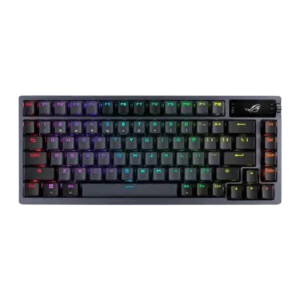
The 75% layout saves desk space while still leaving room for mouse movement and core keys that smaller boards often drop.
Durability is treated positively where discussed, especially around the tough chassis and ability to withstand heavy use.
Long-term and shorter reviews both point to durable construction, with strong materials and good aging characteristics over extended use.
Switch replacement is easy thanks to hot-swap support and included tools, making experimentation much easier than on typical gaming boards.
Ergonomics benefit from the compact layout and adjustable typing angle, with reviewers noting easier centering and comfortable preferred tilt positions.
Ergonomics are mixed: the feet and typing angle help, but the high profile and control design can become tiring or awkward.
Gaming-focused extras include gaming mode and adjustable performance behavior, giving the board more than just raw switch speed.
Gaming extras are plentiful, including macros, Windows lock, stealth shortcuts, and other gamer-focused convenience features.
The aluminum top plate is specifically credited with a very rigid chassis and no noticeable creaking or flexing.
The chassis feels impressively rigid, with reviewers calling it solid and noting very little unwanted flex.
Gaming performance is a recurring highlight, with reviewers describing the board as very good in-game, highly controllable, and especially suited to fast competitive play.
Gaming performance is a major strength, with reviewers praising responsiveness, wireless play, and all-around feel in fast-paced use.
Hot-swap support is one of the Azoth’s defining enthusiast features and is repeatedly highlighted across reviews.
The stock doubleshot PBT keycaps are broadly praised for durability, texture, grip, and feel, though one video reviewer only called them decent and another found them unusually rough.
The stock PBT keycaps are generally well liked for texture and durability, even if not every reviewer loved every detail.
Key response is repeatedly described as fast and dependable in use, with reviewers calling the switches quick and saying presses did not feel missed or delayed.
Key response is consistently described as quick and responsive, whether the board is used for gaming or general work.
One review explicitly says the keys do not feel crowded despite the smaller body, supporting a strong score for spacing.
Key spacing is mostly praised for feeling natural on a compact layout, though the screen does force some keys closer together than ideal.
Longer keys are described as secure and stable when struck off-center, suggesting good stability despite other complaints about stabilizer sound.
Stability is strong, especially on larger keys, with reviewers calling out controlled stabilizers and reduced wobble.
Latency is a clear strength on paper and in perception, with multiple reviews citing 0.2ms-class response or near-zero input lag, even if not everyone found the gains dramatic.
Latency is a strength, with reviewers repeatedly describing the board as low-latency and hard to distinguish from wired use.
Layout flexibility is decent for this category, with reviewers noting the 75% format and availability beyond a single regional layout.
Primary legends generally transmit RGB well, but reviewers repeatedly call out weak secondary legend illumination and some odd-looking legend shapes on certain keys.
Legend visibility is a weak point when the lighting is off, with multiple reviewers saying the legends are hard to see.
Macro support is a real strength, with reviews highlighting on-the-fly recording and broader macro control inside the software.
Macro support exists, but reviewers repeatedly note limits around secondary layers and more advanced mapping flexibility.
Material choices are well regarded, with repeated mentions of aluminum, sturdy plastic, and PBT caps contributing to a premium feel.
Material quality is high, mixing aluminum, steel, quality plastics, and enthusiast-style components in a premium package.
Media controls exist mainly as secondary functions rather than dedicated keys, and reviewers repeatedly note that as a compromise or missing convenience.
Media control support is useful overall, though the dial and rocker implementation can be less satisfying than a traditional wheel.
Noise performance varies by switch and reviewer, but the red-switch versions are often described as especially quiet while clickier or poorly stabilized keys still draw complaints.
Noise is well managed, especially with quieter switches, and several reviews call the board notably quiet for a gaming keyboard.
At least one review confirms onboard profile storage, with up to five profiles available to travel with the keyboard.
Onboard profile storage is a real advantage, letting users keep multiple saved configurations on the keyboard itself.
Passthrough and extra ports are a clear weakness, because reviewers explicitly note the lack of USB passthrough and audio jacks.
Per-key lighting control is strongly supported, with multiple reviews noting individual-key customization and bespoke effects through Razer software.
Per-key lighting control is well supported, with reviewers highlighting both per-key RGB hardware and detailed tuning options.
The 8,000Hz polling rate is widely highlighted as a headline feature, but several reviews also question how noticeable or necessary it is outside niche competitive use.
The 1,000Hz polling rate is in line with premium wireless gaming boards and was treated as fully competitive in reviews.
The compact footprint and detachable cable make the board easy to move around, and reviewers explicitly frame it as portable.
Portability is mixed: the compact layout helps with travel, but the weight makes it less convenient than lighter small boards.
Profile management is strong, with multiple reviews noting game-specific profiles or multiple saved device profiles.
Profile management is solid, with multiple stored profiles and quick switching available for different setups or tasks.
Reliability is positive where discussed, with reviewers reporting no missed presses in play and expecting solid service life under normal use.
Reliability is strong overall, with reviewers reporting stable wireless use, no missed inputs, and good long-term behavior.
RGB customization is extensive, with Synapse and Chroma giving users wide control over effects and color setups beyond basic presets.
RGB customization is deep, covering effects, brightness, presets, and software-driven personalization.
RGB presentation is attractive overall, ranging from reserved to vivid depending on reviewer taste, but brightness consistency and some legend rendering quirks keep it from being flawless.
Lighting quality is generally praised as attractive and useful, though it is more subtle than flashier gaming keyboards.
The tenkeyless form factor is widely viewed as compact and well judged, balancing smaller size with better usability than ultra-mini layouts.
The 75% form factor is one of the board’s biggest strengths, balancing compact size with much better everyday usability than 60% boards.
Synapse is generally viewed positively for breadth and control, but there are minor complaints about extra installs, complexity, or resource tradeoffs around advanced settings.
Software quality is the clearest drawback, with repeated complaints about Armoury Crate being bloated, slow, unstable, or frustrating.
The added foam and damping changes are repeatedly noticed and usually credited with reducing hollowness, bottom-out noise, and overall harshness.
Sound dampening is excellent thanks to multiple foam and silicone layers that reduce ping, echo, and hollowness.
Stabilizers are the clearest weak point in the reviews, with repeated complaints about rattle, poor design choices, and lack of proper tuning or lubrication.
Stabilizers are a strength, with pre-lubed larger keys delivering smoother travel and better consistency than usual for gaming boards.
Across red and purple variants, reviewers consistently describe the switches as very fast and generally smooth, but several also note damped or mushy bottom-out feel and mixed preference depending on switch type.
Switch feel is strong overall, with smooth stock switches and good variety, though some reviewers still preferred other switch types.
Reviews note two switch choices, clicky purple and quieter red linear, with the red option usually favored for lower noise while purple remains the louder alternative.
Switch choice is solid, with multiple stock switch variants that cover linear, tactile, and clicky preferences.
Typing comfort is helped by the soft wrist rest and light, easy key action, though overall comfort still depends on whether you like the switch tuning.
Typing comfort is very good for most users thanks to the gasket-style build and compact but still practical layout, though a full-size board can still feel easier for long writing sessions.
Typing feel trends positive on the linear version, with reviewers calling the keys responsive, smooth, and crisp, though not necessarily enthusiast-grade.
Typing feel is one of the Azoth’s biggest strengths, with many reviewers describing it as premium, smooth, and enthusiast-leaning.
Value is one of the most divisive areas: some reviewers call it the better deal versus certain rivals, but many still think the price is high for what the upgrades deliver.
Value is mixed: reviewers love the hardware, but many still question whether the premium price is easy to justify.
Volume control is not dedicated, forcing function-layer use or leaving out a physical roller entirely.
Volume control works, but the dial and rocker can feel finicky enough that some reviewers found it less convenient than expected.
One review explicitly states the keyboard cannot be wireless, so wireless performance is effectively absent.
Wireless performance is a standout, with stable 2.4GHz results, minimal lag, and behavior reviewers considered effectively wired-grade.
The included wrist rest is usually seen as soft and comfortable, but attachment complaints are common because many reviewers wanted a magnetic or more secure connection.
The lack of an included wrist rest hurts long-session comfort for some users, especially given the board’s higher profile.