Trueplay and room correction are a recurring strength, with reviewers describing automatic or room-tailored tuning that improves or adapts performance, though some note iOS dependence.
AirPlay 2 support is repeatedly highlighted and helps the Beam fit Apple households for direct casting and Siri-linked playback.
App experience is mixed: some reviewers found the app great for control, while others ran into pairing retries or unclear setup flows.
There is no companion mobile app, which keeps things simple but removes per-input memory and app-based control backup.
Review coverage consistently points to Dolby Digital or Dolby Digital 5.1 and stereo PCM support, with clear limitations around DTS and Atmos on Gen 1.
Dolby Audio and common Dolby Digital formats are supported in reports and specs, but there is no Dolby Atmos support.
The included optical adapter helps the Beam work with TVs that lack HDMI ARC, giving it useful compatibility with older sets.
Compatibility is generally fine with typical TVs and sources, but the use of ARC instead of eARC and the absence of Atmos make it less future-proof for feature hunters.
Multiple reviews note that the Beam does not support Bluetooth, so Bluetooth codec support is effectively absent.
Codec support is basic in reports, with at least one reviewer explicitly observing SBC; there is no consistent mention of premium codecs.
Because Bluetooth is not supported, there is no Bluetooth connection path to evaluate, which is a clear limitation versus some rivals.
Bluetooth is generally described as stable for casual streaming, with few complaints about drops; range depends on room conditions and some note typical short-range limits.
Reviews consistently note that Bluetooth is unavailable, so there is no Bluetooth range advantage here.
Expected Bluetooth range is around a typical 10 meters in open space, with real-world walls and placement potentially reducing it.
Where reviewers discuss musicality and balance, they describe the Beam as sculpted, balanced, and cohesive rather than disjointed.
Most reviews describe the overall sound as cohesive, with the subwoofer generally well integrated, though boosting bass too much can upset balance.
Touch controls receive positive feedback and are described as pleasant and responsive to use.
On-unit buttons are generally described as easy and responsive, especially for quick source and SuperWide toggling.
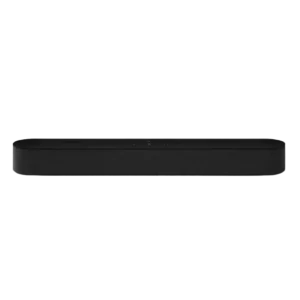
The Beam is widely praised for its compact, sleek, stylish appearance and its ability to blend into modern rooms.
Design is compact and generally liked, with some enjoying the bronze accents and others calling it cheap-looking. The small size suits desks and smaller TVs more than large screens.
Reviewers describe the Beam as robust, well-built, and premium-feeling for a compact soundbar.
Reviews mention detailed special effects and precise presentation, indicating solid fine-detail retrieval for a bar this small.
Detail is better than expected for the price, especially for dialogue and smaller-room movie playback, though some midrange congestion appears with dense mixes or processing engaged.
Dialogue clarity is one of the Beam’s most consistent strengths, with multiple reviews calling speech crisp, clear, or well separated from effects.
Across reviews, dialogue is a standout strength: many call speech crisp, clear, and easy to follow, though at least one tester reports muffled dialogue in busy action scenes when bass is pushed hard.
High-volume behavior is mostly positive but not perfect: several reviews found little distortion, while one noted distortion at maximum volume.
At moderate levels it stays controlled, but multiple reviewers hear strain or sharpness at higher volumes, and one notes brief audio skipping with UHD Blu-ray playback.
Gen 1 reviews consistently frame Dolby Atmos as absent, so overhead height effects are not a strength here.
Reviewers mention scale, dynamics, punch, and convincing impact that exceed expectations for the Beam’s compact size.
The Sonos app offers meaningful tuning options, including bass and treble adjustment plus extra listening modes in multiple reviews.
Bass and treble adjustments on the remote are widely appreciated for quick tuning. Deeper multi-band EQ is not available, and some find the preset modes subtle.
Across TV and music use, reviewers repeatedly describe the Beam as balanced, clear, and tonally well judged, though not especially deep in the lowest bass.
Tuning leans lively with boosted mids and/or highs to help clarity. It can sound bright or sharp when cranked, and SuperWide processing may trade detail for space.
Google Assistant support is repeatedly mentioned, giving the Beam flexibility for users who prefer Google’s ecosystem.
HDMI ARC is central to the Beam’s design and ease of use, enabling simple TV hookup, synced control behavior, and voice-linked TV commands on compatible sets.
HDMI ARC works for basic TV integration and CEC control, but multiple users report volume-scaling quirks or prefer optical to avoid HDMI behavior.
A recurring advantage is how easily the Beam can serve as the center of a Sonos TV setup with optional surrounds or a Sub.
Best results are reported in bedrooms, offices, and small-to-medium rooms. Larger spaces expose limits in soundstage scale and subwoofer output.
Reviewers highlight smooth connection to other Sonos speakers for multi-room audio or rear-channel expansion.
Reviews describe HDMI ARC as helping sync audio and picture, and app adjustments are available if dialog timing needs correction.
Lip-sync is generally not flagged as a major problem, but one review reports brief half-second audio skips with UHD Blu-ray content, suggesting occasional source/format sensitivity.
The Beam gets impressively loud for its size and is commonly described as enough for small to medium rooms.
Volume output is impressively high for a compact bar, with plenty of headroom for small rooms and desktop use. Several note it can get uncomfortably loud up close.
Low-volume results are mixed but useful: speech and night modes help late-night listening, though some reviewers still think the Beam comes alive more at higher volumes.
Low-volume listening is workable, but some want finer steps, a night mode, or a lower baseline level on HDMI for bedrooms.
The built-in microphone array is a well-covered feature, with several reviews noting far-field pickup and smart-assistant readiness.
Where reviewed directly, pairing extra Sonos speakers is described as simple and app-friendly.
The top-panel touch controls are a consistent convenience for basic playback, volume, and mic mute functions.
Top-mounted controls for power, volume, input, and SuperWide are convenient for desktop use and provide a fallback if the remote is unavailable.
The included optical adapter is frequently mentioned as a useful fallback for TVs without HDMI ARC.
Optical input is commonly used as a stable fallback for TVs, though it may require separate remote control handling depending on the source device.
Privacy handling centers on the ability to mute or disable the microphones when desired.
Remote integration is generally strong, with existing TV remotes working automatically over ARC or being easy to configure in the app.
The remote offers helpful direct access to modes and tone controls, but it often requires separate AAA batteries and a few users mention minor ergonomics or control quirks.
Setup is generally easy on compatible ARC TVs, but several reviews say it becomes more finicky when ARC or first-time pairing goes wrong.
Setup is repeatedly described as plug-and-play, with straightforward wiring and quick switching between TV, PC, and Bluetooth sources.
Alexa support is a core Beam feature, and reviews treat it as a major differentiator for TV and music control.
Beyond sound, the Beam is repeatedly praised for smart-home and assistant features that make it more than a basic soundbar.
Smart features are minimal: no voice assistants and no Wi-Fi streaming, with emphasis instead on simple presets and SuperWide processing.
One of the stronger audio compliments is a sense of tall presentation despite the compact cabinet.
Spotify support is useful overall, but at least one review reported playlist-finding issues, so the experience is not uniformly flawless.
LED indicators clearly communicate operating or microphone status without adding much visual clutter.
The front LED display is useful for showing source and volume, but brightness and standby behavior can be distracting in dark rooms, with limited dimming control noted.
Reviewers often praise the Beam’s wide image, spatial spread, and left-right steering for a single compact bar.
Stereo imaging is best when you are centered and fairly close. From a couch distance or off-axis seating, the image can feel localized and less immersive.
On its own the Beam delivers some bass, but many reviews note that buyers wanting deeper or more physical low end may want an added Sub.
No summary yet.
The Beam can sound spacious or surround-like from the front, but reviewers are clear that standalone performance is not the same as true surround.
SuperWide Near and Far modes can widen the presentation and add a wraparound feel, but Far often softens focus and Near can be distance-sensitive. Many prefer using it selectively depending on content.
For the feature set, size, and sound quality, value sentiment is strongly positive across the review set.
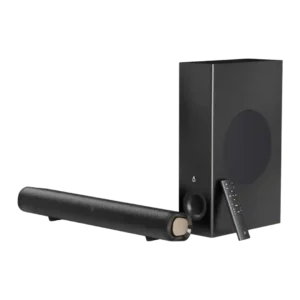
Reviewers repeatedly frame Stage Pro as a punch-above-its-price 2.1 bundle, especially because it includes a subwoofer and multiple inputs while staying in the budget range.
Reviews make clear that the single HDMI connection is for TV audio return, not source switching or video passthrough.
Assistant response is generally strong, with reviewers noting that the Beam hears and reacts well across a room.
Vocal reproduction is described positively both for enhanced speech modes and for music vocals.
Vocals and spoken-word content generally come through clean and forward, with Vocal-focused modes seen as optional rather than required.
Voice pickup is usually good, but one review notes it does not catch every command, so recognition is strong rather than perfect.
The Beam’s smaller, lighter form is repeatedly treated as a practical advantage for placement and everyday living.
Wi-Fi-based streaming is portrayed as stable in use, with one review explicitly calling out no dropouts or repeated pairing hassles.
Wi-Fi streaming features are absent, so services like Spotify Connect or Tidal-style direct streaming are not available without going through a TV, streamer, or phone.
Physical connections are intentionally minimal but useful, typically centered on HDMI, optical via adapter, and sometimes Ethernet.
Input options are a strong point for the price, commonly cited as HDMI ARC, optical, AUX, USB-C/USB audio, and Bluetooth.