
Trueplay and room correction are a recurring strength, with reviewers describing automatic or room-tailored tuning that improves or adapts performance, though some note iOS dependence.
AirPlay 2 support is repeatedly highlighted and helps the Beam fit Apple households for direct casting and Siri-linked playback.
AirPlay support is repeatedly confirmed for easy iOS/macOS streaming and multi-room scenarios; reviewers generally describe it as straightforward and reliable once the bar is on Wi-Fi.
App experience is mixed: some reviewers found the app great for control, while others ran into pairing retries or unclear setup flows.
SmartThings is widely used for setup and tuning; app control is generally stable and useful for calibration, channel levels, and modes, though some note the remote/display is slower for deeper adjustments.
Review coverage consistently points to Dolby Digital or Dolby Digital 5.1 and stereo PCM support, with clear limitations around DTS and Atmos on Gen 1.
Format support is a major strength: reviewers cite Dolby Atmos and DTS:X support, with some also noting Samsung/Google’s Eclipsa Audio readiness alongside common Dolby legacy formats.
The included optical adapter helps the Beam work with TVs that lack HDMI ARC, giving it useful compatibility with older sets.
Multiple reviews note that the Beam does not support Bluetooth, so Bluetooth codec support is effectively absent.
Because Bluetooth is not supported, there is no Bluetooth connection path to evaluate, which is a clear limitation versus some rivals.
Bluetooth connections are generally described as quick and stable once paired, used mainly for casual playback and fast handoff from phones.
Reviews consistently note that Bluetooth is unavailable, so there is no Bluetooth range advantage here.
Bluetooth range is not deeply tested in most reviews, but general use descriptions imply typical room-to-room coverage without frequent dropouts.
Google Cast/Chromecast-style casting is commonly listed among the streaming options; it broadens wireless playback beyond Bluetooth when the soundbar is on Wi-Fi.
Where reviewers discuss musicality and balance, they describe the Beam as sculpted, balanced, and cohesive rather than disjointed.
Across film and Atmos demos, the system is praised for a seamless, cohesive bubble of sound with smooth handoffs between bar, rears, and sub, especially after calibration.
Touch controls receive positive feedback and are described as pleasant and responsive to use.
Physical top-panel controls are described as clicky and responsive, offering quick access to input/volume and mic mute without relying on the app.
The Beam is widely praised for its compact, sleek, stylish appearance and its ability to blend into modern rooms.
The package looks premium and is easier to place than prior generations thanks to the smaller sub, but several reviewers call the bar’s design a bit dated or visually plain.
Reviewers describe the Beam as robust, well-built, and premium-feeling for a compact soundbar.
Reviews mention detailed special effects and precise presentation, indicating solid fine-detail retrieval for a bar this small.
Detail and separation are frequently highlighted, with subtle effects and low-level ambience coming through clearly in movies and well-recorded music.
Dialogue clarity is one of the Beam’s most consistent strengths, with multiple reviews calling speech crisp, clear, or well separated from effects.
Many reviews find dialogue clear and well-centered (especially with voice-enhancement features available), but a notable minority report muffled speech depending on content, mode, and room.
High-volume behavior is mostly positive but not perfect: several reviews found little distortion, while one noted distortion at maximum volume.
At high volumes, most reviewers report clean playback with little strain; a few note the new subwoofer can creak/rattle when pushed extremely hard in certain rooms.
Gen 1 reviews consistently frame Dolby Atmos as absent, so overhead height effects are not a strength here.
Reviewers mention scale, dynamics, punch, and convincing impact that exceed expectations for the Beam’s compact size.
Dynamic swings in action scenes are a standout: loud moments hit hard while quieter cues remain intelligible, giving the system strong headroom for small-to-medium rooms.
The Sonos app offers meaningful tuning options, including bass and treble adjustment plus extra listening modes in multiple reviews.
Tuning flexibility is strong via channel-level controls and multiple sound modes; EQ is present but sometimes limited (often bass/treble only outside Standard), so fine shaping varies by mode.
Across TV and music use, reviewers repeatedly describe the Beam as balanced, clear, and tonally well judged, though not especially deep in the lowest bass.
Overall tonal balance is praised as full and engaging, with controlled bass integration after calibration; a few reviewers note genre-dependent bass timing or mids/voices that can feel less refined.
Google Assistant support is repeatedly mentioned, giving the Beam flexibility for users who prefer Google’s ecosystem.
Google ecosystem support is present through Google Cast and Google Home/Assistant integrations in many accounts, though some note region/model quirks in setup.
HDMI 2.1 passthrough is repeatedly cited as a key advantage for gamers, supporting 4K/120 (and often VRR) so consoles/PCs can run through the bar.
HDMI ARC is central to the Beam’s design and ease of use, enabling simple TV hookup, synced control behavior, and voice-linked TV commands on compatible sets.
HDMI eARC/ARC connectivity is commonly described as painless, enabling TV-remote volume control via CEC and simplifying day-to-day use.
A recurring advantage is how easily the Beam can serve as the center of a Sonos TV setup with optional surrounds or a Sub.
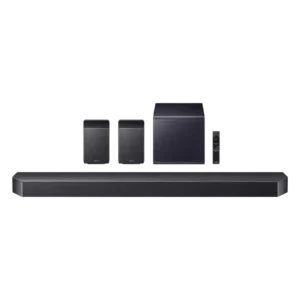
As a compact home-theater replacement, the four-box kit integrates easily in living rooms and is frequently compared favorably to more complex receiver-based setups.
Reviewers highlight smooth connection to other Sonos speakers for multi-room audio or rear-channel expansion.
No summary yet.
Reviews describe HDMI ARC as helping sync audio and picture, and app adjustments are available if dialog timing needs correction.
Lip-sync performance is usually reported as solid over HDMI, and several reviewers call out low latency for gaming/video; wireless TV-to-bar modes may be more environment-dependent.
The Beam gets impressively loud for its size and is commonly described as enough for small to medium rooms.
Maximum output is a highlight: reviewers describe room-filling volume that stays composed, often feeling louder than expected at modest volume settings.
Low-volume results are mixed but useful: speech and night modes help late-night listening, though some reviewers still think the Beam comes alive more at higher volumes.
Low-volume performance is frequently praised, with good intelligibility and detail at night-friendly levels; private rear/voice modes can help in shared spaces.
The built-in microphone array is a well-covered feature, with several reviews noting far-field pickup and smart-assistant readiness.
Where reviewed directly, pairing extra Sonos speakers is described as simple and app-friendly.
The top-panel touch controls are a consistent convenience for basic playback, volume, and mic mute functions.
On-device controls (buttons and mic mute) add convenience, though deep settings navigation is easier via SmartThings than via the bar’s small front display.
The included optical adapter is frequently mentioned as a useful fallback for TVs without HDMI ARC.
An optical input is included for older TVs and devices, providing a simple fallback when HDMI eARC/ARC is unavailable.
Privacy handling centers on the ability to mute or disable the microphones when desired.
Privacy controls get positive mentions thanks to a physical microphone mute and the option to disable/avoid voice assistants if desired.
Remote integration is generally strong, with existing TV remotes working automatically over ARC or being easy to configure in the app.
The included remote is generally considered simple and practical; many users end up using their TV remote via eARC/CEC after initial setup.
Setup is generally easy on compatible ARC TVs, but several reviews say it becomes more finicky when ARC or first-time pairing goes wrong.
Setup is widely described as plug-and-play: power each speaker, connect HDMI, and pairing happens automatically; a few reviewers note minor manual level tweaks or app steps.
Alexa support is a core Beam feature, and reviews treat it as a major differentiator for TV and music control.
Voice-assistant support (notably Alexa, plus compatibility with Google ecosystems) is a feature highlight, though usefulness varies by user and region.
Beyond sound, the Beam is repeatedly praised for smart-home and assistant features that make it more than a basic soundbar.
Smart features are robust, including streaming integrations, room calibration, and Samsung ecosystem extras like Q-Symphony; most reviewers find them additive rather than mandatory.
One of the stronger audio compliments is a sense of tall presentation despite the compact cabinet.
Height effects are consistently strong for a soundbar system, creating convincing overhead cues in Atmos mixes, though some note the perceived height depends on ceiling and room reflections.
Spotify support is useful overall, but at least one review reported playlist-finding issues, so the experience is not uniformly flawless.
Spotify Connect is commonly listed among direct-streaming options and is generally treated as a reliable, convenient way to play music without Bluetooth.
LED indicators clearly communicate operating or microphone status without adding much visual clutter.
The front dot-matrix display helps with status and input feedback, but multiple reviewers find it small or hard to read, making app control preferable.
Reviewers often praise the Beam’s wide image, spatial spread, and left-right steering for a single compact bar.
Imaging is typically wide and precise for a soundbar package, with stable placement across the front stage; dedicated stereo listeners may still prefer separate speakers.
On its own the Beam delivers some bass, but many reviews note that buyers wanting deeper or more physical low end may want an added Sub.
No summary yet.
The Beam can sound spacious or surround-like from the front, but reviewers are clear that standalone performance is not the same as true surround.
Surround performance is a core strength, with rears and side/height drivers creating a highly enveloping field; a few critiques focus on satellites sounding less premium for music or intense scenes.
For the feature set, size, and sound quality, value sentiment is strongly positive across the review set.
Value is viewed through the lens of its high price: many call it worth it for an all-in-one flagship surround kit, while others recommend waiting for discounts or choosing rivals for better cost-to-performance.
Reviews make clear that the single HDMI connection is for TV audio return, not source switching or video passthrough.
Video passthrough support is repeatedly highlighted, with HDMI inputs that pass modern 4K/120 signals and common HDR formats, letting the bar act as an AV hub.
Assistant response is generally strong, with reviewers noting that the Beam hears and reacts well across a room.
Voice responsiveness is generally acceptable, with the option to mute microphones; some users find always-listening behavior annoying if left enabled.
Vocal reproduction is described positively both for enhanced speech modes and for music vocals.
Voice reproduction is often described as clean and natural, especially after calibration or with dialogue modes, but can be inconsistent in certain mixes/rooms according to a minority of reviewers.
Voice pickup is usually good, but one review notes it does not catch every command, so recognition is strong rather than perfect.
The Beam’s smaller, lighter form is repeatedly treated as a practical advantage for placement and everyday living.
The main bar is described as large/hefty, which can complicate placement on narrow TV stands; wall mounting is a common recommendation.
Wi-Fi-based streaming is portrayed as stable in use, with one review explicitly calling out no dropouts or repeated pairing hassles.
Wi-Fi streaming is a strength for AirPlay/Cast and service integrations, though a few accounts mention fussy features (like tap-to-play) or occasional wireless-Atmos reliability depending on setup.
Physical connections are intentionally minimal but useful, typically centered on HDMI, optical via adapter, and sometimes Ethernet.
Wired inputs are centered on HDMI (including eARC) plus optical, making the bar an effective hub for TVs, consoles, and disc players; the lack of analog aux is a noted omission in some coverage.