
Trueplay and room correction are a recurring strength, with reviewers describing automatic or room-tailored tuning that improves or adapts performance, though some note iOS dependence.
AirPlay 2 support is repeatedly highlighted and helps the Beam fit Apple households for direct casting and Siri-linked playback.
App experience is mixed: some reviewers found the app great for control, while others ran into pairing retries or unclear setup flows.
Review coverage consistently points to Dolby Digital or Dolby Digital 5.1 and stereo PCM support, with clear limitations around DTS and Atmos on Gen 1.
Reviews agree the HT-S100F handles basic TV audio well but has limited format ambition, with explicit mention of missing DTS and no Atmos-grade presentation.
The included optical adapter helps the Beam work with TVs that lack HDMI ARC, giving it useful compatibility with older sets.
Its HDMI ARC and optical options make it easy to pair with a wide range of TVs, including older sets that lack ARC.
Multiple reviews note that the Beam does not support Bluetooth, so Bluetooth codec support is effectively absent.
Because Bluetooth is not supported, there is no Bluetooth connection path to evaluate, which is a clear limitation versus some rivals.
Bluetooth was repeatedly described as stable and trouble-free for phone streaming, with no notable dropouts in normal use.
Reviews consistently note that Bluetooth is unavailable, so there is no Bluetooth range advantage here.
One review found Bluetooth playback still audible from roughly 20 to 30 feet away and even from upstairs, indicating solid range for casual home use. Range impressions were positive, with music remaining usable from farther across the home rather than only at close distance.
The cabinet is described as mostly plastic with mesh grille elements, but reviewers still found it sturdy, solid enough, and nicely finished for the price.
Where reviewers discuss musicality and balance, they describe the Beam as sculpted, balanced, and cohesive rather than disjointed.
The overall presentation is usually described as clean, balanced, and more layered than TV speakers, even if it is not especially cinematic.
Touch controls receive positive feedback and are described as pleasant and responsive to use.
The top touch controls work, but one detailed review found them inconsistent enough that the remote became the preferred way to operate the bar.
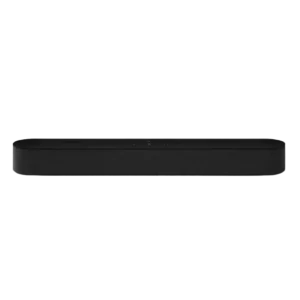
The Beam is widely praised for its compact, sleek, stylish appearance and its ability to blend into modern rooms.
The slim black design is widely liked for blending into TV setups, looking neat under screens, and offering flexible placement or wall mounting.
Reviewers describe the Beam as robust, well-built, and premium-feeling for a compact soundbar.
Build quality is considered good for the class: mainly plastic, yet generally sturdy, well-finished, and more premium-feeling than the price suggests.
Reviews mention detailed special effects and precise presentation, indicating solid fine-detail retrieval for a bar this small.
Reviewers noted clear small details such as metallic effects, instrument separation, and cleaner sound cues than built-in TV speakers provide.
Dialogue clarity is one of the Beam’s most consistent strengths, with multiple reviews calling speech crisp, clear, or well separated from effects.
Dialogue is one of this bar's strongest traits, with voice-focused modes and naturally crisp speech making TV and dialogue-heavy content easier to follow.
High-volume behavior is mostly positive but not perfect: several reviews found little distortion, while one noted distortion at maximum volume.
It stays composed better than expected at higher volume, though some tinniness can appear and it never sounds as refined as pricier setups.
Gen 1 reviews consistently frame Dolby Atmos as absent, so overhead height effects are not a strength here.
Multiple reviews explicitly note the lack of Dolby Atmos or true height presentation, so this is not a bar for overhead effects.
Reviewers mention scale, dynamics, punch, and convincing impact that exceed expectations for the Beam’s compact size.
For a compact 2.0 bar, it has respectable punch and can fill a small to average room without falling apart.
The Sonos app offers meaningful tuning options, including bass and treble adjustment plus extra listening modes in multiple reviews.
There are useful preset modes like Auto, Voice, Music, Cinema, Standard, and Night, but no deep manual EQ or separate bass/treble adjustment.
Across TV and music use, reviewers repeatedly describe the Beam as balanced, clear, and tonally well judged, though not especially deep in the lowest bass.
The sound signature is generally balanced and clear, with strong upper-mid intelligibility, but bass depth is limited and occasional tinniness shows through.
Because it has no HDMI input passthrough, it is not suited to gaming passthrough use cases.
Google Assistant support is repeatedly mentioned, giving the Beam flexibility for users who prefer Google’s ecosystem.
There is no evidence of HDMI 2.1 gaming support, and reviews specifically frame connectivity as basic ARC-only TV hookup rather than advanced passthrough.
HDMI ARC is central to the Beam’s design and ease of use, enabling simple TV hookup, synced control behavior, and voice-linked TV commands on compatible sets.
HDMI ARC is the preferred connection path in the reviews because it is simple, supports TV remote control, and usually works reliably after setup.
A recurring advantage is how easily the Beam can serve as the center of a Sonos TV setup with optional surrounds or a Sub.
It works well as a basic TV-speaker upgrade, but reviewers consistently say it is not a serious home-theater centerpiece for cinephiles.
Reviewers highlight smooth connection to other Sonos speakers for multi-room audio or rear-channel expansion.
Reviews describe HDMI ARC as helping sync audio and picture, and app adjustments are available if dialog timing needs correction.
The Beam gets impressively loud for its size and is commonly described as enough for small to medium rooms.
This small soundbar gets louder than many expected and can fill smaller rooms, but it is not a party bar or a powerhouse for huge spaces.
Low-volume results are mixed but useful: speech and night modes help late-night listening, though some reviewers still think the Beam comes alive more at higher volumes.
The built-in microphone array is a well-covered feature, with several reviews noting far-field pickup and smart-assistant readiness.
Where reviewed directly, pairing extra Sonos speakers is described as simple and app-friendly.
Sound remains front-focused rather than room-enveloping, so it does not create a truly all-around presentation.
The top-panel touch controls are a consistent convenience for basic playback, volume, and mic mute functions.
The soundbar includes on-device touch controls, but usability is only fair because the on-bar inputs are less convenient than the remote.
The included optical adapter is frequently mentioned as a useful fallback for TVs without HDMI ARC.
Optical input support is a practical backup for TVs without ARC, though reviewers generally prefer HDMI ARC for better convenience and control.
Privacy handling centers on the ability to mute or disable the microphones when desired.
Remote integration is generally strong, with existing TV remotes working automatically over ARC or being easy to configure in the app.
The included remote is consistently praised for being simple, well laid out, and easy to use, with solid buttons and helpful direct mode access.
Setup is generally easy on compatible ARC TVs, but several reviews say it becomes more finicky when ARC or first-time pairing goes wrong.
Setup is one of the clearest strengths: most reviewers describe installation as quick, beginner-friendly, and little more than plugging in power plus one cable. Across reviews, setup is repeatedly described as fast and uncomplicated, especially when using HDMI ARC.
Alexa support is a core Beam feature, and reviews treat it as a major differentiator for TV and music control.
Smart assistant support is effectively absent here, with reviews explicitly noting no smart-home integration or assistant ecosystem features.
Beyond sound, the Beam is repeatedly praised for smart-home and assistant features that make it more than a basic soundbar.
Feature set is intentionally basic: useful sound modes and Bluetooth are present, but there are few advanced or smart-platform extras.
One of the stronger audio compliments is a sense of tall presentation despite the compact cabinet.
Height is the weakest dimension of the stage, with reviewers describing the sound as limited compared with Atmos-capable or multi-channel bars.
Spotify support is useful overall, but at least one review reported playlist-finding issues, so the experience is not uniformly flawless.
LED indicators clearly communicate operating or microphone status without adding much visual clutter.
Basic indicator feedback exists through LEDs and status lights, but the interface is simple rather than especially informative.
Reviewers often praise the Beam’s wide image, spatial spread, and left-right steering for a single compact bar.
Stereo separation is decent for a compact 2.0 bar, especially with music and effects, but the image narrows off-axis and cannot match wider multi-speaker systems.
On its own the Beam delivers some bass, but many reviews note that buyers wanting deeper or more physical low end may want an added Sub.
Bass is the main compromise: there is no dedicated subwoofer and no external sub connection, so low-end impact is limited even if bass reflex tuning adds some punch.
The Beam can sound spacious or surround-like from the front, but reviewers are clear that standalone performance is not the same as true surround.
Sony's virtual surround processing adds some width and immersion, but reviews consistently stop short of calling it a real surround replacement.
For the feature set, size, and sound quality, value sentiment is strongly positive across the review set.
Value is a standout strength, with repeated praise for how much clearer and more enjoyable it is than TV speakers at around the entry-level price tier.
Reviews make clear that the single HDMI connection is for TV audio return, not source switching or video passthrough.
There is no real video passthrough story here because the bar is treated as a basic ARC/optical audio endpoint rather than an HDMI switching hub.
Assistant response is generally strong, with reviewers noting that the Beam hears and reacts well across a room.
Vocal reproduction is described positively both for enhanced speech modes and for music vocals.
Voices come through cleanly and crisply, which makes speech-heavy viewing more enjoyable and easier to understand.
Voice pickup is usually good, but one review notes it does not catch every command, so recognition is strong rather than perfect.
The Beam’s smaller, lighter form is repeatedly treated as a practical advantage for placement and everyday living.
Its slim, compact footprint is frequently praised for fitting easily under TVs or in small rooms without taking over the setup.
Wi-Fi-based streaming is portrayed as stable in use, with one review explicitly calling out no dropouts or repeated pairing hassles.
Wi-Fi streaming features are effectively missing, with reviewers explicitly noting no Wi-Fi music or multi-room capability.
Physical connections are intentionally minimal but useful, typically centered on HDMI, optical via adapter, and sometimes Ethernet.
Connectivity is basic but useful, with recurring mention of HDMI ARC, optical, USB, and Bluetooth as the main ways to use the bar. Input quality is best over HDMI ARC, while optical remains serviceable but is treated as the lesser connection path when both are available.