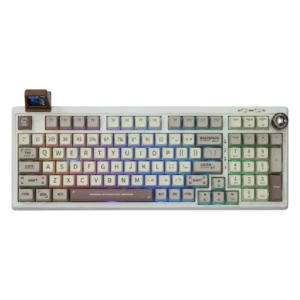
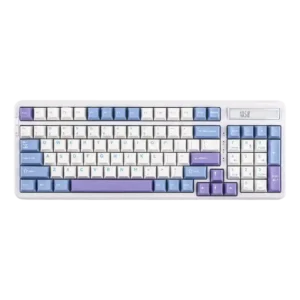
The RT100 tends to produce a satisfying deep or pleasant sound signature when paired with non-problematic switches.
The overall sound is generally liked, with reviewers calling it fantastic or delightfully clacky, but one review also notes metallic ping from some keys.
One reviewer reported occasional double spaces and inconsistent actuation feel, so key triggering may not feel perfectly uniform for every user.
One review says the linear switches feel consistent and reliable.
Lighting visibility is acceptable to good rather than extreme, with one review calling it plenty visible and another saying it is not especially strong.
Brightness control is present and usually adequate, but one review finds the side underglow too weak to stand out much.
Battery life is serviceable but not universally excellent; reports range from roughly 1.5-2 days with heavier use to about a week or more with lighter settings.
Several reviews emphasize the dual 4000mAh batteries and say battery life should not be a major worry.
Across multiple outlets, the RT100 is described as sturdy, premium-feeling, and well built for a plastic keyboard.
Most reviews describe the board as solid or well built for the price, but there are conflicting impressions because some reviewers still report flex or only average refinement.
The included cable is often singled out as unusually premium for a bundled accessory.
The included cable is described as braided and reliable in one review, and basic but serviceable in another.
Mac and Windows support is repeatedly confirmed, and at least one review also notes Linux usability outside the app.
Multiple reviews say the keyboard and software work on both Windows and Mac, though one notes the lack of Mac-specific replacement keys.
Tri-mode connectivity is one of the RT100’s most widely praised strengths, with wired, Bluetooth, and 2.4GHz support cited again and again.
Tri-mode connectivity is a clear strength, and reviewers repeatedly say switching among Bluetooth, 2.4GHz, and wired use is easy.
Beyond switches and colorways, reviewers consistently highlight the RT100 as a highly customizable board, especially around the screen, lighting, and mapping.
Reviewers say users can remap keys, change lighting, record macros, and otherwise tailor the board with little friction.
Several reviews praise the board for fitting a numpad into a footprint that stays relatively compact for the desk.
Reviewers repeatedly say the Cypher96 keeps a numeric keypad without taking too much desk space.
PBT caps and sturdy construction are treated as long-term positives, with reviewers expecting the legends and caps to hold up well.
Reviewers specifically praise the PBT caps for resisting shine and being more durable than ABS caps.
Where reviewers actually changed switches, they generally found the swap process easy.
Switch swapping is described as straightforward and solder-free.
Comfort is helped by the compact full-size layout and adjustable angle, though wrist-rest support is not part of the package.
One review straightforwardly describes the keyboard as comfortable to use.
One review explicitly highlights NKRO and anti-ghosting, which strengthens the RT100’s gaming utility.
Reviewers mention programmable buttons, FN shortcuts, anti-ghosting, and N-key rollover.
One reviewer specifically noted no key rattle or flex, indicating a firm overall structure.
Frame rigidity is mixed: some reviews report no flex, while others describe noticeable flex or twisting.
Gaming performance looks good for general play, but it is more convincing for casual and mixed use than for demanding twitch play with softer switches.
One review says the Flamingo switches are well suited to fast-paced games.
Hot-swap support is one of the most consistently praised features, with repeated mentions of broad socket compatibility.
Hot-swap support is consistently confirmed, including compatibility with 3- and 5-pin switches.
Reviewers consistently like the thick PBT caps and profile quality, even when they differ on the taller shape.
The PBT double-shot caps are usually praised for feel and longevity, but one reviewer criticizes overall cap quality and inconsistent thinner legends.
Where directly tested, keys were described as fast and precise, with reviewers not noticing sluggish response in normal use.
Reviewers describe the switches as responsive and say the board supports quicker typing and fast-paced play.
Keys are generally described as well spaced and easy to navigate without feeling cramped.
One reviewer dislikes the compressed layout because the arrow keys are harder to find by feel.
The space bar was described as firm and in line with the rest of the keycaps, suggesting solid stability on larger keys.
Larger stabilized keys are described as free from rattle.
Multiple reviews report no discernible wireless lag, with the board feeling close to wired during use.
Wireless 2.4GHz is described as low latency, and wired mode is said to deliver minimal latency.
One review notes an ISO option in addition to the standard layout, which adds some regional flexibility.
The board is consistently described as a compact 96% or 90% layout, though one reviewer personally prefers a proper full-size layout.
Legends are generally easy to read in normal lighting, though one review says the opaque caps hurt visibility in the dark.
One review praises the legends as sharp and visible, while another says thinner legends look inconsistent.
Macro support is a clear strength, with several reviews confirming remapping and macro creation in software.
Reviews say macro recording is supported and simple to set up.
Materials are mixed: the main board often feels solid, but the knob is repeatedly criticized for feeling cheap or plasticky.
The ABS construction is usually framed as decent and better than cheap-feeling plastic, but not truly premium.
Dedicated media functions are a real plus, with the knob/button setup adding useful playback control.
With the right switches, especially Sea Salt, the RT100 is repeatedly described as impressively quiet.
Most reviews say the keyboard stays controlled and not overly loud, though one review mentions metallic ping from some keys.
One review explicitly says remaps and macros can be stored to onboard memory.
One review explicitly confirms per-key RGB backlighting.
One review explicitly mentions per key RGB underglow.
One reviewer said the 2.4GHz dongle matched the speed of many wired gaming keyboards, suggesting strong scan performance for its class.
One review explicitly calls out an impressive 1000Hz polling rate.
Portability is mixed: the RT100 is not tiny, but its weight and removable screen make it manageable if you really want to move it around.
One review explicitly calls the board lightweight and portable.
One review explicitly mentions Bluetooth support for up to three profiles, which helps multi-device use.
One review highlights preset sharing and downloading other users’ configurations.
The only direct mention was negative: one reviewer said rapid trigger inputs felt off the table with Sea Salt switches.
One review describes the connection modes as working well, suggesting dependable everyday operation.
One reviewer says the wired connection never lets them down.
At least one review explicitly notes software-based RGB customization, reinforcing that lighting control goes beyond presets.
Multiple reviews say the software lets users change colors, effects, brightness, and related lighting behavior with little fuss.
RGB is described as vibrant and full-featured, even if it is partly hidden by the non-shine-through caps.
RGB is mostly described as vibrant, bright, or attractive without being overpowering, though one review says the side underglow is weak.
The 95%/96% style layout is frequently framed as a smart near-full-size design that keeps the numpad while trimming bulk.
Several reviews praise the board for staying compact while still fitting a numpad.
Software support is functional but mixed: it usually works and offers many features, yet multiple reviewers call it finicky, clunky, or less polished than major-brand alternatives.
The companion software is repeatedly described as easy to use and good enough for common remaps, macros, and lighting changes.
Foam and internal dampening are repeatedly credited with cutting hollowness, pinging, and harsh resonance.
Multiple reviews credit the multilayer dampening and gasket construction for reducing vibration, hollowness, and harshness.
Stabilizers are generally good out of the box, though at least one review still noticed minor ticking.
Stabilizers are mostly praised for keeping larger keys controlled, though a few reviewers mention looseness or a need for extra tuning.
Across switch variants, reviewers mostly describe the RT100 as smooth and enjoyable, though the Sea Salt option can feel mushy or unusually soft to some users.
Reviews generally describe the stock switches as smooth, light, pre-lubed, and pleasant to use, though one reviewer calls the Wisterias fairly generic.
Reviews repeatedly note that Epomaker offers several switch choices, giving buyers good flexibility across linear, tactile, and quieter preferences.
Stock choice is limited in one review, while others note two out-of-box switch options and hot-swap flexibility for changing them later.
Typing comfort is positive overall, but very tall keycaps may not suit everyone equally well.
Typing comfort is a recurring strength, with reviewers calling the board pleasurable, cloud-like, or well suited to long sessions.
Typing feel is generally praised as soft, satisfying, and pleasant, though one review found it only solid rather than class-leading.
Typing is repeatedly described as lovely, soft, and thocky rather than harsh.
Value is a major strength, with many reviews saying the RT100 delivers unusual features and strong core performance for around the $100-$120 range.
The keyboard is regularly framed as affordable, competitive, or good value despite some compromises.
Volume adjustment is consistently described as tactile and pleasant to use.
Wireless use is generally described as responsive and dependable enough for everyday work and gaming.
Wireless use is described as fast, responsive, and low-lag in everyday use.