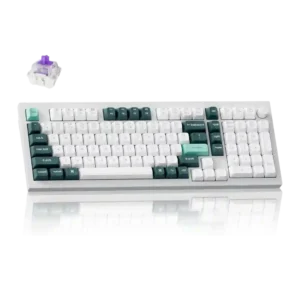
- Alternative: metallic ping and sound profile The reviewer recommends the Epomaker RT100 as an alternative if the Cypher96's ping bothers the user.
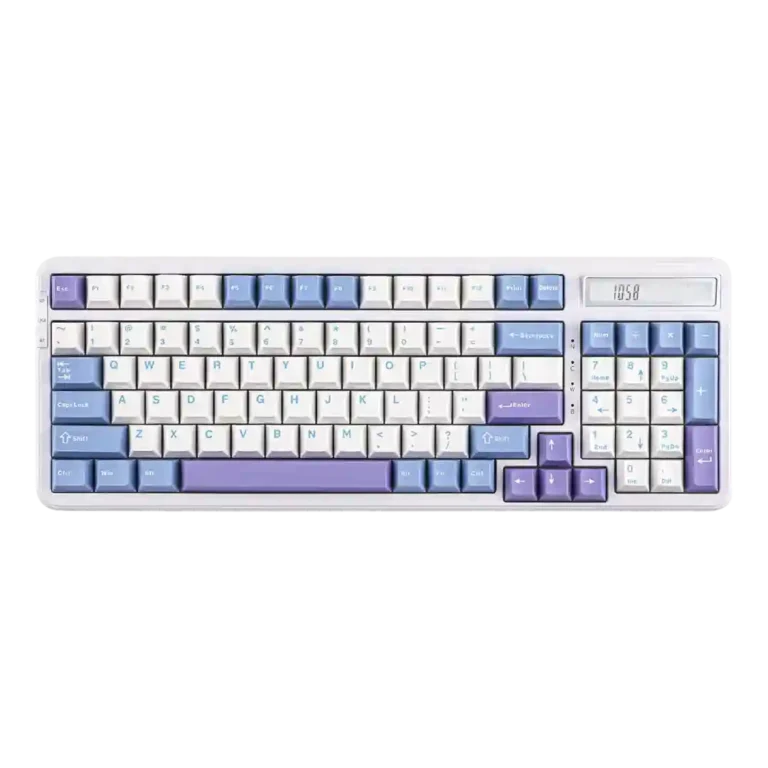
Epomaker Cypher96 Keyboard Review
Bottom Line
Choose the Epomaker Cypher96 if you want a compact numpad keyboard with smooth switches, strong customization, tri-mode connectivity, and a useful calculator. Skip it if body flex, pinging keys, or limited stock switch choices bother you.
Best for productivity users, spreadsheet-heavy workers, and casual gamers who want a compact 96% board with a numpad, calculator, tri-mode wireless, hot-swap switches, and easy software customization.
Not for buyers who want an aluminum-feeling chassis, a true full-size layout, advanced magnetic-switch gaming features, dedicated media or volume controls, or a broad set of stock switch options.
The Epomaker Cypher96 earns its strongest praise as a productivity-first mechanical keyboard that keeps a numpad, adds a genuinely useful calculator, and delivers a smooth, dampened typing feel for the price. Reviewers consistently like its tri-mode connectivity, hot-swap support, RGB customization, PBT keycaps, and approachable software. The tradeoff is that its plastic build is not uniformly praised: some reviewers find it sturdy, while others report body flex, PCB dipping, or a bit of hollowness. Stock switch variety is also limited, and the sound profile can be undercut by pinging or stabilizer tuning needs. Overall, the evidence points to a feature-rich value board with excellent everyday typing comfort but only mid-tier enthusiast refinement.
Compared in Reviews
Products reviewers directly compared with this model, grouped into quick takeaways.
Epomaker Dyna Tab 75X
- Better: Mac-specific keys The Cypher96 works with Mac, but lacks dedicated Mac hotkeys compared with the Epomaker Dyna Tab 75X.
Epomaker EK68
- Similar: body flex and PCB bending The reviewer says the Cypher96 shares a flex issue seen on the Epomaker EK68.
Feature Scorecards
Pros
-
Polling rate is strong, with multiple reviewers citing a 1,000Hz rate in wired and wireless modes.
-
Hot-swappable switch support is consistently praised, with reviewers noting easy replacement and broad 3-pin or 5-pin compatibility.
-
Typing feel is one of the strongest attributes, repeatedly described as smooth, cushioned, pleasant, and premium for the price.
-
Battery life is a strength thanks to the dual 4,000mAh packs, with reviewers repeatedly noting the large 8,000mAh total capacity.
-
Connectivity is a major strength, with reviewers consistently pointing to wired, 2.4GHz, and Bluetooth modes, plus multi-device pairing.
-
Switch replacement is easy because the board is hot-swappable and supports common 3-pin and 5-pin MX-style switches.
-
Sound dampening is one of the clearest strengths, with reviews repeatedly citing foam, silicone pads, gasket mounting, and reduced vibration.
-
Typing comfort is a highlight, with reviewers describing long sessions as comfortable, cushioned, and easy on the fingers.
-
Latency is strong in 2.4GHz and wired modes, with low-latency wireless and minimal-latency wired performance cited; Bluetooth is a slight caveat.
-
Gaming performance is solid for conventional play thanks to responsive switches, anti-ghosting, N-key rollover, and 1,000Hz polling.
-
Customization options are strong, covering key remapping, RGB adjustments, macros, programmable inputs, and shared configurations.
-
Key responsiveness is rated highly, with reviewers calling the switches responsive, fast enough, and light to actuate.
-
Wireless performance is strong overall, with low-latency 2.4GHz, multi-device Bluetooth, and usable range, though Bluetooth response rates can dip slightly.
-
Durability evidence centers on double-shot PBT keycaps, which reviewers say resist shine and should last well over time.
-
Macro customization is a clear software strength, with reviews citing macro recording, mouse-click detection, and easy setup.
-
Gaming extras are present but basic, with reviews citing anti-ghosting, N-key rollover, and a 1,000Hz polling rate rather than advanced analog features.
-
Actuation is supported by one review that describes keypresses as consistent and smooth, helped by the gasket-mounted design.
-
RGB customization is consistently strong, with software controls for effects, colors, brightness, zones, and multiple lighting modes.
-
The 96-key layout keeps a numpad while saving desk space, making it more compact than a typical full-size keyboard.
-
Reviewers describe the Cypher96 as pleasingly clacky or thocky, with strong overall sound quality, though one review notes pinging can spoil the profile.
-
Noise level is generally well controlled by dampening, with reviewers saying it avoids obnoxious noise and keeps rattles down.
-
RGB lighting quality is generally praised as vibrant, bright, and attractive, though the lack of shine-through legends limits visibility through keycaps.
-
Value for money is strong, with reviewers repeatedly framing the Cypher96 as affordable or well priced for its features.
-
Software quality is generally good and easy to use, though one review says it is less customizable than deeper enthusiast platforms.
-
The compact 96%/96-key form factor is widely recognized as useful because it retains a numpad in a smaller footprint.
-
Keycap quality is mostly strong because of double-shot PBT caps, although one reviewer disliked inconsistent thin legends.
-
Per-key lighting evidence is limited but positive, with references to per-key RGB underglow and zone-based effects.
-
Lighting brightness is generally viewed positively, with several reviewers calling it vibrant or bright, while one found the side underglow weak.
-
Ergonomics are helped by adjustable feet and multiple resting positions, though the evidence is limited to setup angle rather than wrist support.
-
Profile management has limited but positive evidence through shareable configurations for keymaps, macros, and lighting profiles.
-
Switch feel is mostly positive, with smooth pre-lubed linear switches praised, though some reviewers found them generic or too light.
-
Compatibility is good for Windows and Mac users, though one review notes the lack of dedicated Mac-specific keycaps or hotkeys.
-
Stabilizer quality is mixed: several reviews say large keys are rattle-free or solid, while others recommend tuning or relubing.
-
Cable feedback is mixed: one review praises the braided USB-C cable, while another calls the included cable generic but usable.
-
Portability is decent for a 96-key board because reviewers cite a lightweight portable form and use while commuting, though it is not tiny.
-
Build quality is mostly solid for a plastic budget board, though opinions differ because some reviewers report flex while others found no creaks or wobble.
-
Key stability is mostly good on large keys, but stabilizer looseness appears as a caveat for rattle-sensitive users.
-
Reliability is mixed: some evidence praises reliable switches and daily dependability, but one review warns PCB bending may be a long-term risk.
-
Materials quality is acceptable rather than premium: reviewers repeatedly identify an ABS plastic build that feels sturdy but not aluminum-like.
-
Layout options are somewhat mixed: the board supports Mac/Windows layout modes, but one reviewer preferred a true full-size layout.
Cons
-
Legend visibility is mixed, with one review praising sharp visible legends while another criticizes inconsistent thin lettering.
-
Frame rigidity is mixed: some reviewers report flex and twisting, while another found no flex when pressing down.
-
Switch options are limited because stock choices are basically Wisteria or Flamingo, though hot-swap support lets users change them later.
-
Key spacing is a weakness for one reviewer, who found the 96% layout harder to navigate without looking.
Compared With Category Average
Compared with other Gaming Keyboard, this product is above average in hot-swappable switches, ease of switch replacement, wireless performance, below average in key spacing, frame rigidity, materials quality.
| Attribute | This product | Category average | Difference |
|---|---|---|---|
| hot-swappable switches | 4.6 | 3.2 | +1.4 |
| key spacing | 2.6 | 3.9 | -1.3 |
| frame rigidity | 3.3 | 4.5 | -1.2 |
| ease of switch replacement | 4.5 | 3.4 | +1.2 |
| wireless performance | 4.4 | 3.3 | +1.1 |
| materials quality | 3.5 | 4.3 | -0.8 |
| value for money | 4.3 | 3.6 | +0.7 |
| connectivity | 4.5 | 3.9 | +0.6 |
FAQ
Is the Epomaker Cypher96 good for typing?
Yes. Multiple reviewers describe the typing feel as smooth, cushioned, pleasant, and comfortable for long sessions.
Does the built-in calculator feel useful or gimmicky?
Reviewers generally treat it as useful for quick number work, especially because it can switch from numpad mode to calculator mode without opening a separate app.
How is the wireless performance?
The reviews support strong wireless flexibility, with Bluetooth, 2.4GHz, and wired modes. 2.4GHz is described as low-latency, while Bluetooth can have slightly lower response rates but remains usable.
Are the switches replaceable?
Yes. Reviewers repeatedly note that the Cypher96 is hot-swappable and supports common 3-pin and 5-pin switches, making switch replacement straightforward.
What are the main downsides?
The recurring downsides are limited stock switch options, plastic build tradeoffs, possible body or PCB flex, occasional metallic ping, and stabilizers that may need tuning.
Is it good for gaming?
It has conventional gaming strengths such as responsive switches, anti-ghosting, N-key rollover, and a 1,000Hz polling rate. The reviews do not support advanced analog or rapid-trigger gaming features.
Consider This Instead
If you want better key spacing
Choose Logitech G512. It scores 4.8 vs 2.6 for key spacing, with a 3.9 overall score.
If you want better frame rigidity
Choose Keychron Q6 HE. It scores 5.0 vs 3.3 for frame rigidity, with a 4.4 overall score.
If you want better switch options
Choose MonsGeek M1 V5 HE. It scores 4.9 vs 3.1 for switch options, with a 4.3 overall score.
If you want better legend visibility
Choose Keychron Q3 HE 8K. It scores 5.0 vs 3.3 for legend visibility, with a 4.5 overall score.
Overall Top Gaming Keyboard Alternatives
Best for 8K polling, magnetic-switch gaming control, premium build, and deep web customization. Skip it if you need broad switch compatibility, USB passthrough, a wrist rest, or a portable keyboard.
Pros: latency, polling rate
Cons: portability, switch options
Good if you want a premium full-size Hall Effect keyboard with smooth switches, strong gaming controls, and quiet acoustics. Skip it if you need a portable, budget, or broadly switch-compatible...
Pros: key stability, frame rigidity
Cons: portability, switch options
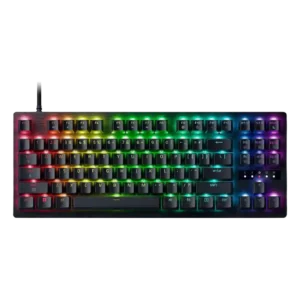
Best for a premium, quiet Hall Effect TKL with strong wireless, software, and gaming features. Skip it if price, switch flexibility, USB passthrough, or an included wrist rest matter most.
Pros: rapid trigger support, typing feel
Cons: switch options, portability
Best for a premium 96% metal keyboard with Hall Effect tuning, strong wireless, and excellent typing feel. Skip it for travel, bargain pricing, or maximum esports specs.
Pros: build quality, frame rigidity
Cons: portability, switch options