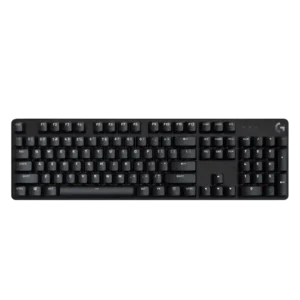
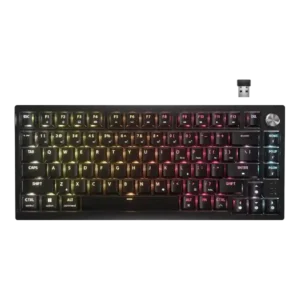
Sound impressions lean negative overall, with reviewers calling the keyboard unpleasant, scratchy, pingy, or only modestly refined.
Reviews describe the K65 Plus as acoustically refined, with softer, rounder sound than typical gaming boards.
One review specifically found the tactile bump inconsistent from key to key, with some switches feeling lighter or heavier than others.
One review says the keys travel smoothly with little variance, supporting generally consistent actuation.
Reviewers consistently found the white backlight bright, with multiple brightness levels or intensity adjustment available.
Backlighting is bright enough to stand out well around the keycaps, even though legends do not shine through.
Battery life is a clear strength, with multiple reviewers getting days to weeks depending on lighting use.
Across reviews, the board is described as solid, sturdy, and better built than many budget peers despite its stripped-down feature set.
Build quality is repeatedly praised for sturdy construction, hefty feel, and a premium overall impression.
The attached cable is repeatedly described as basic, non-detachable, and unbraided, which feels cheap for the price.
The included USB-C cable is described as braided, long enough for typical setups, and easy to disconnect.
Multiple reviews specifically highlight the lack of Logitech G Hub compatibility, limiting ecosystem integration.
Compatibility is broad, with repeated support for Windows, Mac, and multiple console or mobile use cases.
Reviews describe a wired, non-detachable connection that works but offers little flexibility.
Connectivity is a major highlight thanks to wired, 2.4GHz, and Bluetooth modes plus easy multi-device switching.
Reviewers consistently say customization is minimal, with little to no remapping, layout changes, or deeper tweaking available.
Customization is extensive, covering hot-swap hardware changes, remapping, lighting, and other programmable behaviors.
The compact footprint, slim bezel design, and TKL option leave more room on the desk, especially for mouse movement.
The 75% footprint noticeably frees desk space, especially for mouse movement and tighter workstations.
PBT caps and sturdy metal-backed construction are repeatedly framed as long-lasting, heat- and wear-resistant design choices.
Durability impressions are strong, with sturdy construction, durable caps, and long switch lifespan claims noted.
One reviewer notes switch replacement is not straightforward and would require tools or modification rather than simple user swapping.
Switch replacement is generally easy thanks to hot-swap support and included tools, though sockets can feel tight.
Ergonomics are mixed: some reviewers liked the low-profile angle and adjustable feet, while another found the board uncomfortable without a wrist rest.
Ergonomics are mostly positive, especially at lower angles, but comfort can depend on setup and wrist support.
The keyboard covers basic gaming needs with anti-ghosting and six-key rollover, but reviewers repeatedly say its feature set is minimal and misses staples like game mode.
Gaming extras include full key rollover, anti-ghosting, and lockout shortcuts that help avoid accidental interruptions.
Reviews consistently report very little flex, giving the chassis a firm, rigid feel.
Reviewers describe the frame as rigid and low-flex, with enough heft to stay planted during use.
In games, the board generally keeps up and registers commands well, but several reviewers say it lacks the richer gaming-focused feature set expected at this price.
Gaming performance is strong overall, with fast input feel and good control, though one review found it less standout than rivals.
Multiple reviews explicitly state the switches are not hot-swappable.
Hot-swap support is one of the keyboard’s headline features and is praised across multiple reviews.
PBT keycaps are a clear strength, with reviewers praising their texture, durability, and better-than-expected material quality for the price.
Keycaps earn praise for material and feel, though some reviews note the single-shot, non-shine-through design as a compromise.
Reviews that addressed responsiveness say inputs register quickly and feedback is fast enough for gaming.
Key response is consistently described as quick, clear, and dependable in both gaming and typing scenarios.
Reviewers describe the spacing as comfortable overall, though one noted the keys feel a bit narrower than typical.
The layout feels well spaced for a compact board, keeping keys usable without feeling overly cramped.
One reviewer found the spacebar stable with little wobble.
Key stability is good, with low switch wobble and sturdier large keys than many typical gaming keyboards.
The few reviews that discussed response speed describe the board as nippy and fast enough for quick in-game inputs.
Latency is effectively a non-issue in use, with reviewers calling wired and wireless input lag-free or unnoticeable.
Availability in both full-size and TKL is a plus, but one reviewer criticized the TKL layout for omitting expected keys.
Layout flexibility is decent, with mention of ANSI/ISO availability and quick Windows or Mac layout switching.
Visibility is a weakness, with legends described as hard to see without the backlight and some function labels unlit.
Legend visibility is acceptable in good light, but opaque caps make dark-room use noticeably harder.
Reviews consistently say macro creation is unavailable or effectively unsupported.
Macro support is solid through iCUE, with reviewers noting macro recording, remapping, and other programmable actions.
The brushed aluminum or aluminum-magnesium top plate is repeatedly described as premium-feeling and sturdy.
Material quality is good for the price, though several reviews still call out the plastic shell as a compromise.
Media access is present mainly through Fn shortcuts, but reviewers frequently note the lack of dedicated controls.
Media control coverage is good, led by the multifunction dial and secondary media shortcuts on the keyboard.
Noise impressions vary from moderate to fairly loud, but the board is generally not positioned as especially quiet.
Noise levels are low for a mechanical board, with several reviewers calling the K65 Plus quiet or subdued.
One review says settings revert to default because there is no built-in memory.
Onboard memory is useful, with reviewers noting stored settings and space for multiple saved profiles.
Multiple reviews call out the removal or absence of USB passthrough.
Reviewers say the lighting cannot be individually customized, even though the keys are backlit.
Per-key lighting control exists and can be programmed in software, though one review notes wireless limitations.
One review explicitly warns not to expect especially high polling rates.
The 1,000Hz polling rate is viewed as fast enough for most use, but not cutting-edge for competitive buyers.
The TKL version and relatively light build make the keyboard easy to carry and easier to fit into travel or event setups.
Portability is mixed: the compact footprint travels well, but the board’s weight makes it less ideal for constant carry.
One review specifically notes there is no way to create profiles.
Profile management is flexible, with multiple onboard profiles and software-based profile creation or switching.
One reviewer praised the updated switches for avoiding the double-typing issue they associated with older keys.
Reliability is strong in actual use, with reviewers reporting stable operation and dependable wireless behavior.
Reviewers repeatedly note white-only lighting and no RGB options, so personalization is essentially absent.
RGB customization is broad, with many effects and presets available, though one review calls wireless customization limited.
The white lighting is generally bright and clean-looking, with a few modes, but it remains limited for users who want richer effects.
RGB lighting quality is generally praised for rich color and strong visibility around the keys.
Reviewers repeatedly call the board compact for its class, with slim proportions and both full-size and TKL options.
The 75% form factor is widely praised for balancing compact size with useful navigation and function keys.
The dominant software story is negative: most reviews highlight no G Hub support or no companion software at all.
iCUE is generally considered capable and easy to use, though some functions remain more limited than enthusiasts may want.
Sound control is mixed, with one review calling out ping while another praised the lack of echo or reverb.
Dual sound-dampening layers are repeatedly credited for the quieter, fuller sound signature.
Stabilizer impressions are mixed but lean negative overall, with one review noting ticking and another noting only slight wobble on larger keys.
Stabilizers are better than past Corsair efforts, reducing wobble and rattle, though tuning is not flawless everywhere.
Switch feel is the product’s most divisive area, with many reviewers calling the switches mushy, stiff, clunky, or inconsistent, though a few found them smooth or acceptably light.
Switch feel is a major strength, with reviewers calling the stock MLX Reds smooth, soft, and satisfying.
One review explicitly criticizes the board for offering only brown switches.
Stock switch choice is limited because the keyboard ships only with linear MLX Reds unless you swap later.
Typing comfort is mixed; some reviewers found the board comfortable or fatigue-free, while others found it less comfortable than alternatives.
Typing comfort is a standout, with several reviewers calling the board comfortable even over long sessions.
Typing feel lands in the middle overall, with some reviewers enjoying the response and tactility but others describing dullness, mushiness, or friction.
Typing feel is widely praised for feeling premium, smooth, and enjoyable across work and play.
Value is mixed-to-negative overall: some reviewers appreciate the simple, sturdy package, but many argue the missing features and competition make the asking price hard to justify.
Value is generally good for the feature set, though not every reviewer thinks it clearly beats cheaper alternatives.
Volume adjustment is available through Fn-layer shortcuts rather than dedicated hardware.
Volume control is convenient through the top-right dial, which defaults to volume and mute behavior.
Wireless performance is a clear strength, with stable, lag-free behavior reported across multiple reviews.
Reviews repeatedly note that there is no included wrist rest.
Wrist rest quality is the weakest area because reviewers repeatedly note that no wrist rest is included.