Reviewers describe the keyboard’s sound as mixed but often louder than ideal, with only limited praise for how it sounds.
Across reviews, the Air75 V3 is described as cleaner, less hollow, and more refined than earlier low-profile boards, with notably pleasing stock sound.
Backlight brightness is decent, but several reviews say it is less bright or vibrant than some competing or larger boards.
Brightness can be adjusted in software or shortcuts, but at least one review reports that brightness looks uneven across rows.
Battery life is a major strength, with repeated praise for long runtime and infrequent charging in real use.
Battery life is one of the product’s strongest themes, with very high claims and mostly positive real-world impressions, even if one reviewer measured less than the headline figure.
The chassis usually feels sturdy and premium, though at least one reviewer expected better execution for the price.
Build quality is consistently praised, with the aluminum-top and ABS-bottom construction feeling solid and premium in use.
The included cable is described as braided or fabric-covered and generally feels well made.
Only one review comments directly on the included cable, calling it decent overall but not especially premium.
Compatibility is broad across Windows, Mac, mobile, Xbox, and PlayStation, though Mac-specific labeling remains a drawback.
Compatibility is a standout strength, especially for Mac users, while Windows and even iPad use are also described positively.
Wired, Slipstream, and multi-device Bluetooth connectivity are consistently praised and easy to switch between.
Tri-mode connectivity is widely praised for being flexible and easy to manage, with clear switches and convenient dongle storage.
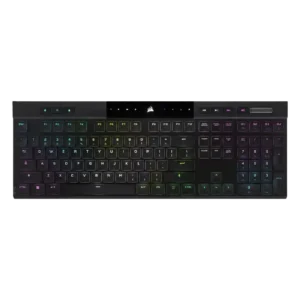
The K100 AIR offers extensive remapping, lighting, and software-driven customization across multiple reviews.
Customization is broad, spanning remaps, knob actions, layers, lighting, and app-specific functions, which gives the board flexibility beyond stock use.
Despite being full-size, the thin layout uses desk space efficiently and can fit into tighter setups than bulkier boards.
Its compact footprint is repeatedly framed as a strength for crowded desks, workstation setups, and mobile use.
Reviews indicate strong durability, with successful drop testing, good transit resilience, and solid long-term wear.
Durability impressions are favorable thanks to wear-resistant PBT caps, engraved labels, and generally robust construction.
Serviceability is a clear weakness because removing caps or accessing the switches can be difficult and risky.
At least one review explicitly notes that switch changes are easy and do not require soldering, making experimentation accessible.
Its low height, adjustable feet, and minimal need for a palm rest make the board comfortable to use ergonomically.
Low-profile geometry, sculpted caps, and practical feet contribute to a more comfortable and fatigue-friendly experience than many bulkier keyboards.
Gaming-focused extras such as PlayStation mode, streaming integration, and dedicated shortcut controls add useful functionality.
The board includes extra gaming-oriented functions such as SOCD-style features, but reviews still treat them as bonuses rather than the core reason to buy it.
The ultra-thin chassis still feels impressively rigid, with little to no concerning flex in the cited reviews.
The chassis is described as sturdy with minimal flex, giving the board a firmer and more confident feel than its slim profile suggests.
Gaming performance is consistently strong, with fast response and accurate input across wired and wireless use.
Gaming performance is viewed as competent for casual or secondary gaming, but most reviews still position the board as productivity-first.
The keyboard is explicitly described as not hot-swappable.
Hot-swap support is a well-documented feature and a consistent selling point across the review set.
Keycap quality is mixed: the shape helps finger placement, but the ABS material and surface quality draw criticism.
The included double-shot PBT keycaps are regularly described as durable, solid-feeling, and appropriate for the premium target.
Keys are repeatedly described as quick, accurate, and highly responsive.
The reviewed typing response feels fast and accurate, with one review explicitly calling out strong speed and confidence while typing.
One review specifically praises the extra spacing between keys for preserving familiar finger positioning.
One review notes that the spacing differs slightly from standard mechanical boards, creating a brief adjustment period before comfort returns.
One reviewer highlights balanced keys with no spacebar wobble.
One long-term review specifically notes low rattle on stabilized keys, suggesting stable key behavior in day-to-day use.
Latency is a standout strength, with very fast wired and wireless response highlighted across several reviews.
Latency is treated as low enough for responsive wired or dongle use, but the board is still framed as casual-gaming friendly rather than esports-first.
The full-size layout works well for those who want everything onboard, but reviewers also wish smaller variants existed.
ISO and JIS availability stand out as meaningful layout additions that broaden the board’s appeal beyond standard ANSI buyers.
Legend visibility is generally good through shine-through legends, though secondary symbols are not always fully illuminated.
Backlighting is present, but one review says the stock caps do not let light shine through the legends well, which can hurt night visibility.
Macro support is flexible and well integrated, though some reviewers find the macro-key position less ideal in play.
Macro support is clearly present and repeatedly mentioned as part of the board’s practical everyday customization set.
Premium aluminum surfaces help the board feel upscale, but plastic elements and sharp edges reduce the overall impression.
Reviewers like the material mix of aluminum and ABS, finding it premium enough for the price while keeping the board practical for a low-profile design.
Dedicated media controls are consistently praised as useful and well integrated.
Media controls are easy to access through knob functions or software remapping, which adds day-to-day convenience.
Noise is divisive: some find it workable for general use, while others call it loud or rattly.
Noise level depends heavily on switch choice; the silent option is genuinely quiet, but the board still retains recognizable mechanical character with other switches.
Onboard storage is a strength, with support for many saved profiles and hardware-side customization.
The K100 AIR lacks USB, headset, or similar passthrough connections.
Lighting control is flexible, with per-key or advanced programmable lighting support highlighted in the cited reviews.
Reviews explicitly call out the lack of per-key RGB programming, so lighting control is broad but not granular.
Polling-rate capability is one of the board’s headline strengths, especially in wired mode.
Multiple reviews cite 1000Hz wired and 2.4GHz polling, with lower Bluetooth polling, which aligns with its work-first but gaming-capable positioning.
The thin design helps portability, but the long full-size footprint can still make transport awkward.
Portability remains a clear strength thanks to the compact low-profile build, though several reviews note the V3 is heavier than some earlier or rival options.
Profile management is strong, with onboard profile storage and quick switching options.
The cited reviews describe reliable connections and stable long-term operation without major functional issues.
Reliability feedback is mostly positive overall, but a handful of reviewers mention software quirks, connection hiccups, or mode oddities.
RGB customization is deep, with layered effects and extensive lighting control repeatedly praised.
Lighting customization is a recurring positive, with reviews noting easy adjustment of main effects and side-light behavior through software.
RGB lighting quality is generally good, though it is not the brightest implementation in the segment.
RGB lighting is generally well-liked for brightness, effects, or appearance, though one review noticed uneven perceived brightness across rows.
The ultra-thin full-size form factor is one of the keyboard’s most distinctive and most praised traits.
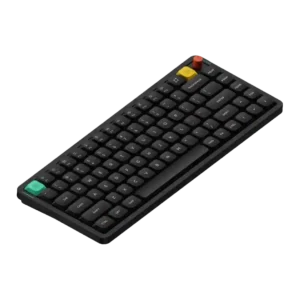
The 75% low-profile form factor keeps the board compact and practical while still covering the keys most reviewers expect to use daily.
iCUE is widely viewed as powerful and feature-rich, even if some users may find it heavy or complex.
Software quality is mostly viewed positively for ease of use and capability, though some reviews still mention missing polish or early recognition issues.
Sound dampening is weak in the cited evidence, with leakage through the chassis noted in one review.
Gasket mounting and internal foam are repeatedly credited with reducing hollowness and harshness, materially improving how the board sounds and feels.
Stabilizer quality is inconsistent, with multiple complaints about looseness or rattle despite one positive stability note.
Stabilizers are usually described as solid and low-rattle, especially on major keys, though at least one review stops short of calling them class-leading.
The low-profile tactile switches are widely praised for feeling fast, tactile, and satisfying.
Reviewers consistently praise the switch feel as smooth, tactile or well-traveled depending on switch choice, giving the board a more satisfying feel than many low-profile peers.
Switch choice appears limited on this board, with reviewers noting tactile-only availability or a lack of alternatives.
Switch choice covers linear, tactile, and silent options, but multiple reviews still call the overall selection limited compared with some expectations or prior models.
Typing comfort is a strong point once users adjust to the low-profile format.
Long-session comfort is a recurring positive, with reviewers highlighting cushioned feel, comfortable profiles, and usable typing angles.
Typing feel is generally described as enjoyable, fluid, and tactile.
Typing feel is a major strength, with reviews repeatedly calling it premium, cushioned, refined, and more pleasant than previous Air models.
Value for money is mixed to poor because the feature set is strong but the premium price is hard to justify.
Reviewers generally feel the feature set justifies the price, but several also note that it sits above some competing low-profile options.
The dedicated volume wheel or roller is consistently well liked.
Volume control works out of the box and is widely mentioned, though some reviewers criticize the knob’s wobble rather than the function itself.
Wireless performance is a clear strength, with fast low-latency behavior and no meaningful lag reported.
Wireless performance is generally useful and fast enough, but a few reviews report isolated Bluetooth or dongle quirks that keep it from feeling flawless.
No wrist rest is included, and at least one reviewer calls that out as a miss at this price.