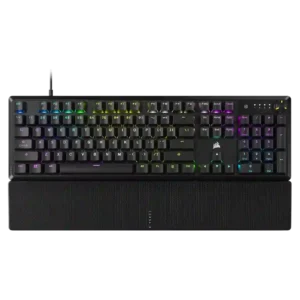
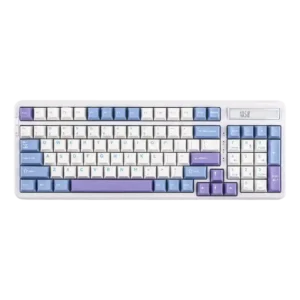
Acoustics are usually described favorably as subdued, efficient, deep, or satisfying rather than pingy, but one strongly negative review disliked the sound.
The overall sound is generally liked, with reviewers calling it fantastic or delightfully clacky, but one review also notes metallic ping from some keys.
One review says the linear switches feel consistent and reliable.
Backlighting is described as bright and adjustable, with controls for brightness in hardware and software.
Brightness control is present and usually adequate, but one review finds the side underglow too weak to stand out much.
Several reviews emphasize the dual 4000mAh batteries and say battery life should not be a major worry.
Build quality is generally rated well for the price, especially rigidity and overall feel, though one review considered the construction a clear step down.
Most reviews describe the board as solid or well built for the price, but there are conflicting impressions because some reviewers still report flex or only average refinement.
Cable quality is one of the most repeated drawbacks. The fixed cable is often described as rubber, non-detachable, or cheap-feeling.
The included cable is described as braided and reliable in one review, and basic but serviceable in another.
Compatibility is a strength in the reviews that discuss it, with support noted for Windows, Mac, consoles, or specific PlayStation/Xbox use.
Multiple reviews say the keyboard and software work on both Windows and Mac, though one notes the lack of Mac-specific replacement keys.
Connectivity is wired-only. Reviews treat that as stable and low-lag, but it also limits flexibility compared with wireless boards.
Tri-mode connectivity is a clear strength, and reviewers repeatedly say switching among Bluetooth, 2.4GHz, and wired use is easy.
Customization options are broad, especially through iCUE, with key remapping, dial changes, lighting, assignments, and other controls repeatedly highlighted.
Reviewers say users can remap keys, change lighting, record macros, and otherwise tailor the board with little friction.
Desk efficiency is a weakness of the full-size design. Reviews note that it occupies a lot of room rather than conserving desk space.
Reviewers repeatedly say the Cypher96 keeps a numeric keypad without taking too much desk space.
The limited durability evidence is positive overall, with one review explicitly expecting the keyboard to last a long time.
Reviewers specifically praise the PBT caps for resisting shine and being more durable than ABS caps.
Ease of switch replacement is poor because the switches are not meant to be easily swapped or replaced by the user.
Switch swapping is described as straightforward and solder-free.
The single direct ergonomics comment is positive about the easy, reliable magnetic wrist-rest attachment.
One review straightforwardly describes the keyboard as comfortable to use.
Extra gaming features are solid rather than flashy, with anti-ghosting, N-key rollover, Win lock, and similar basics supported in the reviews.
Reviewers mention programmable buttons, FN shortcuts, anti-ghosting, and N-key rollover.
Frame rigidity is a strong point for most reviewers, who describe low flex, good resistance to bending, or a sturdy feel.
Frame rigidity is mixed: some reviews report no flex, while others describe noticeable flex or twisting.
Gaming performance is consistently positive, with reviewers describing the board as impressive, responsive, and easy to game on.
One review says the Flamingo switches are well suited to fast-paced games.
Hot-swap support is clearly absent. Multiple reviews explicitly say the switches are not hot-swappable.
Hot-swap support is consistently confirmed, including compatibility with 3- and 5-pin switches.
The ABS keycaps are generally seen as usable and reasonably grippy, but they are not treated as a premium highlight and one review was strongly negative about them.
The PBT double-shot caps are usually praised for feel and longevity, but one reviewer criticizes overall cap quality and inconsistent thinner legends.
Most reviews describe the keyboard as responsive, speedy, sharp, or snappy in use, though one outlier review reported chatter and extra keypresses.
Reviewers describe the switches as responsive and say the board supports quicker typing and fast-paced play.
The one direct spacing comment is positive, noting a conventional layout with spaced-out function keys.
One reviewer dislikes the compressed layout because the arrow keys are harder to find by feel.
Key stability is good in the reviews that address it, with little wobble noted on the switches and keys feeling firmly seated.
Larger stabilized keys are described as free from rattle.
The one direct latency comment says latency and speed are solid overall for this wired board.
Wireless 2.4GHz is described as low latency, and wired mode is said to deliver minimal latency.
Layout availability is only lightly covered, but one review notes multiple regional layouts and languages are offered.
The board is consistently described as a compact 96% or 90% layout, though one reviewer personally prefers a proper full-size layout.
Legend visibility is mostly good thanks to shine-through legends, though some reviewers noticed uneven lighting or weaker visibility in certain conditions.
One review praises the legends as sharp and visible, while another says thinner legends look inconsistent.
Macro customization is a clear strength, with multiple reviews noting macro recording, app launching, remaps, and extensive assignment options.
Reviews say macro recording is supported and simple to set up.
Materials are clearly budget-conscious: reviewers note aluminum up top or internally, but also plenty of plastic in the case and keycaps.
The ABS construction is usually framed as decent and better than cheap-feeling plastic, but not truly premium.
Media controls are present, but feedback is mixed because some functions rely on the dial, button, or function row instead of a fuller dedicated cluster.
Noise level is consistently described as low for a gaming keyboard, with reviewers repeatedly calling it quiet or less annoying to others nearby.
Most reviews say the keyboard stays controlled and not overly loud, though one review mentions metallic ping from some keys.
Onboard memory is well supported across reviews, usually with up to five profiles mentioned, though one review cited fewer stored profiles.
Passthrough features are effectively absent; reviewers explicitly note the lack of a USB hub or passthrough port.
The provided reviews directly support per-key RGB lighting, though this point is only explicitly stated in one review.
One review explicitly mentions per key RGB underglow.
Polling is widely described as a standard 1,000Hz. Reviewers generally found that sufficient, but not a standout high-end spec.
One review explicitly calls out an impressive 1000Hz polling rate.
Portability is mixed. Some reviewers found the weight manageable, but the full-size wired design is still not especially bag-friendly.
One review explicitly calls the board lightweight and portable.
Profile management is functional but not perfect: onboard and software profiles are supported, yet one review says they must be managed separately.
One review highlights preset sharing and downloading other users’ configurations.
Reliability evidence is split: one reviewer reported serious chatter issues, while another specifically said the board caused no issues in testing.
One reviewer says the wired connection never lets them down.
iCUE-based RGB customization is widely praised, with effects, murals, and fine-grained color control giving the keyboard strong lighting flexibility.
Multiple reviews say the software lets users change colors, effects, brightness, and related lighting behavior with little fuss.
RGB lighting quality is a recurring strength, with bright, crisp, or uniform lighting called out across several reviews.
RGB is mostly described as vibrant, bright, or attractive without being overpowering, though one review says the side underglow is weak.
The K70 Core is consistently described as a full-size board, with no smaller default form factor discussed in the main reviews used here.
Several reviews praise the board for staying compact while still fitting a numpad.
Software quality is generally seen as good to very good, especially for breadth of control, but several reviews mention a learning curve or profile-management awkwardness.
The companion software is repeatedly described as easy to use and good enough for common remaps, macros, and lighting changes.
Sound dampening is one of the clearest strengths. Multiple reviews mention foam layers and reduced ping or resonance.
Multiple reviews credit the multilayer dampening and gasket construction for reducing vibration, hollowness, and harshness.
Stabilizer feedback is mostly positive, with low rattle or ticking reported, though one reviewer still wanted more lube refinement.
Stabilizers are mostly praised for keeping larger keys controlled, though a few reviewers mention looseness or a need for extra tuning.
Reviews consistently praise the MLX Red switches for smoothness and comfort, often calling them buttery or superb, though one review found them unusually stiff and poor.
Reviews generally describe the stock switches as smooth, light, pre-lubed, and pleasant to use, though one reviewer calls the Wisterias fairly generic.
Switch choice is limited: the K70 Core is repeatedly described as shipping only with red linear switches, with no alternate switch options noted.
Stock choice is limited in one review, while others note two out-of-box switch options and hot-swap flexibility for changing them later.
Typing comfort is a major strength, especially for longer sessions, with several reviews highlighting how easy and pleasant it is to type on.
Typing comfort is a recurring strength, with reviewers calling the board pleasurable, cloud-like, or well suited to long sessions.
Typing feel is one of the strongest recurring positives. Multiple reviews call it excellent, pleasant, or class-leading for the price.
Typing is repeatedly described as lovely, soft, and thocky rather than harsh.
Value for money is one of the strongest themes. Many reviews say the keyboard delivers excellent typing and feature value around the $100 mark.
The keyboard is regularly framed as affordable, competitive, or good value despite some compromises.
Volume control is a consistent feature highlight, with the dial commonly praised for handling volume even when other dial functions divide opinion.
Wireless use is described as fast, responsive, and low-lag in everyday use.
Wrist-rest quality is mixed to poor overall. Some reviewers liked the magnetic attachment or found it usable, but rough texture and comfort complaints were common.