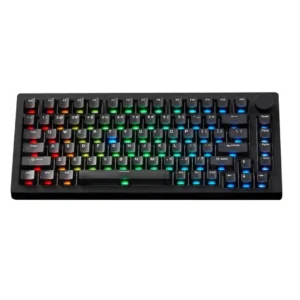
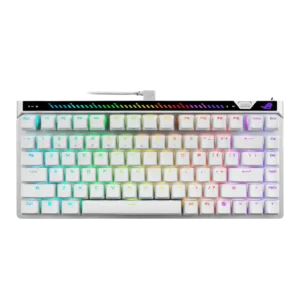
Reviewers generally liked the board's sound, describing it as pleasant, muted, clean, silent, or impressive, though one review found the stock sound somewhat pingy and hollow.
Reviews describe a controlled, mature sound that avoids the hollow, pingy character common on gaming boards, and one reviewer says it sounds better than expected.
Magnetic/TMR actuation was mostly described as predictable and controlled, with little accidental input in normal use; one reviewer only triggered accidental clicks at very sensitive test settings.
One review specifically calls out very consistent key response, supporting precise Hall-effect actuation behavior across the board.
Analog-style input is absent; one reviewer explicitly states that there is no analog mode here.
Lighting brightness was praised in some variants for strong vibrancy and diffusion, but one TMR review called the lighting not very bright and a weak point.
RGB backlighting is described as bright and evenly lit in the reviews that mention brightness directly.
Battery feedback was consistently strong, with reviewers citing 8,000 mAh capacity, long wireless use, and claims or experiences ranging from many hours to weeks between charges.
The reviews repeatedly describe the keyboard as premium, heavy, aluminum, solid, and well built, with only minor concerns about a loose-feeling shell or rapid-disassembly sensitivity in some units.
Across reviews, the keyboard is repeatedly described as solid, premium, and well assembled, with strong fit and finish.
Cable feedback was mixed: some reviews mention a spiral/coiled or nice-feeling USB cable, while others note non-braided, non-coiled, thick-fit, or not very durable cable issues.
One review says the included L-shaped cable works but looks awkward in a typical desk setup.
Compatibility is broad across devices, layouts, platforms, and switch types, including multi-device Bluetooth, Windows/Mac/Linux software access, and mechanical or magnetic switch support in TMR-focused reviews.
The web-based setup is praised for working across different computers, giving the board good multi-system flexibility.
Connectivity is a clear strength, with repeated support for USB-C, 2.4 GHz wireless, and Bluetooth, although Bluetooth polling and some wake or dongle details vary by review.
Connectivity is stable and fast over a wired connection, but several reviewers criticize the lack of any wireless option.
Customization is one of the strongest themes: reviewers cite included accessories, VIA/web software, rapid disassembly, switch/keycap changes, lighting, remapping, and internal modding access.
Customization is a major strength, with reviewers praising easy tuning for actuation, rapid trigger, mappings, and other settings.
The compact 75% layout gives the board a smaller footprint than full-size designs, while the heavy chassis keeps it stationary rather than easy to move around.
The 75% layout is repeatedly framed as compact while still preserving important keys, which helps desk efficiency.
Durability evidence centers on the aluminum case, PBT keycaps, built-to-last comments, and the ability to open, clean, maintain, and replace parts over time.
Durability looks strong from the available evidence, with wear-resistant keycaps and wear-free magnetic switch operation highlighted.
Reviewers found the board easy to open or modify, especially because of the ball-catch/rapid-disassembly design, with several reviews highlighting fast access compared with screw-heavy boards.
Switch swapping is supported, but reviewers note that compatible magnetic options are limited, which reduces modding freedom.
Ergonomics are mixed: reviewers liked the slanted or comfortable typing feel, but several disliked hidden mode switches, fixed typing angles, no adjustable feet, and occasionally awkward layout or cable access.
General comfort is good, but the rear touchbar gets mixed ergonomic feedback because some reviewers find it awkward to reach.
Gaming extras are extensive in the TMR/HE reviews, including Rapid Trigger, SOCD or snap key, DKS, mod-tap, toggle keys, and other advanced magnetic-keyboard features.
The board offers a rich competitive feature set, including rapid trigger, SOCD-style features, on-board controls, and fast tuning tools.
The aluminum frame is generally described as stable, heavy, tank-like, or desk-planted, though a few reviews note loose shell feel, uneven flex, or case-opening sensitivity.
Rigidity is a clear strength, with reviewers describing the chassis as solid and free from flex.
Gaming performance is strong overall, with reviewers citing responsive actuation, no meaningful performance limits, high polling, low latency, and fast magnetic-switch features.
Gaming performance is one of the clearest positives, with reviewers praising fast movement, precise control, and very responsive feel.
Hot-swap support is widely supported in the reviews, including replaceable switches, 3-pin/5-pin support, magnetic and mechanical switch compatibility, and easy switch experimentation.
Hot-swap support is present, but the practical upside is reduced by limited magnetic switch compatibility.
Keycap quality is generally positive, with PBT, double-shot, shine-through, frosted, and OEM-profile options praised, although some reviewers found certain caps too smooth, dull, or hollow-sounding.
Keycaps are consistently praised for their feel and quality, with multiple reviews highlighting PBT caps and solid finishing.
Responsiveness is a major strength in TMR/HE coverage, with reviewers citing low actuation settings, rapid key presses, quick registration, and responsive wired and wireless use; one VIA review noted plug-in lag.
Input response is described as immediate and controlled, giving the keys a very quick feel in play.
The only direct spacing/layout criticism came from the ISO sample, where the reviewer struggled with the small Shift key and chunky Enter key.
Key stability is praised across several reviews, with minimal wobble, stable stems, and stable keycaps or stabilizers noted repeatedly.
Key stability is strong in the reviews, with minimal wobble and solid larger-key behavior called out directly.
Latency evidence is positive, with reviews citing low millisecond results, acceptable latency, no lag, and gaming-focused speed and precision.
Wired performance is described as latency-free, matching the product’s competitive focus.
Layout support is positive overall, with 75% layout, ISO availability, layer remapping, and needed keys praised; one ISO sample had small-key layout complaints.
The 75% layout is widely praised for balancing compact size with useful extras like arrows, F-keys, and a small nav cluster.
Legend visibility varies by variant: reviewers found backlit or printed legends readable in some versions, while another praised segmented keycap labeling for easier visual spotting.
Legend styling is divisive: reviewers note clean alignment and shine-through support, but several dislike the aggressive ROG font.
Macro support is consistently supported through VIA or web software, with reviewers citing macro creation, recording, remapping, and multi-action gaming functions.
Macro and advanced mapping support are available through Gear Link, including macros and more advanced remap functions.
Materials quality is a standout strength, with repeated evidence for aluminum construction, premium weight, PBT keycaps, and high-quality materials.
Materials are generally well regarded, especially the metal top construction, though some reviewers still note mixed-material tradeoffs at this price.
The knob appears across many reviews as a major media/control feature, and several reviewers note that it can be reprogrammed, though one found its default usefulness limited.
Media control is well covered through the touch area and physical controls, though some users find the touchbar less intuitive than the wheel.
Noise depends heavily on switch and build choice: some reviewers found the board louder or pingier, while others described it as quieter, muted, deep, or very silent.
Noise control is a strength, with reviewers describing restrained acoustics and reduced ping or hollowness.
Onboard memory is directly supported in VIA/TMR coverage, with settings saved on the keyboard; one review noted no onboard storage for the 2.4 GHz dongle.
Lighting control is strongly supported through VIA/web software, per-key RGB references, south-facing LEDs, and per-key or software-level lighting adjustments.
Polling-rate support is a strong gaming point in TMR/HE reviews, with multiple mentions of 8K wired/wireless polling and lower Bluetooth polling on VIA models.
Polling rate support is a headline feature, with multiple reviews calling out the 8K capability.
Portability is weak because reviewers repeatedly describe the keyboard as extremely heavy, around 1.75-1.8 kg or over 4 lb, and poor for travel.
Portability is helped by the included carrying case, which reviewers call out as a useful travel extra.
Profile support appears in the web/software coverage, including quick profile switching, downloadable/shared profiles, created profiles, and onboard-stored settings.
Profiles can be stored in the cloud, giving the board practical profile management across multiple systems.
Rapid Trigger is strongly supported in TMR/HE reviews, with fine-grained 0.01 mm adjustments and repeated gaming-oriented praise.
Rapid Trigger support is heavily praised and positioned as one of the keyboard’s standout competitive features.
Reliability is mixed because one reviewer reported random volume ghost inputs and another said the rapid-disassembly case could open when moved, even though normal desk use was fine.
Reliability looks strong from the available evidence, with wear-free switch design and stable in-game performance both highlighted.
RGB customization is broadly available through VIA/web software, onboard shortcuts, preset effects, custom effects, profile lighting, and RGB programming.
RGB customization is well supported, with reviewers noting flexible lighting controls through both software and on-board inputs.
RGB quality is mixed by variant: many reviewers praised clean, vibrant, bright, flicker-free lighting, while others disliked dull lighting, blocked light, or charging-indicator behavior.
Lighting quality is generally praised, with reviewers calling the RGB well integrated, bright, and evenly lit.
The keyboard is consistently described as a compact or exploded 75% board with a knob, balancing desktop efficiency with a heavy premium chassis.
Reviewers repeatedly present the form factor as a sweet spot, offering compact dimensions without giving up everyday usability.
Software is capable but uneven: VIA/web tools offer broad remapping and customization, while reviewers also mention UI quirks, bugs, setup friction, and 2.4 GHz customization limits.
Gear Link is consistently viewed as a strong point: it is lighter, faster, and easier to live with than older Armoury Crate workflows.
Sound dampening is well supported by foam, silicone, gaskets, and spacebar treatment, reducing resonance, ping, and hollow spacebar sound in several reviews.
Internal dampening is a recurring positive, with multiple reviews pointing to layered foam and reduced resonance.
Stabilizer feedback is positive overall, with lubed stabilizers, minimal wobble, no excessive rattle, and rattle-free stock behavior noted across reviews.
Stabilizers are praised for low rattle and a solid feel on larger keys.
Switch feel is broadly praised as smooth, responsive, satisfying, stable, creamy, or quiet depending on the installed switches and variant.
Switch feel is widely praised for being smooth and controlled, though some reviewers find the feel lighter or less engaging than other HE options.
Switch flexibility is a standout strength, especially in TMR versions that can mix magnetic and mechanical switches and support multiple 3-pin/5-pin options.
ROG offers multiple compatible magnetic switch options, but reviewers still describe the overall ecosystem as limited.
Typing comfort is generally positive, with reviewers using it as a daily keyboard or calling it plug-and-play, though comfort depends on layout and typing-angle preferences.
Typing comfort is strong overall, with reviewers saying long sessions stay comfortable and low-fatigue once settings are dialed in.
Typing feel is generally strong, with reviewers describing smooth, soft, cushioned, satisfying, and impressive feel, though foam removal or personal switch preference can change the experience.
Typing feel is generally described as controlled, easy, and satisfying rather than harsh or sloppy.
Value is consistently positive at the cited prices, especially for buyers who value aluminum construction, wireless, customization, and gaming features; one review warned non-modders may pay for unused features.
Value is the biggest tradeoff: several reviewers like the board but still question the price against cheaper rivals.
Volume control is a common knob use case, with several reviews noting default volume control or reprogrammable knob behavior.
Volume adjustment is easy to access through the touch controls and related physical inputs.
Wireless performance is mostly positive, with stable dongle/Bluetooth use, no lag, low-latency claims, and efficient wireless behavior; Bluetooth wake or minor connection issues appear in some reviews.
Wireless performance is effectively absent because the board is wired-only and reviewers repeatedly call out the missing wireless option.
One reviewer specifically criticizes the lack of any included wrist rest at this price.