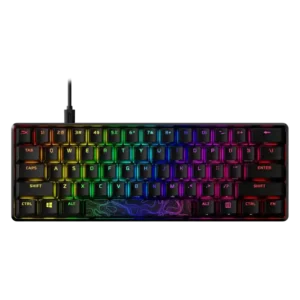
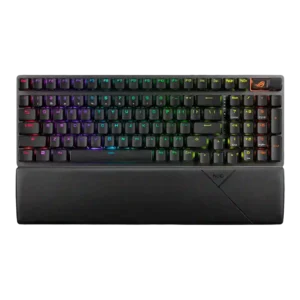
Sound impressions were mixed but generally acceptable: reviewers described satisfying thock or solid clack in some versions, while others noted louder mechanical noise, hollow tones, or stabilizer-related clatter.
Acoustics skew warm and polished, with several reviewers calling the board thocky, pleasant, or notably refined.
Testing and reviewer impressions consistently pointed to reliable key registration, with anti-ghosting, N-key rollover, and repeatable switch behavior supporting fast input without conflicts.
One reviewer specifically describes keystrokes as consistent and smooth, suggesting even, repeatable actuation.
Brightness was a standout strength, with multiple reviewers calling the RGB very bright, vivid, or adjustable across levels, though some noted color quirks with whites or red-tinted stems.
Brightness is a weak spot in at least one major review, which says the RGB stays dim even when maxed out.
Battery life is one of the board’s biggest advantages, with repeated 1,500-hour claims and strong real-world endurance reports.
Build quality was the most consistently praised area, with reviewers repeatedly describing the keyboard as premium, tank-like, sturdy, solid, and unusually well built for its price class.
Build quality earns repeated praise for feeling solid, premium, and sturdy rather than flimsy.
The detachable USB-C cable was widely appreciated for convenience and portability, but cable impressions were mixed because several reviewers found it stiff, rigid, or limited by recessed port fit.
The included USB-C cable gets positive notes for length, braiding, or standard connector usability.
Compatibility evidence covered consoles and operating systems, with reviewers noting support for PlayStation, Xbox, PC, and in one case major desktop operating systems, while software support remained more Windows-focused.
Compatibility is broad across devices and use cases, with support noted for phones, tablets, and multi-system setups.
The keyboard is consistently treated as a wired USB-C model with a detachable cable, which reviewers liked for travel, cleaning, and setup flexibility, despite no wireless mode.
Tri-mode connectivity is a standout strength, with wired, 2.4GHz, and Bluetooth all regularly highlighted.
Customization was described as broad in lighting and key behavior, but not universally frictionless; reviewers praised available options while noting software and design decisions could limit the experience.
Customization is one of the board’s strongest areas, spanning hot-swap support, remapping, lighting, and wheel functions.
Compact full-size, TKL, 60%, and 65% variants were repeatedly praised for preserving mouse room and improving desk layout, especially for gaming setups with large mouse movement.
Compared with full-size boards, the layout generally frees noticeable desk and mouse space.
Durability was supported by the 80 million keypress switch rating and repeated comments that the aluminum construction should hold up well through heavy or long sessions.
The keyboard is generally viewed as durable, with long-term confidence tied to its solid build and harder-wearing PBT materials.
Switch replacement was not a strength: one review mentioned visible or replaceable switches, but another noted desoldering would be needed, making practical replacement inconvenient.
Switch replacement is made approachable with included tools and straightforward puller-based access.
Ergonomics were mostly positive because reviewers liked the multi-angle feet and stable tilt positions, though several comfort concerns remained around missing wrist rests or compact layouts.
Magnetic wrist support and adjustable angles help ergonomics, especially over longer sessions.
Gaming extras centered on Game Mode, Windows-key disabling, anti-accidental key behavior, and shortcut-based controls rather than dedicated premium gaming buttons.
Gaming extras include preset capture and mic hotkeys plus other utility functions beyond standard typing duties.
Frame rigidity was a major strength, with reviewers repeatedly noting minimal flex, rock-solid stability, aluminum construction, and little movement during use.
The chassis is repeatedly described as sturdy and resistant to flex, helped by its weight and rigid top structure.
Gaming performance was consistently strong, with reviewers describing responsive switches, low-latency behavior, strong anti-ghosting/N-key rollover support, and comfortable use in fast-paced games.
Gaming performance is a major selling point, with reviewers reporting smooth play, quick response, and strong competitive usability.
Hot-swap support was not meaningfully present in the evidence; the clearest review evidence described the board as missing hot-swappable switches.
Hot-swap support is widely noted and makes the board more appealing to tinkerers and long-term owners.
Keycap quality varied sharply by model: later 60%/65% versions earned praise for PBT keycaps, while full-size/Core reviews often criticized ABS caps, oil pickup, shine, or average quality.
PBT and double-shot caps are consistently seen as a quality inclusion, with solid feel and reduced wobble.
Key responsiveness was a repeated strength, with reviewers describing fast, responsive, smooth, low-delay, and confidence-inspiring key presses for gaming and typing.
Multiple reviewers call the keys responsive in both gaming and general use, with quick return and no shaky presses.
Key spacing evidence was mixed by size: compact 60% layouts felt tight to one reviewer, while a 65% review found the keys did not feel cramped.
Key spacing is the main ergonomic compromise, with several reviews calling the board cramped until muscle memory adjusts.
Key stability was generally good, with reviewers mentioning little wobble, stable key feel, and enough keycap grip to keep fingers controlled.
Stabilizers and shorter-stem keycaps are credited with reducing wobble and keeping keystrokes stable across the board.
Latency evidence was favorable, including measured low latency, no noticeable lag, and one review calling input latency very low for fast-paced play.
Wireless performance is repeatedly described as very fast, with quoted sub-1ms figures and no noticeable lag in play.
Layout flexibility was strong across the product family, with evidence for full-size, TKL, 65%, and 60% options plus standard layouts or retained navigation keys depending on model.
The 96% layout preserves many full-size functions, but several reviewers call out awkward Delete or navigation positioning.
Legend visibility was generally good because shine-through legends and side-printed functions were visible, though one review noted some hotkey legends were not illuminated.
Legend readability can suffer in lower brightness conditions, especially on sub-legends or when backlighting is below mid-level.
Macro support was consistently available through NGENUITY or key remapping, with reviewers noting programmable keys, macro creation, and reassignment options.
Macro support is present both in software and, in some reviews, through on-the-fly recording.
Materials quality was one of the strongest areas, with repeated references to aluminum cases, premium shells, and solid construction across sizes.
Reviewers highlight the aluminum top, plastic lower shell, and internal foam or silicone layers as a thoughtfully chosen material mix.
Media controls were present mostly through Function-key shortcuts, but reviewers commonly missed dedicated media keys or a physical volume wheel.
The wheel and button combo covers media functions well enough, though at least one reviewer finds it only basically functional.
Noise level depended on switch and chassis: some reviewers found the board quieter or inoffensive, while others noted mechanical clack, annoying noise, or louder keys.
Noise is usually described as quiet for a mechanical keyboard, though one reviewer still wanted either more sound or true near-silence.
Onboard memory usually allowed up to three profiles or presets, but reviewers were split between appreciating the portability and criticizing sync limits or the low profile count.
Onboard memory is a real plus, allowing multiple profiles to be saved directly to the keyboard.
USB passthrough was a weakness: reviewers explicitly noted the lack or removal of USB pass-through or charging compared with other boards.
Per-key lighting control was well supported, with several reviews describing individual-key RGB adjustment, per-key customization, and individually lit keys.
Per-key lighting control is explicitly supported and seen as useful for both aesthetics and function-specific highlighting.
Polling-rate evidence was positive but limited, with testing and specs pointing to 1000 Hz behavior suitable for gaming response.
Reviews that measured or cited specs consistently point to a 1,000Hz polling rate, including over 2.4GHz.
Portability was a repeated strength for compact variants and detachable-cable designs, with reviewers mentioning travel, LAN use, backpacks, and easy transport.
Portability is mixed: some find it easy enough to carry, while others say the 96% body still feels too large to be truly portable.
Profile management was mixed: several reviews liked onboard profile switching, but others described sync failures, limited onboard slots, or confusing preset behavior.
Profile support is solid, with multiple reviews mentioning several onboard or software-managed profiles.
Reliability evidence was positive but limited, supported by one long-term two-year usage review and references to reliable switches.
At least one review explicitly calls wireless performance reliable, reinforcing the broader theme of stable day-to-day behavior.
RGB customization was widely available through presets, effects, layering, colors, and software, but reviewers often criticized limited effects, awkward layers, or software friction.
Lighting customization is broad, with effects, color control, sync, and detailed backlight settings available in software.
RGB lighting quality was highly praised overall, with reviewers describing bright, vivid, saturated, gorgeous lighting, though a few noted color-mixing imperfections.
RGB quality is mixed: some reviewers like the shine-through and power, while another finds it underwhelmingly dim.
Size and form factor were major strengths, with reviewers praising compact full-size, TKL, 60%, and 65% versions depending on desk-space and productivity needs.
The 96% form factor is praised for fitting a numpad into a smaller footprint, even if it is not tiny by compact-board standards.
Software quality was the most consistent weakness, with reviewers citing sync issues, Windows Store friction, limited effects, unintuitive controls, installation problems, or basic functionality.
Armoury Crate offers useful controls, but reviewers repeatedly criticize detection issues, slow updates, clutter, or general friction.
Sound dampening evidence was mixed: some reviewers liked the lack of ping, while others noted no foam or only modest case-ping control.
Foam, pads, and other dampening layers clearly reduce ping, echo, and hollowness according to multiple reviews.
Stabilizer quality was inconsistent, ranging from mostly good or acceptable to squeaky, rattly, or under-lubed depending on the reviewed model.
Lubricated stabilizers are a meaningful strength, helping cut friction, wobble, and larger-key noise.
Switch feel was widely praised, especially HyperX Red and Aqua switches, with reviewers describing smooth travel, satisfying feel, and balanced gaming/typing response.
The NX Snow switches are widely praised for a smooth, satisfying feel, though preferences still vary between linear and clickier styles.
Switch options were good across the family with Red, Aqua, and Blue variants mentioned, though availability varied by size and some compact versions were more limited.
The board is sold with Snow and Storm switch variants, letting buyers choose between smoother linear or clickier tactile-feeling options.
Typing comfort was mixed: reviewers liked the feel and angles, but compact layouts, low actuation, and missing wrist rests created adjustment or soreness issues for some users.
Comfort is a repeated positive, with several reviewers saying it stays easy on the hands for long typing or gaming sessions.
Typing feel was generally positive, with reviewers praising smooth, satisfying, or comfortable key action, although some preferred tactile or Cherry-style alternatives.
Typing feel is a recurring strength, with reviewers describing it as pleasant, refined, or exceptional out of the box.
Value was broadly positive, with reviewers often calling the board fair, competitive, or unusually premium for its price, while still noting software and feature tradeoffs.
Value is good for an enthusiast-grade wireless gaming keyboard, but reviewers still acknowledge the price is firmly premium.
Volume control was a recurring limitation on the full-size models because reviewers missed a dedicated dial or wheel, though shortcut-based volume control was available.
Dedicated wheel-based volume control is repeatedly mentioned as quick and convenient.
Wireless performance was effectively absent: the reviewed models were wired-only, and reviewers explicitly noted no wireless mode or multi-device wireless use.
Wireless performance is consistently praised as stable, fast, and interruption-free in 2.4GHz mode.
Wrist-rest support was weak because the board generally did not include one; reviewers mentioned optional separate wrist rests or recommended buying one for comfort.
Wrist rest feedback is mixed but mostly positive: it is comfortable and magnetic, though some find it stiff.