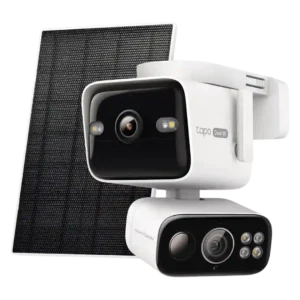
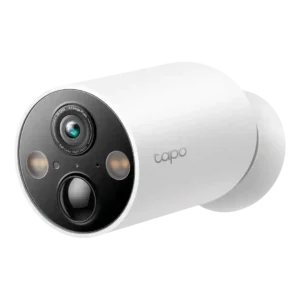
The app exposes practical controls for detection types, sensitivity, motion zones, activity zones, notifications, storage settings, and tracking behavior. Reviewers found the controls useful, though advanced notification controls are not perfect.
Controls are deep for a budget camera, with settings for resolution, fps, night modes, sensitivity, retrigger timing, privacy, and spotlight behavior. Several reviewers called the feature set surprisingly comprehensive once configured.
The pan/tilt lens offers wide mechanical movement and tracked a sprinting reviewer almost the entire time. Extreme close, fast motion can briefly exceed the motor speed.
Audio is mixed. One hands-on reviewer found the recordings tinny and wind-sensitive, while another noted that two-way audio worked well during setup.
Two-way audio is generally described as usable to clear, and several tests found voices understandable. A few noted lag or a weaker speaker compared with premium systems.
Battery performance is a strength across reviews. Claims and hands-on testing point to long standby, useful solar replenishment, and meaningful charge recovery even under heavy settings.
Battery life is highly situational: light-traffic areas can last many months, while high-traffic placements may need monthly-ish charging. Pairing the solar panel can dramatically extend uptime and reduce maintenance.
The physical build was described as solid during setup. No reviewer raised a general build-quality concern, though theft protection depends on installation and alarm setup.
Build quality is often described as premium-feeling and sturdy, with a sealed design suited for outdoor use. A few criticisms focus more on mounting accessories than the camera body itself.
Cable management is helped by the included long USB-C extension cable and weatherproof cabling. Reviewers could place the panel away from the camera while keeping the setup clean.
Storage value is favorable because core use does not depend on a paid plan. Cloud storage is optional, while local microSD and Tapo hub options reduce subscription pressure.
Tapo Care is positioned as optional and relatively low-cost, adding rich notifications, snapshots, smart sorting, and roughly 30 days of cloud history. If you want those premium notification features, a plan is generally required.
Color output at night was described as crisp and balanced in testing, especially when comparing infrared and color night-vision modes.
Daytime color is generally well-saturated, while night color tends to lose pop and detail. Reviewers often preferred black-and-white IR for clarity when it is truly dark.
Connectivity was praised in the off-grid review, where the camera held signal well on Starlink. Other reviews confirm 2.4GHz and 5GHz Wi-Fi support.
The camera typically connects directly to Wi-Fi, which simplifies setup and avoids a base station for the MagCam. Connection quality is mostly solid, but a few accounts mention occasional flakiness or the need for good signal strength.
Continuous capture is supported, but it is closer to interval snapshot capture than full wired-camera-style video. Reviewers still found it useful for daily timelines and reducing missed events.
The two-lens tracking design is a major strength. Multiple reviews describe the fixed lens detecting motion while the moving lens tracks the subject for more context and detail.
Custom activity zones are supported and used to narrow where alerts fire, helping reduce irrelevant activity from streets or nearby areas.
Motion zone tools are robust, including multiple zones and the ability to tune zones by detection type in several reviews. This makes it easier to ignore roads, trees, or neighbors while keeping the areas that matter.
Detection features are broad and well regarded. Reviews mention people, pets, vehicles, on-device AI, and hands-on testing where events were consistently detected.
Detection features are comprehensive for the price, including motion sensing, subject detection categories, and deterrence options like lights and alarms. Most reviewers found detection useful and generally dependable after tuning.
Detection range is strong for an outdoor battery camera. Reviews cite up to 60 feet in product coverage and hands-on nighttime detection beyond 30 feet.
Detection range varies with placement and sensitivity, but one hands-on test found person detection topping out around 20 feet. It can work well for entryways yet may feel short for larger yards.
Zoom is useful but not perfect. Reviews cite 18x or nearly 11x digital/telephoto zoom and tap-to-zoom, while one reviewer noted that AI zoom is digitally applied in-app rather than changing downloaded footage.
Digital zoom can help inspect details, but clarity drops quickly at higher zoom levels because it is fully digital. One reviewer wanted a simpler zoom solution instead of relying on privacy masking for framing.
Dual-band Wi-Fi support is repeatedly confirmed, including 2.4GHz and 5GHz operation. One review specifically valued 5GHz for reducing network congestion from Wi-Fi cameras.
This camera line is commonly described as 2.4GHz-only Wi-Fi, which can improve range but removes the option of 5GHz. If your network is crowded, this can affect stability in some homes.
The dual-camera design is the defining feature. Reviewers repeatedly highlight the combination of a fixed wide lens with a separate tracking lens, giving both context and close-up detail.
Dual-stream recording is supported through separate 4K views. Reviewers mention two 4K recordings and simultaneous full-scene plus close-up coverage.
Durability testing was positive: one reviewer left the camera outside in minus 20 Celsius weather with no issues, and the camera is described as weatherproof.
Noise handling is a weakness. One reviewer specifically reported wind sensitivity and a lot of wind noise in recordings.
Event recording reliability tested very well. One reviewer found every event captured during a two-week test, and another described the camera as one of the few options that consistently worked.
Event capture is usually reliable for deliveries and visitors, but a few missed events were noted in edge cases like snow changes or approach angles. Fine-tuning sensitivity, retrigger time, and buffers helps reduce misses.
False alert filtering is generally helpful, but not flawless. Reviews mention fewer noisy alerts and onboard filtering, while one hands-on test found some vehicle events were also classified as motion.
Smart filtering by person/pet/vehicle is frequently accurate and helps cut down nuisance alerts. Occasional misclassification or sensitivity tuning may be needed depending on the scene.
Field of view is excellent. Several reviews cite a 169-degree or 169.7-degree wide view, and reviewers frame it as useful for broad yard or driveway coverage.
The wide 150-degree view covers a lot of property, which many reviewers loved for all-in-one coverage. A few found it too wide, with a fisheye-like look and extra areas outside their property in frame.
The spotlights are bright enough to affect full-color night mode and deterrence. One reviewer called even the first brightness level huge.
Frame rate is acceptable but not exceptional. One reviewer noted 15 fps at night and warned that very fast movement can blur.
Frame rate is configurable (often 15–30 fps depending on mode), and higher settings can make motion look smoother. Expect a battery hit when you push the camera to maximum quality and fps.
HomeKit support is limited. A reviewer got Apple-related routing working through Home Assistant, but also noted there was no direct integration for that path.
HomeKit support is repeatedly called out as missing for this lineup, which is a dealbreaker for Apple-first setups. Reviewers commonly suggest alternative brands if HomeKit is required.
A hub is optional rather than mandatory. Reviews mention direct microSD recording and also describe the Tapo H500 as an add-on that provides local storage and Wi-Fi backup.
The MagCam itself is described as hub-free in multiple reviews, but a related Tapo wire-free kit uses an included hub for its cameras. This can create confusion across the lineup, so verify the exact model and bundle.
Automation performance is strong when routed through supported systems. One reviewer measured near-zero delay, while also noting that some workarounds may be needed.
IFTTT support and Tapo ecosystem automations are highlighted as a strength, enabling reliable triggers to control other smart devices. This adds flexibility beyond basic alerts.
Included accessories are generous. Reviews mention the solar panel, extension cable, mounting hardware, anchors, screws, and related installation pieces.
Packages typically include the magnetic mount, a metal plate, screws/anchors, templates, and a charging cable/adapter. A microSD card is usually not included, and some bundles add extra components like a hub.
Installation is straightforward. Reviews describe a simple bracket/click-in process and a setup that can be completed without running power wires.
No summary yet.
Local storage is one of the strongest features. Reviews repeatedly note microSD support, local recording without cloud dependence, and continued recording even when Wi-Fi or internet status changes.
Local microSD recording is a major advantage, letting you avoid subscriptions and keep clips on-device (microSD is usually user-supplied). Some reviewers hit SD setup or formatting friction, and one kit stores locally via its hub instead of the camera.
Low-light performance is a major strength. Reviewers mention starlight sensors, clear nighttime footage, and strong performance even when the camera is placed farther back.
Low-light performance is the main image tradeoff: distance detail softens and high-contrast scenes can be challenging without HDR. It is generally fine for near-field monitoring but not ideal for long-range identification in darkness.
Microphone sensitivity is mixed. It picked up voices from distance in one setup, but another reviewer found the recordings too sensitive to wind.
Microphone pickup is a highlight in some reviews, capturing voices and ambient sounds clearly. It tends to be good enough for porch conversations and deliveries.
The mobile app is generally reliable and easy to use. Reviewers said live view loaded quickly, pairing was smooth, and the app layout was easy to navigate.
The app is feature-rich, but reliability is mixed: several reviewers had smooth day-to-day use, while others reported setup headaches, low-battery prompts, or occasional control glitches. After initial configuration, the experience often improves.
Mounting flexibility is strong because the camera is wireless, solar-assisted, and has a tracking lens that can be aimed after installation. Cable length also helps panel placement.
The magnetic mount and tripod thread provide lots of aiming and placement options, and removal for charging is quick. Adhesive-only mounting can fail outdoors over time, and extreme angles can stress the magnetic hold in some setups.
Night vision is consistently praised. Reviews mention infrared, full-color, and color night vision, with hands-on tests showing strong night footage.
Black-and-white IR night clips are often described as crisp and evenly lit at close-to-medium distances. Color night vision can look murkier and benefits from ambient light or the built-in spotlights. IR night vision is usable up close but detail drops as subjects move farther away, especially past roughly 25 feet in some tests. Range is acceptable for porches and near-yard monitoring, less so for deep yards.
Notification management has caveats. Notification speed is good, but one reviewer wanted snooze alerts and custom notification sounds, and rich notification snapshots require a subscription.
Notification scheduling and tuning options are available, and users can adjust how often alerts arrive. Advanced behaviors like geofencing are noted as missing by at least one reviewer.
Notification speed is strong. Reviews mention faster alerts from local processing, less-than-a-minute notification timing, and lightning-fast smart-home responses.
Notifications are typically fast, with many reviewers describing near-instant alerts. Rich notifications and previews may add a slight delay and generally require a subscription.
On-device features are useful but not complete. The camera includes smart detection and local processing, but one test noted it lacks a physical tamper switch.
On-device AI is a strength. Reviews describe local processing, on-camera smart detection, and AI that recognizes people, pets, vehicles, or other events without relying on cloud processing for basics.
On-device subject recognition for people, pets, and vehicles is widely praised and helps reduce generic motion noise. Accuracy is generally strong, though performance still depends on placement and sensitivity settings.
At least one reviewer noted RTSP/NAS options for local network storage, but it is not emphasized consistently across all reviews. Treat it as a potential bonus feature rather than the primary storage path.
Cold-weather performance was proven in testing when the camera handled minus 20 Celsius weather without issues.
Battery power is practical because the camera has a large built-in rechargeable battery and can also be topped up through USB-C or the included solar panel.
A large built-in battery enables long runtimes without wiring, but real-world longevity depends heavily on traffic, settings, and spotlight use. Recharging usually means taking the camera down, which the magnetic mount makes easier.
Solar power is one of the clearest strengths. Reviews mention autonomous placement, quick charging from sunlight, and hands-on testing where the panel charged the camera substantially per day.
The optional solar panel can keep the battery topped up and, in sunny placements, maintain very high charge levels for months. It adds cost and can be visually bulky, but it minimizes maintenance.
Pre-event coverage is improved by continuous capture snapshots. Reviews describe interval captures from 1 to 60 seconds and note that this helps reduce missed beginnings of events.
Recording options include buffers and adjustable clip length in the app, letting you trade battery for more context. Even with tuning, clips can still skew short compared with always-on wired cameras.
Value is favorable for the feature set but not cheap. Reviews cite a price around $199 to $229.99, while one reviewer called it not a bad deal and another noted it is well over $200.
Value is one of the strongest themes: reviewers repeatedly compare the feature set favorably against more expensive cameras. The main compromises are HDR absence, some low-light distance limits, and occasional app quirks.
Privacy zones are available and useful for masking neighbors or streets, but usability feedback is mixed. One reviewer found privacy masking clunky and occasionally misaligned with the live view.
PTZ performance is mostly strong. Reviews praise 360-degree tracking, quiet pan/tilt movement, and manual control, though extreme close fast motion can briefly outrun the motor.
Recording start lag appears low in hands-on testing. One reviewer said motion was detected already before the walking-toward-camera test could fully begin.
Start-of-clip timing is usually strong for a battery camera, with at least one reviewer praising extra seconds that capture what happened. Another reviewer noted late triggers when motion approaches head-on, tied to limited detection distance.
The camera is physically large compared with smaller Tapo models. That size supports powerful hardware, but buyers should expect a noticeable outdoor unit.
Smart-home integration is useful but uneven. Amazon integration was praised, Alexa and Google Assistant support were cited, while direct HomeKit/Home Assistant support was not available without workarounds.
Works with Alexa and Google Assistant for live viewing on compatible displays in most accounts, and Alexa routines can react very quickly. A few reviewers reported occasional hiccups with Google casting or smart display loading.
Accessory and platform compatibility is solid for Amazon, Google, and SmartThings-related setups. Apple/HomeKit-style workflows require workarounds rather than direct support.
Speaker and talk-back functions are usable. Reviews mention two-way audio and the ability to talk back through the camera, plus siren/alarm functions elsewhere.
Speaker output ranges from adequate to loud, with siren/alarm features acting as a deterrent. Some reviewers found the speaker slightly weak or the siren not the loudest in the category.
Spotlight and deterrent features are strong. Reviews mention built-in spotlights, full-color night vision, and red/blue warning or alarm lights.
Spotlights enable color night vision and can flash or illuminate as a deterrent, with brightness controls in the app. They do not throw light very far and can overexpose faces up close if the subject is in the wrong distance band.
Streaming and live access appear reliable. Reviews mention quick live view loading, monitor streaming when smart motion is detected, and local recordings remaining accessible through hub-style backup.
Live view commonly loads in about 2–4 seconds and then stays stable, with low latency noted in some long-form testing. A minority reported occasional slow loads, spinning screens, or sporadic Wi-Fi flakiness.
System scalability is strongest inside the broader Tapo ecosystem. The H500 hub was described as adding value to every Tapo camera owned.
Video detail is a major strength. Reviews repeatedly cite dual 4K recording, full 4K resolution on both lenses, and clear footage.
Crisp 2K video is a consistent strength and is usually sharp enough to identify faces at typical porch/driveway distances. It does not match pricier flagships in harsh lighting, and the lack of HDR can leave bright areas blown out.
Weather resistance is well supported. Reviews cite IP65 or IP66 protection, outdoor mounting, and performance in rain, dust, snow, and cold conditions.
Weather resistance is a strong point, commonly cited as IP66 for the camera and generally holding up through rain and cold. Some related kits carry IP65, but overall durability in the elements is well-regarded.