If you want better Echo/noise cancellation
Choose Eufy EufyCam S3 Pro Security Camera. It scores 4.4 vs 2.4 for Echo/noise cancellation, with a 4.2 overall score.
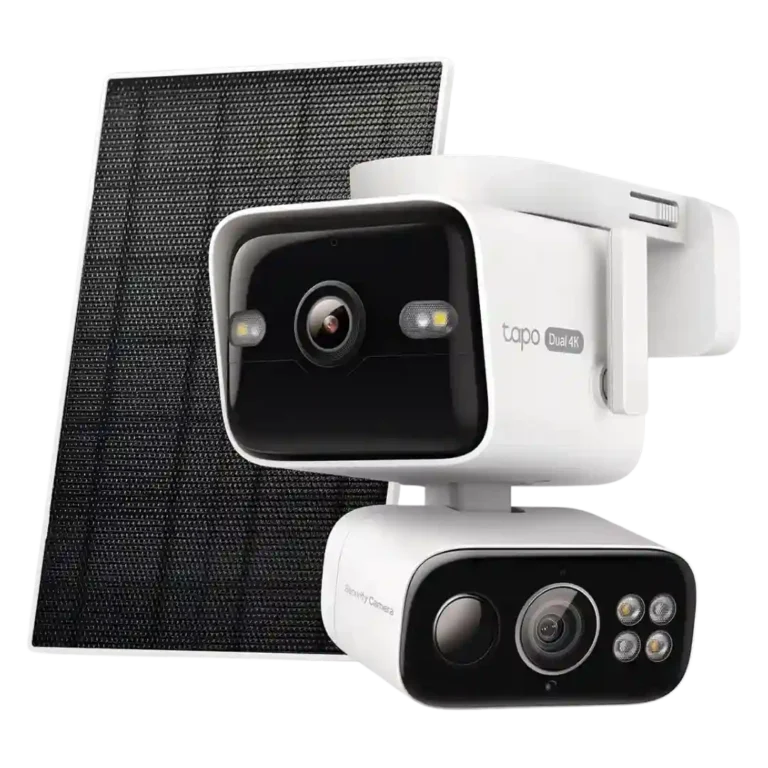
Choose the Tapo C675D for wide outdoor coverage, fast tracking, solar power, and local storage. Skip it if clean audio, direct HomeKit support, compact size, or richer notification controls matter most.
Best for larger yards, driveways, gates, homesteads, and off-grid setups where wide coverage, tracking, solar power, and local recording matter most.
Not ideal for buyers who need a compact camera, crisp wind-resistant audio, direct HomeKit support, or advanced notification controls without workarounds.
Review evidence points to the Tapo C675D as a strong outdoor camera for large yards, driveways, and off-grid setups. Reviewers repeatedly praise the dual-lens approach: the fixed wide view keeps context while the tracking lens follows motion, and multiple tests found clear 4K footage, strong night performance, reliable event capture, and useful local recording. The biggest tradeoff is that its ambitious design brings some rough edges: one reviewer disliked the missing default guard position and notification controls, audio was called tinny and wind-sensitive, and direct HomeKit support was absent. Solar charging and the large battery earned especially strong marks, but the camera is also physically large and its continuous capture is not full-frame wired-style 24/7 video.
Compared with other Surveillance Cameras, this product is above average in Recording start-time lag, PTZ (pan/tilt/zoom) control responsiveness, Cable management, near average in App controls and settings, Microphone sensitivity, below average in Audio recording quality, Echo/noise cancellation, Notification management.
| Attribute | This product | Category average | Difference |
|---|---|---|---|
| Recording start-time lag | 4.9 | 3.4 | +1.5 |
| Audio recording quality | 2.5 | 4.0 | -1.5 |
| Echo/noise cancellation | 2.4 | 3.7 | -1.3 |
| PTZ (pan/tilt/zoom) control responsiveness | 4.7 | 3.4 | +1.2 |
| Notification management | 2.7 | 3.9 | -1.2 |
| Size and footprint | 2.5 | 3.7 | -1.2 |
| Cable management | 4.5 | 3.4 | +1.1 |
| Continuous recording capability | 4.2 | 3.3 | +0.9 |
Choose Eufy EufyCam S3 Pro Security Camera. It scores 4.4 vs 2.4 for Echo/noise cancellation, with a 4.2 overall score.
Choose Eufy S340 Solar Camera. It scores 4.0 vs 2.5 for Audio recording quality, with a 4.0 overall score.
Choose Reolink Altas PT Ultra 4K Solar Security Camera. It scores 4.5 vs 3.3 for Cloud storage plan value, with a 4.0 overall score.
Choose Eufy S330 4K Solar Camera (eufyCam 3). It scores 5.0 vs 2.7 for Notification management, with a 4.3 overall score.
Products reviewers directly compared with this model, grouped into quick takeaways.
Yes. Reviewers praised the fixed wide lens, tracking lens, and dual-camera design for covering large yards and reducing blind spots.
Yes. Reviewers described the footage as clear, said it held up, and praised the 4K detail from both lenses.
Night performance was one of the strongest areas. One hands-on reviewer said the infrared and color night vision looked crisp and balanced.
The reviews highlight local microSD recording and subscription-free core use. One review noted cloud storage can still be useful if local storage fills quickly.
Audio was a weak point in one hands-on review, where recordings were described as tinny and sensitive to wind noise.
Direct HomeKit integration was not available in the review evidence. Automation was still possible through workarounds, but that adds setup complexity.
These are a few of the reviews included in our analysis.




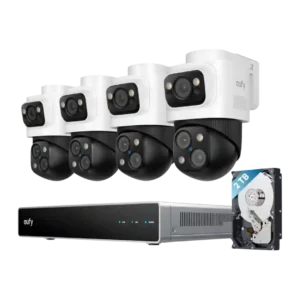
Choose the S4 Max for serious wired security, local AI, sharp 4K footage, and strong tracking. Skip it if you need easy wireless setup, broad smart-home integration, or a budget...
Pros: Detection range, Recording start-time lag
Cons: ONVIF/RTSP support, HomeKit integration
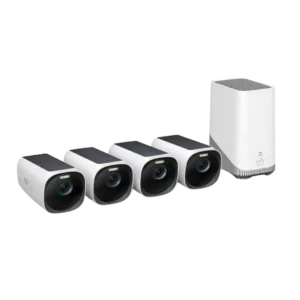
Choose the Eufy S330 if you want sharp 4K outdoor video, solar charging, local storage, and strong AI without monthly fees. Skip it if you need HomeKit/IFTTT, 24/7 recording, or...
Pros: Cloud storage plan value, Weather resistance rating (IP code)
Cons: Recording start-time lag, Pre-event recording length
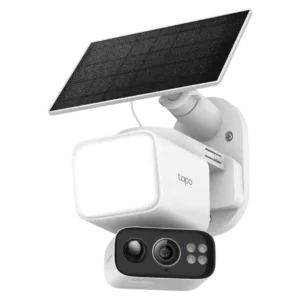
Best for solar-powered, wire-free yard coverage with strong value and bright lighting. Skip it if you need flawless app reliability, true continuous video, or premium low-light tracking.
Pros: Speaker volume, Lens distortion correction
Cons: Field of view, Detection range
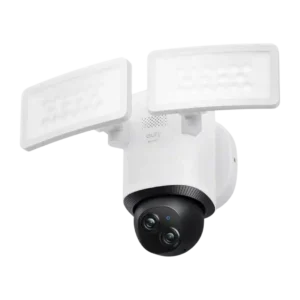
Choose the Eufy E340 for bright hardwired floodlight coverage, sharp dual-lens video, local storage, and no required subscription. Skip it if you need HomeKit, battery power, or the smallest outdoor...
Pros: Cloud storage plan value, Dual-band (2.4/5GHz) performance
Cons: HomeKit integration, ONVIF/RTSP support