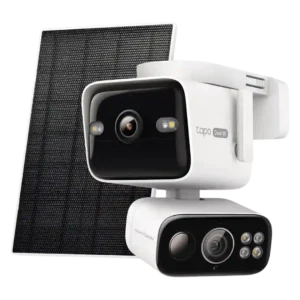
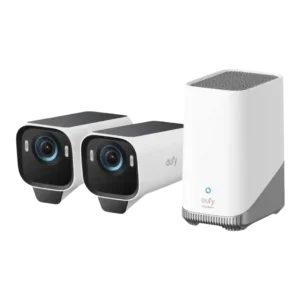
Average score
P1
Product 1: Tapo C675D
4.2
P2
Product 2: Eufy EufyCam S3 Pro Security...
4.2
App controls and settings
P1
Product 1: Tapo C675D
3.9
Reviewers liked the app’s easy layout, but one hands-on reviewer flagged missing guard-home/default position controls.
P2
Product 2: Eufy EufyCam S3 Pro Security...
4.5
The app and controls were broadly praised for being feature-packed, customizable, intuitive, and responsive.
Articulation range
P1
Product 1: Tapo C675D
4.4
The fixed lens and adjustable mount were praised for letting the camera cover a wider monitoring area.
P2
Product 2: Eufy EufyCam S3 Pro Security...
4.6
Articulation and aiming flexibility were praised in one review that found the mounting hardware easy to aim exactly where needed.
Audio recording quality
P1
Product 1: Tapo C675D
2.5
Audio recording drew criticism in testing, with recordings described as tinny.
P2
Product 2: Eufy EufyCam S3 Pro Security...
3.7
Audio quality was mixed: several reviewers heard clear two-way talk or voice recording, while others found the app audio mediocre or difficult to understand.
Battery life
P1
Product 1: Tapo C675D
4.5
Battery life was viewed positively, especially with solar assistance and ordinary use not quickly draining the unit.
P2
Product 2: Eufy EufyCam S3 Pro Security...
4.7
Battery life was a strong point, with reviewers reporting long runtime, strong solar-assisted charging, and very low maintenance.
Build quality
P1
Product 1: Tapo C675D
4.2
The physical build received a positive hands-on impression as solid.
P2
Product 2: Eufy EufyCam S3 Pro Security...
4.6
Build quality was praised across reviews, with solid mounts, premium feel, and tidy design language.
Cable management
P1
Product 1: Tapo C675D
4.5
Cable length was praised because it allowed a clean solar-panel setup without needing the extension cable.
P2
Product 2: Eufy EufyCam S3 Pro Security...
4.5
Cable handling was helped by wireless placement and flexible solar-panel cable positioning.
Cloud storage plan value
P1
Product 1: Tapo C675D
3.3
Cloud storage was treated as optional, but one reviewer noted a tradeoff where local storage could fill quickly for some features.
P2
Product 2: Eufy EufyCam S3 Pro Security...
4.6
Cloud-plan value was framed positively because reviewers emphasized avoiding recurring subscriptions and saving the usual annual fee burden.
Color accuracy
P1Product 1: Tapo C675D
No score yet
P2
Product 2: Eufy EufyCam S3 Pro Security...
4.8
Color accuracy was praised for natural, accurate hues rather than boosted or washed-out night footage.
Connectivity options
P1
Product 1: Tapo C675D
4.8
Connectivity was praised in an off-grid setup, with the camera holding signal better than many tested alternatives.
P2
Product 2: Eufy EufyCam S3 Pro Security...
2.7
Connectivity options were a concern where reviewers disliked dependence on Wi-Fi, connection limits, and the lack of fallback when Wi-Fi is unavailable.
Continuous recording capability
P1
Product 1: Tapo C675D
4.2
Continuous capture was viewed as useful, though evidence frames it as interval snapshots rather than full wired-style video.
P2
Product 2: Eufy EufyCam S3 Pro Security...
3.9
Continuous recording improved after firmware and worked in wired mode, but long-term reviewers noted it is limited to powered operation.
Cross-camera tracking
P1
Product 1: Tapo C675D
4.6
Cross-camera tracking was praised for keeping movement in frame and letting the tracking lens follow across the scene.
P2
Product 2: Eufy EufyCam S3 Pro Security...
4.7
Cross-camera tracking was repeatedly praised as practical and seamless for combining multi-camera movement into one easier event timeline.
Customizable motion zones
P1
Product 1: Tapo C675D
4.4
Activity zones were described as useful for reducing alerts from streets or neighboring activity.
P2
Product 2: Eufy EufyCam S3 Pro Security...
4.6
Reviewers liked the ability to customize motion zones because it helps reduce unwanted triggers and tailor coverage areas.
Detection features
P1
Product 1: Tapo C675D
4.5
Detection features were consistently praised for well-rounded smart detection and fewer unnecessary alerts.
P2
Product 2: Eufy EufyCam S3 Pro Security...
4.3
Detection features were broadly positive, including AI detection, facial recognition, and accurate analytics, though one reviewer saw little practical difference from radar.
Detection range
P1
Product 1: Tapo C675D
4.5
Detection range looked strong in hands-on testing, including detecting from behind and to the side of the camera.
P2
Product 2: Eufy EufyCam S3 Pro Security...
4.4
Detection range was strong enough to catch movement around 40 feet away and even distant street activity, though that sensitivity required tuning.
Digital zoom clarity
P1
Product 1: Tapo C675D
3.7
Digital zoom was useful but somewhat qualified, with tap-to-zoom and in-app zoom working acceptably rather than impressively.
P2
Product 2: Eufy EufyCam S3 Pro Security...
4.6
Digital zoom was praised for preserving usable detail, including text, license plates, and close-in identification.
Dual-band (2.4/5GHz) performance
P1
Product 1: Tapo C675D
4.5
Dual-band Wi-Fi was praised because 5 GHz can reduce network strain from multiple cameras.
P2Product 2: Eufy EufyCam S3 Pro Security...
No score yetDual-camera design
P1
Product 1: Tapo C675D
4.8
The dual-camera design was one of the strongest positives, solving the wide-view versus close-up tradeoff and covering motor blind spots.
P2
Product 2: Eufy EufyCam S3 Pro Security...
4.8
The two-camera kit was praised for covering property well and making multiple cameras feel like one coherent system.
Dual-stream recording
P1
Product 1: Tapo C675D
4.8
Dual-stream recording was praised because the two lenses produce separate 4K recordings rather than one stitched image.
P2Product 2: Eufy EufyCam S3 Pro Security...
No score yetDurability
P1
Product 1: Tapo C675D
4.5
Durability was praised after the camera was characterized as tough in stress testing.
P2
Product 2: Eufy EufyCam S3 Pro Security...
4.8
Durability looked strong in both short-term stress testing and long-term outdoor use.
Echo/noise cancellation
P1
Product 1: Tapo C675D
2.4
Noise handling was a weak point, with wind noise clearly noted in recordings.
P2
Product 2: Eufy EufyCam S3 Pro Security...
4.4
Noise reduction was generally positive, reducing background noise and improving voice clarity.
Event recording reliability
P1
Product 1: Tapo C675D
4.9
Event recording reliability was excellent in the strongest test evidence, with every checked event captured and recorded.
P2
Product 2: Eufy EufyCam S3 Pro Security...
4.6
Event recording reliability was strong overall, with reviewers reporting consistent performance, stable app access, and quick motion detection.
False alert filter effectiveness
P1
Product 1: Tapo C675D
3.8
False-alert filtering helped reduce noise, though one test noted minor misclassification of some events.
P2
Product 2: Eufy EufyCam S3 Pro Security...
4.7
False alert filtering performed well overall, with radar/PIR and AI helping reviewers avoid false alarms from branches, shadows, or non-relevant motion.
Field of view
P1
Product 1: Tapo C675D
4.8
Field of view was praised for covering almost an entire backyard from one fixed lens.
P2
Product 2: Eufy EufyCam S3 Pro Security...
4.5
One reviewer liked the wide 135-degree view as generous enough to cover a broader area.
Firmware update frequency
P1
Product 1: Tapo C675D
4.0
Firmware updating received a positive note because the setup prompted auto update.
P2
Product 2: Eufy EufyCam S3 Pro Security...
3.7
Firmware was mixed: one update added needed 24/7 recording after launch, while another reviewer noted live-feed slowdowns were usually fixed by software updates.
Floodlight brightness
P1
Product 1: Tapo C675D
5.0
Floodlight brightness was praised as very strong in night testing.
P2
Product 2: Eufy EufyCam S3 Pro Security...
3.0
The built-in light was useful but not a full floodlight replacement according to one reviewer.
Frame rate
P1
Product 1: Tapo C675D
3.2
Frame rate was a caveat: the reviewer noted blur could appear with very fast movement.
P2
Product 2: Eufy EufyCam S3 Pro Security...
2.5
The main frame-rate criticism is that the low 15 fps ceiling can make motion look blurry or choppy.
HomeKit integration
P1
Product 1: Tapo C675D
2.0
HomeKit integration was a clear limitation because direct HomeKit support was not available in the review evidence.
P2
Product 2: Eufy EufyCam S3 Pro Security...
3.9
HomeKit support was widely welcomed and often reliable, but reviewers repeatedly noted the 1080p HomeKit resolution cap as a major tradeoff.
Hub requirement
P1
Product 1: Tapo C675D
4.5
A hub was not treated as required; the camera could be used on its own with local recording.
P2
Product 2: Eufy EufyCam S3 Pro Security...
2.6
The HomeBase requirement was mixed to negative because it enables local storage and AI but adds required hardware and sometimes caused setup/network friction.
IFTTT/automation compatibility
P1
Product 1: Tapo C675D
4.0
Automation was powerful but not seamless, with workarounds needed for some setups.
P2Product 2: Eufy EufyCam S3 Pro Security...
No score yetIncluded accessories
P1
Product 1: Tapo C675D
4.2
Included accessories were viewed positively, especially the generous cable length.
P2
Product 2: Eufy EufyCam S3 Pro Security...
4.6
Included accessories were praised for useful mounting hardware and an external solar-panel option.
Installation and Mounting
P1
Product 1: Tapo C675D
4.3
Installation was generally praised as simple and clean, with multiple reviewers calling the mounting process easy.
P2
Product 2: Eufy EufyCam S3 Pro Security...
4.6
Installation was one of the most consistent positives, with reviewers describing setup and mounting as easy, simple, painless, and fast.
Lens distortion correction
P1Product 1: Tapo C675D
No score yet
P2
Product 2: Eufy EufyCam S3 Pro Security...
4.3
The wide lens was praised for avoiding heavy barrel distortion while still covering a broad scene.
Local storage option convenience
P1
Product 1: Tapo C675D
4.7
Local storage was a major strength, praised for simplicity, local recording, and avoiding cloud dependence.
P2
Product 2: Eufy EufyCam S3 Pro Security...
4.8
Local storage was a major strength because reviewers valued avoiding mandatory cloud fees and keeping recordings on the HomeBase.
Low-light performance
P1
Product 1: Tapo C675D
5.0
Low-light performance was exceptionally strong in testing, with the reviewer struggling to find anything to criticize.
P2
Product 2: Eufy EufyCam S3 Pro Security...
4.8
Low-light image quality was repeatedly praised for staying detailed and color-rich after dark without relying only on bright lighting.
Microphone sensitivity
P1
Product 1: Tapo C675D
3.7
Microphone sensitivity was mixed: it picked up distant speech well but was also sensitive to wind.
P2
Product 2: Eufy EufyCam S3 Pro Security...
4.5
Microphone pickup was praised in one review as crisp and clear when listening through the camera.
Mobile app reliability
P1
Product 1: Tapo C675D
4.5
Mobile app reliability was praised because live view loaded quickly.
P2
Product 2: Eufy EufyCam S3 Pro Security...
4.2
Mobile app reliability was mostly positive, with easier navigation and decent live-view loading, though not every live-feed experience was perfect.
Mounting flexibility
P1
Product 1: Tapo C675D
4.2
Mounting flexibility was praised for under-eave and gutter-adjacent setups.
P2
Product 2: Eufy EufyCam S3 Pro Security...
4.3
Mounting flexibility was generally strong thanks to battery/solar placement freedom, though one reviewer wanted more adjustment from the brackets.
Night vision
P1
Product 1: Tapo C675D
4.8
Night vision was strongly praised, including color night vision that looked crisp and balanced.
P2
Product 2: Eufy EufyCam S3 Pro Security...
4.5
Night vision is the strongest point overall, with multiple reviewers calling the color night footage unusually clear, though a few preferred infrared or found one mode too dark.
Notification management
P1
Product 1: Tapo C675D
2.7
Notification management was a weakness because one reviewer wanted snooze alerts and custom notification sounds added.
P2
Product 2: Eufy EufyCam S3 Pro Security...
4.6
Notification management was praised for prompt, consistent alerts and useful AI-powered summaries.
Notification speed
P1
Product 1: Tapo C675D
4.3
Notification speed ranged from under a minute in one test to almost zero delay in automation testing.
P2
Product 2: Eufy EufyCam S3 Pro Security...
4.6
Notifications were reported as fast, with one reviewer getting immediate alerts and another seeing the text notification arrive first.
On-device features
P1
Product 1: Tapo C675D
4.4
On-device features were valued for local AI filtering and fast basic detection without cloud dependency.
P2
Product 2: Eufy EufyCam S3 Pro Security...
4.7
On-device features were valued because reviewers got advanced video access and AI functions without an artificial paywall.
On-device processing (AI)
P1
Product 1: Tapo C675D
4.6
On-device AI processing was praised for enabling faster alerts without relying on the cloud for basic detection.
P2
Product 2: Eufy EufyCam S3 Pro Security...
4.3
On-device AI was a major draw, with reviewers finding facial recognition and contextual notifications useful, though one called face detection only okay.
Operating temperature range
P1
Product 1: Tapo C675D
4.6
Operating temperature performance was praised after the camera handled minus 20 Celsius conditions.
P2
Product 2: Eufy EufyCam S3 Pro Security...
3.0
Operating temperature drew a caveat from one reviewer who worried the cameras may struggle in harsher cold climates despite good freezer-test behavior.
Power options (battery)
P1
Product 1: Tapo C675D
4.6
Battery power was praised for removing outlet dependence and reducing the need for manual power attention.
P2
Product 2: Eufy EufyCam S3 Pro Security...
4.5
Battery power options were praised because the cameras avoid wiring and pair solar-assisted battery life with low-maintenance operation.
Power options (solar panel)
P1
Product 1: Tapo C675D
4.7
Solar power was one of the clearest strengths, praised for placement flexibility and strong charging performance.
P2
Product 2: Eufy EufyCam S3 Pro Security...
4.7
Solar power was a standout strength, with reviewers praising the built-in panel, charging behavior, and low-maintenance operation.
Pre-event recording length
P1
Product 1: Tapo C675D
4.3
Pre-event coverage was praised because continuous capture reduced the chance of missing the beginning of events.
P2
Product 2: Eufy EufyCam S3 Pro Security...
4.3
The wired-mode pre-recording feature was valued because clips started four seconds before motion was detected.
Price value
P1
Product 1: Tapo C675D
4.0
Price value was viewed positively when considering the two cameras and solar panel in the package.
P2
Product 2: Eufy EufyCam S3 Pro Security...
4.0
Price value was split: many reviewers said the feature set and no-fee model justified the cost, while others called the kit expensive or not worth adding to an existing setup.
Privacy zone masking ease
P1Product 1: Tapo C675D
No score yet
P2
Product 2: Eufy EufyCam S3 Pro Security...
4.1
Privacy zones were useful but required careful setup, especially when the camera could see distant streets or nearby properties.
PTZ (pan/tilt/zoom) control responsiveness
P1
Product 1: Tapo C675D
4.7
PTZ control and tracking were praised, especially in normal placement where tracking was described as near perfect.
P2Product 2: Eufy EufyCam S3 Pro Security...
No score yetRecording start-time lag
P1
Product 1: Tapo C675D
4.9
Recording start-time lag looked minimal in testing, with detection beginning immediately.
P2
Product 2: Eufy EufyCam S3 Pro Security...
4.7
Recording start-time was praised for beginning very quickly, including roughly half a second after motion and while a person moved toward the camera.
Size and footprint
P1
Product 1: Tapo C675D
2.5
Size was a drawback, with one reviewer calling it one of the biggest home cameras they had seen.
P2
Product 2: Eufy EufyCam S3 Pro Security...
3.7
Size impressions were mixed, with one reviewer calling the cameras conspicuous while another found the HomeBase small and discreet.
Smart-home integration (Alexa, Google, Siri, HomeKit, Matter, Thread)
P1
Product 1: Tapo C675D
3.3
Smart-home integration was mixed: automation was fast elsewhere, but Google integration was specifically called a problem.
P2
Product 2: Eufy EufyCam S3 Pro Security...
4.4
Smart-home integration worked well with Alexa, Google, and displays in the cited reviews, including fast motion announcements and video-feed loading.
Smart home accessory compatibility
P1
Product 1: Tapo C675D
4.6
Accessory compatibility was praised around Amazon Echo Show integration.
P2
Product 2: Eufy EufyCam S3 Pro Security...
4.5
Accessory compatibility was positive in the cited review because feeds loaded on smart displays without a noticeable platform disadvantage.
Speaker volume
P1
Product 1: Tapo C675D
4.2
Speaker output was considered clear and good in testing.
P2
Product 2: Eufy EufyCam S3 Pro Security...
2.3
Speaker output drew criticism from one reviewer who found talkback too quiet for deterrence.
Spotlight features
P1
Product 1: Tapo C675D
3.7
Spotlight and alarm features were useful, but control was imperfect because the spotlight could not always be disabled.
P2
Product 2: Eufy EufyCam S3 Pro Security...
4.6
Spotlight features were praised for adaptive brightness and useful night illumination, especially as a supplement to color night vision.
Streaming reliability
P1
Product 1: Tapo C675D
4.5
Streaming reliability was praised because live view opened quickly.
P2
Product 2: Eufy EufyCam S3 Pro Security...
3.5
Streaming reliability was mixed, with some reports of reliable live streams and others seeing Wi-Fi slowdowns or live-feed loading delays.
System scalability
P1
Product 1: Tapo C675D
4.6
System scalability was supported by an off-grid reviewer using multiple Tapo cameras consistently around a property.
P2
Product 2: Eufy EufyCam S3 Pro Security...
4.1
System scalability was mostly positive for larger homes and multi-camera coverage, though one reviewer cautioned that very large HomeKit setups may push limits.
Video resolution and detail
P1
Product 1: Tapo C675D
4.6
Video detail earned repeated praise, with reviewers calling footage clear, holding up, and showing good clarity.
P2
Product 2: Eufy EufyCam S3 Pro Security...
4.6
Reviewers consistently praised the S3 Pro's 4K image detail, describing sharp, vibrant footage that preserves faces, text, zoomed detail, and nighttime clarity.
Weather resistance rating (IP code)
P1
Product 1: Tapo C675D
4.5
Weather resistance was praised across year-round outdoor language and a hands-on cold-weather result.
P2
Product 2: Eufy EufyCam S3 Pro Security...
4.6
Weather resistance was treated positively, with reviewers citing strong protection and weather-protected construction.
wired
P1Product 1: Tapo C675D
No score yet
P2
Product 2: Eufy EufyCam S3 Pro Security...
4.1
Wired use adds useful 24/7 recording support, but reviewers treated it mainly as an optional powered mode rather than the default experience.