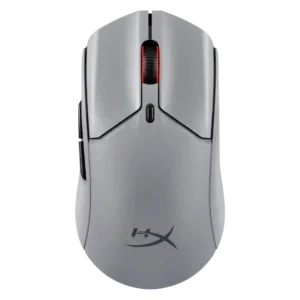
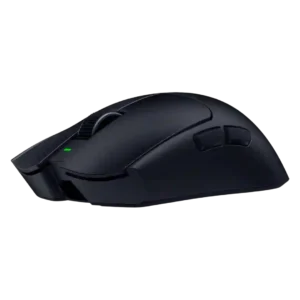
The reviews support versatile 2.4GHz wireless use through dongles or receivers, often alongside Bluetooth and wired modes. Multiple reviewers describe easy switching or gaming-ready wireless setup.
Reviews reference HyperSpeed Wireless Gen-2 and the bundled low-latency dongle as key connection upgrades. This mouse is clearly designed around proprietary dongle wireless rather than casual secondary modes.
Reviews mention Dynamic Sensitivity and related tuning that can change how speed or acceleration behaves. That gives advanced users meaningful control over pointer response.
Tracking precision is one of the strongest findings. Reviewers repeatedly describe the mouse as accurate, smooth, stable, responsive, and dependable for gaming movements.
Reviews consistently describe the tracking as exact, precise, and highly dependable in play. Several reviewers say shots land where intended, especially in competitive shooters.
Balance is directly praised in the reviews that discuss it, with the mouse described as well balanced and evenly weighted despite its light 61g body.
Reviews describe the weight as centered, balanced, or evenly distributed. That balance is repeatedly tied to better control and a lighter-feeling experience during play.
Battery life is generally strong at the standard 1,000Hz setting, with several reviews citing about 90 hours. Reviews also note a major reduction when 4K polling is used.
Battery life is a consensus strength. Most reviews repeat the same core claim of up to 180 hours at 1,000Hz and 45 hours at 8,000Hz, and several say the real-world endurance feels excellent.
Bluetooth support is consistently confirmed as part of the connectivity package, useful for casual, laptop, work, or non-competitive use alongside 2.4GHz wireless.
Reviews explicitly say Bluetooth is absent. The Viper V4 Pro prioritizes its gaming-focused dongle wireless setup instead.
Build quality receives strong support. Reviewers describe the shell as rigid, sturdy, durable, well put together, and solidly constructed.
Build quality is one of the strongest consensus wins in the review set. Reviewers repeatedly praise rigidity, lack of creak, and confidence-inspiring construction.
Button customization is supported through NGENUITY features such as assigning functions, macros, and full button configuration. One review notes limitations in rebinding layers.
Synapse and Synapse Web are repeatedly cited for remapping and control over the available buttons. Reviewers present customization as thorough rather than bare-bones.
Button responsiveness is praised through tactile optical switches, quick actuation, and high-standard button engineering, with only minor preference-based caveats in some reviews.
Button presses are consistently described as responsive, fast, and precise. Multiple reviewers also note that the mouse avoids misclick or laggy-feeling input.
The included cable is described as braided, flexible, slack, or low-drag, making wired use less restrictive than a stiff cable would be.
The included cable is serviceable for charging, but at least one review directly criticizes the wired experience. Cable feel is not treated as a strength of the package.
Charging is convenient because reviewers mention charging while playing, USB-C charging, a round dock connection, and one review cites a quick charge to 80% in 30 minutes.
Charging convenience is mixed. The strong battery life means charging is infrequent, but charging remains cable-only and lacks the ease of a docked solution.
Claw grip support is positive in the reviews that mention it, with both IGN and Wired finding the shape comfortable or natural for claw use.
Claw grip is one of the clearest fit strengths in the reviews. Multiple outlets directly recommend the shape for claw users.
Click latency is strongly supported by instant-reaction, debounce-delay, and crisp-click comments. Optical switch behavior is repeatedly tied to fast input response.
One review explicitly cites a 0.204 ms average click latency. That supports the V4 Pro’s positioning as a very fast competitive mouse.
Click noise is treated positively where discussed, with reviewers calling the clicks or switches satisfying, great-sounding, or producing satisfying audio feedback.
The main clicks are often described as loud, pingy, hollow, or more resonant than muted. This is one of the most common caveats in otherwise positive reviews.
Connection stability is supported by repeated comments about no lag, no connectivity issues, no stuttering, and reliable behavior after standby or across modes.
The new dongle and antenna design are repeatedly tied to stable, reliable connections. Reviewers describe the link as solid and dependable in real use.
Cross-platform compatibility is mixed but supported: one review lists PS5 and Xbox support, another tested Windows 10 and 11, while a Dutch review notes NGENUITY is Windows-only.
Dock compatibility has narrow support from one review, which describes the included round dock as extending the mouse reach and helping with wireless placement.
Reviews explicitly note the absence of a dock or dock compatibility. That omission stands out because the rest of the mouse is positioned as a premium flagship.
DPI evidence is broad, with reviews citing the 26K sensor, 26,000 DPI ceiling, DPI profiles, and DPI switching indicators.
One review highlights the 50,000 DPI ceiling as a meaningful expansion of the usable adjustment range. Even when reviewers did not need that maximum, they saw the headroom as a clear spec upgrade.
Durability over time is supported by comments about a durable frame, long-lasting optical switches, and longevity without double-click issues.
One review explicitly describes the V4 Pro as lighter and more durable than before. That supports the idea that the refinement is not just about speed, but also long-term robustness.
Ecosystem integration is limited but positive, with support for HyperX ecosystem simplicity and OMEN Instant Pair noted in the reviews.
Ergonomics are mostly positive but shape-dependent. Reviewers praise refined ergonomics and light grip control, while some warn the form may not suit every hand.
The ergonomics are acceptable for a competitive symmetrical mouse, but not a headline strength. Reviews often contrast it with more sculpted ergonomic alternatives.
Fingertip grip comfort is only indirectly supported through one review that tested different grips and found the mouse comfortable no matter the handling style.
Fingertip grip is also highlighted as a good match for the Viper V4 Pro’s low-profile symmetrical design. Reviews regularly list fingertip among the preferred grip styles.
FPS suitability is strongly supported by shooter-focused testing, including Counter-Strike, Valorant, Black Ops, and comments about fast-paced tracking and quick aiming.
This is consistently framed as an elite FPS or competitive shooter mouse. Reviews repeatedly connect its shape, low weight, sensor, and latency profile to high-level shooter play.
Glide smoothness is generally positive, especially with smooth or glass skates, though a few reviews say the stock glide is not the best in class.
Feet and skates are repeatedly praised for smooth glide and easy fast movement. Several reviews connect the glide quality to the mouse’s competitive feel.
Grip texture is mixed. Reviewers praise the textured plastic and optional grip tape, but one found the included tape slick rather than grippy.
The shell texture or coating is repeatedly praised for helping grip without feeling slippery. Matte and coated finishes are a recurring positive in day-to-day use.
Handedness support is limited and mixed. Reviews describe a right-handed symmetrical design or a layout mainly aimed at right-handed gamers.
Multiple reviews stress that this is effectively a right-handed mouse because the side buttons sit on the left side only. Left-handed flexibility is limited.
Left and right click quality is strong. Reviews mention good bounce, rapid reset, minimal play, light actuation, and enough resistance to avoid accidental double clicks.
Primary clicks are commonly praised for being sharp, tactile, and consistent across the button surface. The consensus is stronger on feel than on sound.
Lift-off distance is directly supported in software comments, with reviewers noting 1mm and 2mm options.
Lift-off controls and behavior are discussed directly in multiple reviews. Most describe the feature set or results positively, though one reviewer still wanted a lower default lift-off distance.
Long-session comfort is supported by the light weight, reduced strain, wrist comfort, and marathon-session comments, though one review wanted more shaped long-term support.
Low weight and balanced construction help reduce fatigue over long sessions. Multiple reviewers directly connect comfort over time to the mouse’s light, well-distributed design.
Macro support is directly supported in multiple software discussions, including assigning macros in NGENUITY and configuring side-button macros.
One review explicitly says Synapse is where users create macros. Macro support exists, but it is not a major focus of most reviews.
Materials quality is praised where discussed, with reviewers noting no cheap-feeling materials, no shell weakness, and solid plastic construction.
Material quality is described as sturdy, dense, and notably premium for such a light mouse. Reviews reject the idea that the shell feels cheap just because it is ultralight.
MMO suitability has limited support from IGN, which found the scroll wheel and extra buttons helpful in Final Fantasy XIV raid and dungeon play.
Motion consistency is strongly supported through stable path-of-motion, smooth micro-adjustment, and incremental movement comments.
Movement is described as smooth and more fluid, especially when the mouse is tuned well. Reviews connect that smoothness to tracking quality and high polling support.
Onboard memory is narrowly supported by the Windows Central review, which states that up to five DPI profiles can be stored on the mouse.
One review explicitly mentions onboard profiles that can be adjusted in the browser. That suggests the mouse can hold profile data beyond a purely temporary software session.
Palm grip comfort is weakly supported in a negative direction; IGN says the low palm area makes palm grip somewhat tough.
Palm grip support is workable but not universal. Several reviewers were comfortable with it, while others preferred a more ergonomic shape or wanted more thumb-side contour.
Polling-rate evidence is extensive. Reviews confirm 4K support, but several also question how noticeable it is or note battery and measured-performance tradeoffs.
True 8,000Hz polling is a recurring selling point across the reviews. Several reviewers say the higher polling rate improves smoothness or responsiveness, even if some note the benefit is strongest for competitive play.
Portability is supported through Bluetooth laptop use, productivity-on-the-go comments, and work-environment versatility, but one review notes the lack of a pouch.
Portability is not a major strength. One review specifically says the dongle-and-cable setup is less convenient for travel than a simpler all-in-one wireless approach.
Premium feel is generally positive through comments about trustworthy quality, worthy feel, complete packaging, sleek presentation, and not feeling cheap.
Several reviews say the mouse feels distinctly premium in hand. That impression comes from the coating, shell rigidity, and overall finish rather than flashy extras.
Profile switching is supported by DPI cycling and user-set profiles, though coverage is narrower than the general DPI evidence.
Programmable buttons are supported through reprogramming and extra-button mapping, but one review characterizes the mouse as basic with no fancy buttons.
Reviews confirm that the side buttons can be programmed. The mouse stays minimal on button count, but the available buttons are still treated as configurable.
RGB features are limited but present. Reviews repeatedly describe scroll-wheel-only lighting with customization or DPI indication, plus one software-related RGB issue.
The lack of RGB is mentioned again and again as part of the Viper V4 Pro’s stripped-down competitive focus. Reviews frame this as a deliberate trade-off for lower weight and better battery life.
Scroll wheel quality is mostly positive, with firm notches, pronounced steps, satisfying clicks, positive feedback, and stable middle-click behavior.
The optical scroll wheel is one of the mouse’s strongest recurring positives. Reviews praise its accuracy, defined steps, and consistency, although one review found the detents too soft for precise selection.
Sensor performance is consistently praised through 26K sensor references, smooth tracking, precision, responsiveness, and high DPI and IPS specs.
The Focus Pro 50K Gen-3 sensor is repeatedly described as accurate, fast, and technically impressive. Reviews frame it as one of the mouse’s core performance upgrades.
Shape comfort is highly preference-dependent. Some reviewers found it comfortable for their hands or grip, while others cautioned that size, palm grip, or shape will divide users.
The safe symmetrical shell is widely described as comfortable and easy to adapt to. Even reviews with ergonomic reservations still treat the shape as broadly successful.
Side button quality is mixed. Some reviews praise easy access, firmness, and bounce-back, while others criticize narrow, rigid, or uncomfortable side buttons.
Side buttons are generally seen as easy to reach and unusually good for a lightweight competitive mouse. Several reviews specifically praise their tactility or usability.
Skate durability has limited evidence and is a caution rather than a strength, with one reviewer warning that the optional tempered glass skates may shatter if dropped.
Software stability has limited negative evidence: one review reported RGB control trouble until changing a Windows Dynamic Lighting setting.
Software behavior is mostly positive, but not flawless. Reviews praise the new web approach while also mentioning older Synapse heaviness or a web app conflict in one case.
Software usability is mixed. NGENUITY is described as easy or straightforward for DPI, macros, polling, and lighting, but several reviews note limited advanced options.
Synapse Web is widely seen as a meaningful usability improvement because it makes tuning easier without a heavy install. Across the reviews, software control is generally presented as easy and full-featured.
Surface compatibility is supported by hard-mousepad and most-mousepad comments, with low-friction glide generally holding up across surfaces.
Reviews mention reliable tracking and lift-off behavior across different surfaces. Surface handling is treated as dependable rather than finicky.
Switch durability is strong, with reviewers noting optical switches avoid double-click or debounce issues and are rated for longevity.
Multiple reviews cite the 100 million click rating and treat the switches as built for long competitive use. Durability is framed as a real upgrade, not a throwaway spec.
Switch feel is widely praised as tactile, crisp, springy, satisfying, and great-sounding, with optical switch feel a frequent highlight.
The Gen-4 optical switches are usually described as tactile, crisp, lighter to actuate, and responsive. Even reviewers who questioned the sound still tended to praise the core feel.
Value is the most mixed category. Some reviews call it competitive versus rivals, while others say cheaper Haste models are the better deal.
Reviewers agree the V4 Pro performs at a premium level, but many still flag the price as hard to justify for non-competitive users. Value is strongest for buyers who specifically want top-tier lightweight FPS performance.
Weight is a clear strength. Reviews repeatedly cite the 61g body and describe the mouse as light, ultralight, easy to maneuver, and comfortable.
Nearly every review treats the 49 to 50 gram weight as a defining advantage. The mouse is repeatedly described as feather-light, easy to move, and faster-feeling in hand.
Wireless latency is strongly positive, with reviewers describing instantaneous response, zero noticeable latency, and quicker responsiveness than 1,000Hz setups.
Several reviews call out very low latency figures or noticeably crisp wireless response. The low-latency wireless link is a major part of the product’s competitive positioning.
Wireless performance is very strong overall, with reviewers citing smooth 4K behavior, reliable wireless use, versatile modes, and no stuttering.
Wireless performance is broadly praised as fast, responsive, and confidence-inspiring. Reviewers often say it feels fully competitive with wired expectations.