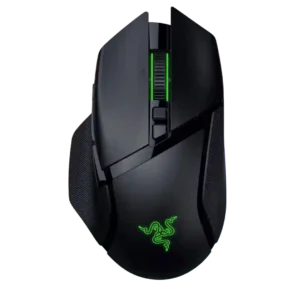
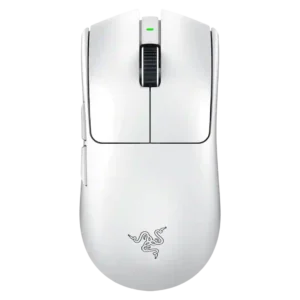
Reviewers repeatedly note 2.4GHz wireless support, usually through Razer HyperSpeed or a dongle. Evidence also points to multi-device dongle use and, in some reviews, higher polling through optional accessories.
Reviews describe the mouse as using 2.4GHz-class Razer HyperSpeed or HyperPolling wireless rather than Bluetooth, with wired USB-C also available. The connection approach is performance-focused, but less versatile than a simple multi-device wireless setup.
The strongest evidence comes from sensor behavior and acceleration handling: one review reports tracking free of acceleration or jitter, while another highlights the high acceleration tolerance. This supports strong control for fast movement.
The reviews that mention acceleration-related control point to software-level tuning, including acceleration curves, dynamic sensitivity, and rotation adjustment. This makes movement behavior adjustable, though the feature is not the main focus of most reviews.
Precision is one of the mouse’s clearest strengths, with reviewers describing accurate tracking, controlled aiming, faster movement tracking, and better in-game accuracy. A minority note high-DPI jitter or weight-limited aiming.
Reviewers consistently describe tracking as precise, accurate, smooth, or confidence-inspiring across gaming and surface tests. The evidence supports a high score for aiming precision, especially in fast shooters and aim-training contexts.
Balance is generally described positively, with centered or well-distributed weight. Some testers still felt front-heaviness or noted that the overall mass affects quick movement.
Reviewers describe the mouse as extremely light without generally feeling flimsy, and several comments connect its size-to-weight feel with control and comfort. The balance is treated as strong overall, though the evidence is more about feel than adjustable balance.
Battery life is widely praised, especially over 2.4GHz and Bluetooth with lighting reduced or off. Reviewers also warn that RGB and high polling rates can cut runtime significantly.
Battery life is strong at 1,000Hz but drops sharply at higher polling rates, especially 8,000Hz. Reviewers repeatedly cite the 95-hour and 17-hour figures, with some practical-use comments finding the lower-rate endurance solid.
Bluetooth support is consistently confirmed across reviews and is often framed as useful for work, travel, or switching devices. Bluetooth battery ratings are also repeatedly cited as a strength.
Bluetooth support is a clear weakness because multiple reviews explicitly say it is absent. Reviewers frame that omission as understandable for an esports mouse, but it reduces versatility for everyday or multi-device use.
Build quality is treated as a premium strength, with reviewers reporting solid construction, no creaking, strong workmanship, and a tank-like chassis.
Build quality is generally praised, with reviewers noting robust construction, durability, lack of flex or creaking, and strong fit despite the low weight. A few comments are more cautious about thin or lightweight materials, but the overall evidence is positive.
Button customization is a core advantage: reviews describe reprogrammable buttons, HyperShift layers, workflow shortcuts, and broad Synapse remapping.
Button customization is supported through Razer Synapse, including remapping, function assignment, HyperShift, and other software controls. The reviews present this as flexible enough for a performance mouse, even if it is not button-heavy.
Button responsiveness is rated highly, with fast actuation, minimal response time, and reliable in-game button behavior. The positive evidence is strongest for quick actuation and optical-switch response.
Button responsiveness is a strength, with reviewers describing clicks as rapid, stable, snappy, responsive, and easy to actuate. The optical switch design and low-latency focus support high scores here.
Cable impressions are mixed. Some reviews criticize stiffness or cable weight during wired use, while others praise the included cable as flexible, paracord-like, or durable.
Cable flexibility receives mixed evidence. Some reviews criticize the cable as stiff, heavy, or cumbersome compared with the wireless experience, while one review describes the charging cable material as more flexible and easier to handle.
Charging convenience is a notable strength when optional accessories are used. Reviews mention wireless charging, dock charging, magnetic placement, and quick USB-C top-ups, though some note extra cost or slower short top-ups.
Charging convenience is mixed. Reviewers note USB-C charging, quick top-ups, and use while charging, but some wanted a charging stand or disliked needing to plug in instead of using a dock-style solution.
Claw grip comfort is mixed. Several testers found claw grip usable or comfortable, but others said the heavier, palm-oriented shape makes claw less natural.
Claw grip comfort is one of the better-supported grip strengths. Several reviews say the shape works well for claw users, with good hand support, finger positioning, and comfort during gaming.
Click latency evidence is strong where reviewers discuss optical switches, zero debounce delay, and debounce testing. The mouse is consistently presented as responsive enough for gaming.
Click latency is scored highly because reviewers cite reduced delay, no debounce delay, near-instant response, optical switches, and very low measured latency. The comments align with the mouse’s esports-focused design.
Click and scroll noise feedback is mixed. Some reviewers praise quiet or satisfying clicks, while others call the Smart-Reel or scroll mode switching sound distracting.
Click noise is a mild drawback. Several reviews say the clicks can be a little loud or uneven in sound, though the same reviews often still praise the click feel and responsiveness.
Connection stability is mostly strong, with multiple reviewers reporting reliable HyperSpeed behavior and no faltering. One review reported occasional connection drops that were resolved by moving the dongle.
Connection stability is mostly strong, with reviewers reporting strong connection, no drops, and no issues in games. One review mentions occasional wake or connection stutters, so the overall score is positive but not flawless.
Cross-platform and multi-device evidence is mixed. The mouse works across multiple devices and setups, but Linux support depends on community tooling and lacks official firmware-update support.
Dock compatibility is frequently cited. Reviews mention Mouse Dock Pro support, charging pucks, wireless charging, and optional high-polling accessories, while noting these accessories cost extra.
DPI range is very high, with 35,000 DPI repeatedly cited for the 35K model. Reviewers generally see the ceiling as technically impressive but more than most users need.
DPI range is very strong on paper and in software, with repeated references to the 35,000 DPI or CPI ceiling and single-step adjustment. Most reviewers note that the extreme ceiling is more headroom than most players will use.
Durability over time has limited but direct support from long-use comments and long expected lifespan claims. Most stronger durability evidence overlaps with build quality and switch ratings.
Durability over time is supported mainly by the 90-million-click switch rating, sturdy construction comments, and one long-term update that found few issues across multiple units. The evidence is positive, though long-term real-world durability is less broadly tested.
Ecosystem integration is strong for Razer users, with Chroma lighting sync, multi-device dongle support, Synapse profiles, and other Razer gear integration repeatedly mentioned.
The mouse integrates with Razer’s Synapse ecosystem for profiles, remapping, sensitivity matching, power settings, and polling controls. Reviews generally accept the ecosystem requirement, though Synapse reactions vary by reviewer.
The mouse is consistently described as ergonomic and right-handed, with thumb support and a contoured shape. Comfort-focused design is one of the most repeated positives.
Ergonomics are broadly positive, especially for a symmetrical esports mouse. Reviewers praise the lightweight body, comfortable shape, secure hand feel, and long-session usability, though a few prefer other shapes.
Fingertip comfort is mixed to weak because the mouse is heavy and palm-oriented. Some reviewers could use fingertip grip, but others found it awkward or too heavy.
Fingertip grip comfort is supported but a little more mixed than claw comfort. Several reviews say it works nicely for fingertip use, while at least one larger-handed reviewer found the V3 shape harder to fingertip than the older flatter design.
FPS suitability is mixed. The sensor and clicks are capable, but the weight makes the mouse less ideal for competitive or fast-flick shooters.
FPS suitability is one of the strongest categories. Reviews repeatedly test or recommend it for Counter-Strike, Valorant, Overwatch, Fortnite, Rainbow Six Siege, and other shooters, emphasizing precision, speed, low weight, and responsiveness.
Glide quality is generally positive, with reviewers describing smooth movement, soft glide, and PTFE feet. Surface choice still matters, especially on harder desks.
Glide smoothness is a clear strength. Reviewers repeatedly highlight large PTFE feet, smooth movement across pads or surfaces, low friction, and effortless motion, often linking glide to better fast-swipe control.
Grip texture is a major strength, with repeated praise for rubberized sides, textured surfaces, secure thumb support, and control during long sessions.
Grip texture is generally positive. Reviewers describe the smooth-touch coating or surface texture as grippy, secure, or naturally frictioned, though some note fingerprints, grime, or optional grip tape as tradeoffs.
Handedness is a limitation because the shape is clearly right-handed. Reviewers repeatedly note that left-handed users are not served by this design.
Handedness is mixed. The shape is symmetrical or semi-ambidextrous and some reviews say left-hand use is possible, but the side buttons are positioned mainly for right-handed use.
Left and right click quality is mostly good, with minimal wobble, fast action, and solid travel. One review found the main clicks a little squishy compared with other Razer mice.
Left and right click quality is a strength. Reviewers describe the main clicks as firm, crisp, tactile, stable, and improved in shell tolerance, with only occasional preference-based criticism of optical feel.
Lift-off distance control is well supported through Synapse and sensor features. Reviewers mention consistent lift-off behavior, asymmetric settings, and adjustable lift-off distance.
Lift-off distance has direct software and sensor support. Reviews mention adjustable lift-off and landing distance, smart tracking, asymmetric cut-off, and lift-off customization, supporting a strong score for tunability.
Long-session comfort is a clear strength for users who fit the shape. Reviewers praise reduced fatigue, easy long sessions, and comfort across work or gaming marathons.
Long-session comfort is strong for its target audience. Reviews mention reduced fatigue, no hand cramping, all-day comfort, and long gaming-session comfort, helped by the very low weight and ergonomic shape.
Macro support is strong through Synapse and HyperShift. Reviews describe macro recorders, full macro functionality, and assigning complex commands to buttons.
Macro support is supported through remapping, HyperShift, and side-button actions or macros. It is present through software, but the limited button count means this is not a macro-heavy MMO-style mouse.
Materials quality is good, with evidence for high-quality rubber, premium surface feel, and durable-feeling finishes. The strongest direct evidence comes from Phantom White and long-use impressions.
Materials quality is mostly positive but not perfect. Reviewers cite soft-touch coating, robust plastic, and solid construction, while some complain about fingerprints, oil residue, or a cheaper-feeling lightweight shell.
MMO suitability is good but not absolute. Reviewers value extra buttons, HyperShift, wheel inputs, and macro support, while noting it has fewer buttons than a dedicated MMO mouse.
MMO suitability is limited. One review had a positive Final Fantasy XIV experience, but the broader evidence shows only two side buttons and another review frames Razer’s Naga as the MMO-focused option.
MOBA suitability is also good because reviewers cite MMO/MOBA targeting, programmable inputs, and utility for complex games. It is not positioned as a pure MOBA specialist.
MOBA suitability is only lightly supported. Some reviews mention League of Legends or DOTA 2 as competitive contexts, but the mouse is more clearly reviewed and positioned around FPS performance than MOBA-specific controls.
Motion consistency is strongly supported where tested, with reviewers reporting perfect consistency, stable tracking, and no acceleration or jitter problems.
Motion consistency is very strong. Reviewers cite smooth smaller movements, quick flicks, micro-adjustments, consistent tracking, and sensor/wireless performance that keeps pace with fast play.
Onboard memory is supported through five saved profiles or onboard profile storage. This helps preserve DPI and profile setups without constant software use.
Onboard memory is mixed. Some reviews say there is only one onboard profile, while others mention onboard memory or multiple onboard DPI profiles, so the useful portability of settings is present but not uniformly described.
Palm grip is the mouse’s best-supported grip style. Reviewers repeatedly praise palm comfort, thumb support, and a shape that encourages full-hand contact.
Palm grip comfort is decent but not the strongest grip category. Several reviews say the shape supports palm contact or works for palm grip, while others position claw and fingertip as the more natural fits.
Polling-rate support is strong, though accessory-dependent for the highest rates. Reviews cite 1,000Hz by default and 4,000Hz or 8,000Hz with supported dongles or docks.
Polling rate is a headline strength, with repeated evidence for wireless polling up to 8,000Hz and selectable lower rates. Reviewers also note diminishing practical returns and battery tradeoffs at the highest settings.
Portability is moderate. Bluetooth, dongle storage, and device switching help, but the large, heavy body is less travel-friendly than compact lightweight mice.
Portability is a weakness. Reviews cite no dongle storage, awkward dongle wiring, limited multi-device use, and the lack of Bluetooth, even though the light chassis itself would otherwise travel well.
Premium feel is strong, with reviewers describing a high-end, feature-packed, solidly built mouse with refined design and a premium overall impression.
Premium feel is supported by comments about high-end positioning, luxurious feel, strong performance, and enjoyable hand feel. Some reviewers still question value, so the premium impression is tied closely to performance rather than extras.
Profile switching is directly supported by the underside profile button and onboard profile behavior. Evidence is narrower than for broader customization, but defensible.
Profile switching is supported through Synapse and DPI profiles, but not without caveats. Reviews mention multiple DPI presets and software-based switching, while one review says the mouse has only one onboard profile.
Programmable buttons are one of the product’s major strengths. Reviews repeatedly cite 11 to 13 programmable controls, extra inputs, and secondary layers.
Programmable buttons are adequate rather than abundant. Reviews cite six programmable buttons or eight programmable functions, plus software remapping, but the layout remains intentionally minimal for esports.
RGB features are extensive, with underglow, logo lighting, scroll-wheel lighting, Chroma zones, and ecosystem syncing repeatedly mentioned. Battery drain is the main caveat.
RGB features score low because the mouse has little or no RGB lighting. Reviews frame the omission as weight- and battery-saving, but buyers wanting lighting effects will not get them here.
Scroll wheel quality is a standout feature. Reviews praise the four-way tilt, free-spin and tactile modes, Smart-Reel behavior, and productivity usefulness, though some dislike the mode-switch sound.
Scroll wheel quality is mixed. Reviewers praise tactile feedback, solid notches, and useful in-game weapon switching, but some find it stiff, uncomfortable, or less pleasant for everyday scrolling.
Sensor performance is excellent overall. Reviewers describe flawless tracking, high accuracy, strong surface handling, and a technically impressive Focus Pro 35K sensor.
Sensor performance is one of the strongest attributes. Reviewers repeatedly mention the Focus Pro 35K optical sensor, high tracking speed, accuracy, jitter improvements, surface handling, and industry-leading performance.
Shape comfort is strong for the intended hand sizes and grip styles, especially with the thumb rest and contoured right-hand form. Some users find it narrow or palm-biased.
Shape comfort is generally strong, especially for claw and competitive play. Reviews praise the streamlined body and multi-grip support, though a few comments say it is not the most comfortable symmetrical mouse for every hand.
Side button quality is generally positive. Reviewers describe the side buttons as easy to reach, tactile, light, crisp, and less prone to accidental activation.
Side button quality is strong. Reviewers praise the side buttons as well placed, separated, easy to find, firm, and low-mush, with several noting improved confidence during gameplay.
Skate durability has limited but useful evidence. Reviews praise large PTFE feet, one review expects slower wear, but another notes replacement feet are not included and aftermarket compatibility changes with the new shape.
Software stability is mixed but mostly improved. Some reviewers praise stable Synapse behavior, while others still call Synapse imperfect or note occasional quirks.
Software stability is mixed. Several reviews find Synapse workable or improved, but others mention loading issues, bloat, or reluctance tied to Synapse, so reliability depends on setup and version.
Software usability is powerful but sometimes complex. Reviews praise deep control, Synapse options, DPI and scroll settings, but also mention confusing setup or overwhelming menus.
Software usability is generally good once installed. Reviewers praise easy setup, clear customization, sensitivity matching, profile tools, and simple navigation, while noting that Synapse can still feel like a lot for a single mouse.
Surface compatibility is strong. Reviews cite tracking on varied surfaces, glass support, Smart Tracking, and high precision across mouse pads, with only harder desks raising concerns.
Surface compatibility is strong. Reviews mention tracking or gliding across cloth, wood, glass, concrete, leather, mouse pads, and other surfaces, with several praising sensor or feet performance beyond standard pads.
Switch durability is well supported through repeated references to Gen-3 optical switches rated for 90 million clicks.
Switch durability is strongly supported by repeated references to Gen-3 optical switches rated for up to 90 million clicks. The evidence is mostly specification-based but repeated across reviews.
Switch feel is generally positive, with tactile, snappy, crisp, or fantastic feel reported by reviewers. One source notes main-click squishiness separately under click quality.
Switch feel is strong overall. Reviewers describe the switches as firm, clicky, crisp, tactile, snappy, or satisfying, though one reviewer slightly preferred mechanical switch sound and feel.
Value for money is the most disputed area. Reviewers like the feature set, but many criticize price, upgrade value, or the cheaper older Basilisk V3 Pro.
Value for money is mixed. Many reviews call the price high or hard to justify for casual players, while others say the feature set, included dongle, or long-term quality can justify it for serious esports buyers.
Weight is the biggest recurring drawback. Reviewers often cite roughly 112g to 115g and say it limits fast FPS movement, even when balance or comfort helps.
Weight is a standout strength. Reviewers repeatedly cite 54g or 1.9 ounces and describe the mouse as exceptionally light, featherweight, or easy to move, often tying that to FPS control and comfort.
Wireless latency is generally strong, supported by low-latency HyperSpeed, high polling options, and reviewers saying wired and 2.4GHz feel hard to tell apart.
Wireless latency is very strong in the evidence. Reviews cite near-zero delay, virtually no input lag, extremely fast response, and smooth high-polling performance, though not everyone sees 8K as practically necessary.
Wireless performance is strong overall. Reviews cite rock-solid HyperSpeed, reliable 2.4GHz behavior, low-latency play, and occasional dongle-placement sensitivity.
Wireless performance is a strength. Reviews praise HyperSpeed or HyperPolling wireless, stable connection, fast response, and strong in-game performance, with the main caveat being battery drain at the highest polling rates.