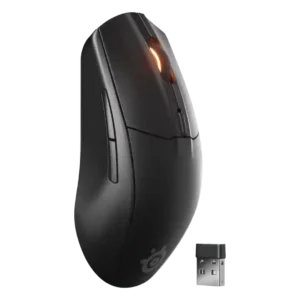
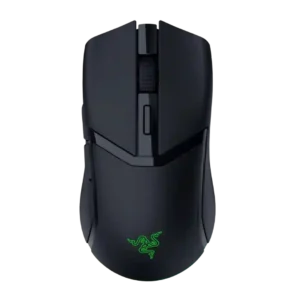
The 2.4GHz mode is a core strength: reviews repeatedly describe low-latency or lag-free dongle performance for gaming, with only isolated setup or interference notes. It is the preferred mode for play and is broadly treated as reliable at this price.
2.4 GHz support is widely documented through HyperSpeed wireless, included receivers, and low-latency 2.4 GHz connectivity, making it the main gaming wireless mode.
Acceleration control is supported through SteelSeries GG in several reviews. Reviewers note acceleration/deceleration controls, angle snapping, or acceleration settings, while one sensor description stresses no artificial acceleration for one-to-one tracking.
Acceleration-related evidence is limited but positive. One review cited 500 IPS and another said speed and acceleration are at a good level, though below Razer's top models.
Accuracy is generally positive for casual and mainstream gaming. Reviewers report accurate aiming, one-to-one tracking, reliable movement, and enough precision for FPS play, though a few note the older sensor is not ideal for high-level competitive tracking.
Tracking accuracy was a clear strength. Reviewers described the mouse as accurate, precise, consistent for aiming, and backed by a 26,000 DPI sensor with high stated accuracy.
AI Prompt Master appears as a distinct productivity feature. Reviewers described software integration and AI-launcher assignment, while one video reviewer dismissed it as basically a ChatGPT shortcut rather than meaningful gaming value.
Weight distribution is mixed. Some reviewers found the battery placement decently balanced or centrally positioned, but several called out rear drag or extra effort from the battery weight during fast flicks.
Balance is mostly positive but somewhat split. Some reviewers described controlled, balanced handling, while one criticized weight sitting toward the back of the mouse.
Battery life is one of the clearest strengths. Reviews consistently cite hundreds of hours, strong endurance in either 2.4GHz or Bluetooth mode, and especially long runtime when using two AAA batteries.
Battery life is one of the clearest wins, with repeated claims around 110 hours on 2.4 GHz and up to 170 hours over Bluetooth, plus hands-on impressions of long real-world use.
Bluetooth support is widely valued for versatility and multi-device use. Most reviews describe easy pairing or useful laptop/tablet support, though a few reviewers had pairing trouble or considered Bluetooth unsuitable for serious gaming.
Bluetooth support is widely documented, often as part of tri-mode connectivity or PC/work-laptop switching. Reviewers generally treated it as useful for everyday or cross-device use.
Build quality is consistently praised. Reviewers describe a solid shell, strong construction, no creaking, and a durable-feeling body that exceeds expectations for a budget wireless mouse.
Build quality is repeatedly praised, with reviewers calling the mouse durable, solid, well-built, buttoned up, or premium-feeling despite its lighter shell.
Button customization is well supported through SteelSeries GG. Reviews mention remapping all six buttons, keybindings, and broader customization options, making the basic six-button layout more flexible.
Button customization is well supported through remapping, command assignment, Synapse controls, and the ability to change the default AI/DPI button behavior.
Button responsiveness is a positive area. Reviewers describe the main clicks as responsive, spammable, satisfying, and quick, with no major recurring complaints about actuation delay in normal use.
Button responsiveness was praised across reviews, with fast, clean clicks, snappy buttons, lighter actuation, rapid response, and quick rebound all appearing in hands-on impressions.
Charging convenience is mixed because the mouse uses replaceable AAA batteries rather than USB charging. Reviewers liked rechargeable AAA support and never needing to plug the mouse in, but several disliked buying or replacing batteries and the lack of wired fallback.
Charging convenience is strong when using Razer's charging ecosystem, especially HyperFlux, and the long battery life reduces urgency. One review still wished wired charging were faster.
Claw grip comfort is generally good. Multiple reviews say the low-profile symmetrical shape suits claw grip users, with longer-session comfort noted by several testers.
Claw grip comfort is supported by broad grip-style praise and direct small-claw comments, but one enthusiast framed it as a heavier small claw mouse rather than a pure ultralight option.
Click latency is viewed as low enough for the target buyer. Several reviews cite 1.9 ms or reduced latency, and testers usually did not feel delay during play.
Click latency is well supported by the optical hardware comments. Reviewers cited zero debounce delay, barely any latency, and optical switch precision as practical strengths.
Click noise receives mixed but mostly acceptable feedback. Some reviewers found the clicks quiet or satisfying, while one noted loud, echoey, cheap sound when clicking hard.
Click noise is the most consistent drawback. Multiple reviewers called the switches loud, noisy, hollow, cheap-sounding, tinnier, or pingy, even when they liked the switch feel.
Connection stability is mostly positive with caveats. Reviews describe flawless or issue-free 2.4GHz operation, but some mention wake delays, Bluetooth pairing trouble, or interference that required dongle placement or software mitigation.
Connection stability is a strength in the available reviews. Reviewers reported immediate recognition, reliable Bluetooth and 2.4 GHz connectivity, and no stuttering or disconnections.
Cross-platform compatibility is a strength for users switching devices. Reviews cite PC, Mac, consoles, mobile devices, tablets, Android, and iOS support through Bluetooth or the dongle.
Cross-platform compatibility is supported by MacBook-to-gaming-PC switching, work laptop use, travel rigs, Bluetooth use, and everyday-task coverage beyond gaming.
Dock compatibility is well supported through references to the Mouse Dock Pro, HyperFlux V2, wireless charging puck, and Razer charging dock, though several reviewers note extra purchases are required.
DPI range is sufficient for most users. Most reviews cite the 18,000 DPI ceiling as adequate or more than enough, while one beginner-focused review reported a lower figure and another noted pros may want higher specs.
DPI coverage is strong for most users, with repeated references to 26,000 DPI and software sensitivity adjustment. The main caveat is that some comparisons place it below flagship Razer sensors.
Durability over time looks promising from the shell, switches, and materials. Reviewers cite durable construction, longevity improvements, and 60-million-click switch ratings, though long-term real-world aging is not fully proven.
Durability over time is supported by durable build comments, normal day-to-day robustness, 100-million-click components, and expectations of years of gaming use.
Ecosystem integration is limited but useful. Reviews point to SteelSeries GG and the existing SteelSeries ecosystem as the main integration benefit rather than deep hardware ecosystem features.
Ecosystem integration is strong for Razer users, with HyperFlux, Razer keyboard dongle pairing, automatic Synapse syncing, and wireless keyboard or mouse receiver support appearing in reviews.
Ergonomic design is comfortable for right-handed users and mainstream grips. Reviews praise the simple symmetrical shape and hand feel, though support is weaker for left-handed and full palm-grip users.
Ergonomic comfort is a repeated strength. Multiple reviews call it comfortable, easy to hold, suited to different grip styles, and suitable for gaming or general productivity.
Fingertip grip comfort is a strong fit because of the low-profile body. Reviews repeatedly pair fingertip and claw as the grip styles this mouse suits best.
Fingertip grip comfort is generally positive, especially in PC Gamer and Wired, though one Viper Mini comparison said the older shape was easier to fingertip.
FPS gaming suitability is good for casual and mainstream FPS play but limited for serious competitive shooters. Reviewers cite accurate sniping, responsive gameplay, and Counter-Strike or shooter testing, while weight and sensor limits keep it from being a pro pick.
FPS suitability is generally positive because reviewers used it in shooters, praised headshot feel, and described competitive play use; one enthusiast still would not make it a top Fortnite recommendation.
Glide smoothness is consistently positive. Reviews praise PTFE feet, smooth movement, effortless glide, and good performance across mousepads and desks.
Glide smoothness is generally good, with praise for smooth skates and mousepad glide, but some reviewers describe the feet as more controlled or less smooth than Razer's higher-end options.
Grip texture is a quiet strength. Reviewers repeatedly mention textured matte plastic, non-slip or grippy surfaces, and a comfortable finish that helps the mouse feel secure.
Grip texture is mostly positive. Reviewers described matte or textured surfaces that were stable and not abrasive, though the finish is smoother than some rubberized alternatives.
Handedness options are a weakness. Several reviewers note the mouse is effectively for right-handed users because the side buttons sit on the left side, and there is no left-handed version.
Handedness evidence is limited to Windows Central, which described an ambidextrous design that still favors right-handed users because of the side-button layout.
Left and right click quality is strong. Reviewers call the main buttons bouncy, responsive, crisp, tactile, or great-feeling, with only minor noise or feel caveats.
Left and right click quality has limited but direct support from one hands-on review, which found little pre-travel or post-travel and no major side-to-side looseness.
Lift-off distance is a weakness. Reviews note the lack of adjustable lift-off distance and a fixed higher distance compared with newer sensors, which matters more for competitive repositioning.
Lift-off distance support is directly mentioned in software coverage, with high and low calibration options or a lift-off adjustment tab available through Synapse.
Long-session comfort is mostly positive. Reviewers report no arm or hand ache, comfort during longer sessions, and all-day usability, though heavy weight may bother users accustomed to ultralight mice.
Long-session comfort is directly supported by reviewers calling the mouse comfortable and balanced for long gaming sessions or suitable as a daily driver.
Macro support is clearly available in SteelSeries GG. Reviews cite macro recording, macro shortcuts, and remapping options, though the mouse still has only six physical buttons.
Macro support appears in the software and button-remapping evidence, including direct references to macros and custom macros for the nine buttons.
Materials quality is good for the price. Reviewers describe matte plastic, durable polymer, translucent plastics, and quality parts, with a sturdy feel despite budget positioning.
Materials quality is supported by premium matte coating, matte finish, smooth contours, and mildly textured surfaces, though some shiny plastic appears in less-contacted gaps.
MMO gaming suitability is limited. The mouse can work for beginners or basic play, but reviews warn that serious MMO users will likely want more buttons and customization.
MOBA gaming suitability is adequate but not specialized. The basic button layout can cover casual or beginner use, while reviews say serious MOBA users may want more buttons.
Motion consistency is mostly good for everyday and casual gaming, with some sensor caveats. Several reviewers found smooth, natural movement, while one measured higher tracking deviation than top-tier mice.
Motion consistency was described positively through predictable twitch reactions and added friction for mouse control, suggesting stable, controllable movement rather than floaty glide.
Onboard memory is a useful plus. Reviews note saved settings or profiles on the mouse, allowing configurations to travel across devices without installing software everywhere.
Onboard memory support is directly supported by the launch coverage noting five on-board profiles.
Palm grip comfort is mixed to weak. Some reviewers found palm and claw workable, but many said the low profile, short body, or right-hand ridge is less supportive for full palm grip.
Palm grip comfort is mixed. Some reviewers said common grip styles work, while others warned palm grip can be difficult for large hands or felt unsupported on the smaller body.
Polling rate is acceptable for the intended audience. Reviews cite 1,000Hz as standard or fine for casual play, while noting that higher-end mice offer 4,000Hz or 8,000Hz.
Polling support is mixed. The standard setup is repeatedly described as 1,000 Hz, while higher 8,000 Hz polling is possible only with compatible Razer accessories or dongles.
Portability is strong. Reviews highlight dongle storage, compact size, Bluetooth laptop/tablet use, and the ability to throw it in a bag without carrying a charging cable.
Portability is supported by the compact body, travel-rig use, lightweight design, and one source explicitly calling the Cobra line portable.
Premium feel is better than expected for the price. Some reviewers describe the mouse as more premium than the price suggests, although scroll wheel and button caveats prevent a uniformly high-end feel.
Premium feel is generally positive, with reviewers citing premium coating, refined aesthetics, premium look and feel, and Razer-like packaging or materials.
Profile switching is supported through software and onboard profile storage, but not always convenient. Reviews mention DPI profiles or saved configurations, while one notes switching configurations requires GG software.
Profile switching is directly supported by profile buttons and preset gaming profiles, with reviewers noting that profiles can be switched from the mouse or configured in software.
Programmable buttons are a strength for a simple mouse. Reviews cite six programmable or remappable buttons, which is useful even though the physical layout remains basic.
Programmable control support is strong. Reviews mention six or nine programmable/customizable controls and extra programmable buttons, giving the mouse more flexibility than basic gaming mice.
RGB features are limited on the wireless model. Reviews repeatedly note no full RGB lighting, with only a scroll-wheel indicator for DPI, pairing, or status.
RGB is present but restrained. Reviews mention Chroma zones, logo lighting, and underglow, while several also note reduced, limited, or duller lighting versus more RGB-heavy Razer products.
Scroll wheel quality is mixed. Some reviewers found it fine, responsive, notched, or good for a budget mouse, while several complained about mushiness, cheap feel, or squeaking.
The optical scroll wheel was one of the better-supported strengths, described as smooth, precise, tactile, resistant to accidental scrolls, and useful for weapon switching.
Sensor performance is sufficient but not cutting-edge. Reviews praise the TrueMove Air sensor for ordinary gaming accuracy and responsiveness, while several call the older sensor mediocre compared with newer competitive models.
The Focus X 26K sensor was consistently treated as capable for normal gaming. Several reviewers praised its precision, while a few noted it is not Razer's absolute top-tier sensor.
Shape comfort is generally positive. Reviewers like the safe, symmetrical, compact shape, especially for smaller hands or claw/fingertip use, though palm-grip and hand-support concerns appear often.
Shape comfort is broadly positive, especially for users who like the Cobra or compact Viper Mini-style shape. Some larger-hand or Viper Mini-focused reviewers found the shape cramped or less ideal.
Side button quality is one of the main weak spots. Reviewers repeatedly describe the side buttons as thin, finicky, hard to hit, or easy to mis-click, with only one review finding improvement over the prior model.
Side button quality is mostly favorable, with praise for placement and solid feel, but one reviewer criticized the side buttons as loud and budget-feeling.
Skate durability is supported by PTFE feet comments and reports that the skates glide smoothly without catching or scraping. Evidence is positive but less extensive than general glide feedback.
Software stability has limited but direct evidence: Wired called the software intuitive while also saying it can be finicky at times.
Software usability is generally useful but not universally loved. Reviews praise simple controls, clear settings, and easy customization, while some complain that GG is cluttered, outdated, or not their favorite app.
Software usability is mostly strong. Synapse is described as useful, coherent, easy to customize, and feature-rich, though one review says it can be finicky at times.
Surface compatibility is mostly positive. Reviews mention reliable tracking or glide across different surfaces including wood, plastic, glass, desks, and mousepads, though one reviewer found faux leather unusable and another noted no glass-tracking feature.
Surface compatibility has direct evidence from one review, which said the mouse worked equally well across mouse mat, glass, wood, and plastic surfaces.
Switch durability is a strength on paper and in reviewer impressions. Multiple reviews cite 60-million-click ratings or improved switches, though one teardown review had an isolated switch issue.
Switch durability is strongly supported by repeated 100-million-click ratings, with several reviews tying the Gen-4 optical switches to long service life.
Switch feel is mostly positive. Reviewers describe crisp, clicky, tactile, responsive switches, though a few found the feel dampened or less energetic than premium mice.
Switch feel is generally strong but not universally loved. Reviewers praised tactile, satisfying, lighter optical switches, while some noted pingy or only modestly changed click character.
Value for money is strong when judged as a budget wireless mouse. Reviews repeatedly call it affordable, budget-friendly, a good deal, or a strong option at $50-$60, while a few prefer competitors at similar sale prices.
Value for money is mixed. Several reviewers call it good value or budget-friendly for its performance, while others criticize the $100 price, optional extras, or competing mice.
Weight is the biggest recurring drawback. Reviewers often cite 95g with one battery and 106g or more with two, calling it heavy compared with modern ultralight mice.
Weight is a major theme. Most sources describe the mouse as light at roughly 60 to 62 grams, though a few competitive-mouse reviewers still wanted it lighter for its size.
Weight tuning is a helpful differentiator. Many reviews praise the ability to run the mouse on one AAA battery to reduce weight, with the tradeoff of shorter battery life.
Weight tuning has only narrow support. One reviewer weighed the mouse with and without the removable puck, suggesting only a minor puck-related weight change rather than full tuning.
Wireless latency is generally good in 2.4GHz mode. Reviews cite low response times, negligible latency, and no noticeable delay during gaming, though wake delays or office-use cursor lag appear in a few accounts.
Wireless latency evidence is positive but tied to context. Reviews cite low-latency 2.4 GHz and good practical response, while standard 1,000 Hz polling limits out-of-box peak performance.
Wireless performance is broadly good for the target buyer. Reviewers describe reliable, stable, solid, or versatile wireless use, with caveats around Bluetooth, interference, or competitive-level sensor expectations.
Wireless performance is consistently positive, with reviewers calling the mouse well-performing, reliable, responsive, and consistent as a daily or gaming wireless device.