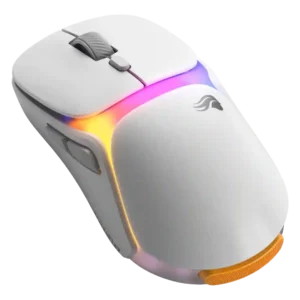
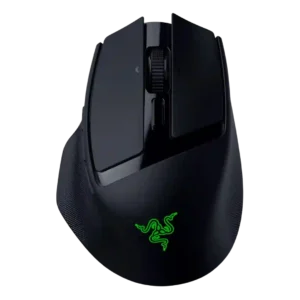
2.4 GHz connectivity is well supported through the receiver, dock, and wireless polling setup, with several reviews treating it as the main high-performance wireless mode.
Tri-mode connectivity is a recurring selling point, with many reviews explicitly confirming 2.4GHz support alongside Bluetooth and wired use.
Acceleration capability is supported by the sensor spec, with one review noting a 50G acceleration rating.
One in-depth review explicitly reports no unwanted acceleration, backing a strong score here.
Tracking precision was mixed: one review reported inconsistent wireless tracking graphs, while another found high precision and speed in practical use.
Reviews consistently describe the Basilisk Mobile as accurate in use, with stable tracking and reliable pointer control for gaming and general work.
Balance was mixed: some reviewers felt the added battery weight was well managed, while others noticed rear weight or shifting balance.
Battery life was the headline strength, supported by 71-hour 2.4 GHz claims, Bluetooth runtime, Guardian backup, and repeated praise for near-continuous use.
Battery life is generally viewed as a strength, although one review reported faster drain than expected during mixed use.
Bluetooth support is clearly present and can extend runtime, although one review found setup or mode switching a little finicky.
Bluetooth support is consistently confirmed and often framed as useful for travel, work devices, and broader compatibility.
Build quality was generally solid to strong, though one premium comparison review felt the overall build lagged behind similarly priced flagships.
Build quality is broadly praised, with reviewers calling the shell solid, sturdy, or not flimsy.
Button customization is a strength, with app, dock, and software controls allowing reassignment or adjustment of buttons and sensitivity controls.
Customization is a major plus, with repeated support for remapping controls and tailoring behavior through Synapse.
Button responsiveness was mostly favorable, with reviewers calling the clicks easy to hit, precise, well placed, or very responsive.
Button response is a recurring strength, with reviewers repeatedly calling the clicks crisp, clicky, snappy, or responsive.
Charging convenience was excellent for reviewers who valued battery swapping, though one critic saw the extra battery steps as unnecessary.
Fast top-ups are a clear advantage, with multiple reviews repeating the 10-minutes-for-about-7-hours convenience claim.
Claw grip comfort was generally positive for reviewers using claw or hybrid palm-claw grips, especially where the O3 shape avoided the D3 gap issue.
The mouse gets direct praise for claw-grip support, with one reviewer also saying the same shape works naturally for palm grip.
Click response was viewed positively where tested, with reviewers describing speed-focused or directly responsive inputs.
Where latency is discussed, reviewers report low-delay clicking and no meaningful input lag during gaming.
Click noise drew criticism in two reviews, including hollow ringing or pinging from the main buttons.
One reviewer explicitly says the click sound may be too clicky for very quiet spaces, so this is not a silent mouse.
Connection stability was a standout during battery swaps, with multiple reviewers noting no disconnections, no downtime, or no noticeable dropouts.
Where connection stability is addressed, reviewers report smooth operation and no notable lag issues across supported modes.
Cross-platform compatibility is limited by software availability, with one review stating Glorious Core was only available for Windows.
Review evidence supports broad device compatibility across PCs, Macs, tablets, and phones, although one video noted Bluetooth switching friction.
Debounce customization is available in software, with multiple reviews noting debounce time controls alongside lift-off and other performance settings.
Dock compatibility is central to the product, with the dock handling charging, receiver placement, indicators, and control functions, though it adds desk or bag space.
DPI support is strong, with reviewers noting 30K DPI or multiple DPI levels that can be adjusted through software, mouse controls, or the dock.
The cited 18K sensor range gives the mouse ample DPI headroom for both gaming and productivity use.
Durability over time is uncertain for the battery mechanism, with one reviewer explicitly saying only time will tell.
One video highlights Razer HyperSpeed multi-pairing, letting multiple compatible devices share one dongle within the ecosystem.
Ergonomics were polarized, with praise for the overall Model O shape and comfort offset by criticism that the large, long shape hurts fit for some users.
Ergonomics are one of the clearest themes across reviews, with repeated praise for the thumb rest, contouring, and comfort-first shape.
Fingertip comfort had limited but positive support from one review that identified the O3 as comfortable for claw and fingertip grip gamers.
Firmware reliability had limited negative evidence from one review that ran into a receiver connection issue after updating firmware.
FPS suitability depends on priority: some reviewers liked the precision and fast aiming, while others said the shape and weight are not ideal for competitive FPS players.
The mouse is seen as capable for FPS play, though not everyone views it as the ideal choice versus lighter specialist options.
Glide smoothness was consistently positive where mentioned, with PTFE feet described as effortless, smooth, or low-friction.
PTFE feet and easy glide come up often, with reviewers calling movement smooth across desks, pads, and other common surfaces.
Grip texture was mixed, with one review saying the matte surface did not slip and others finding the plastic coating less grippy or fairly standard.
Textured or grippy side surfaces are mentioned repeatedly and are generally seen as helpful for control.
Handedness support is partial: the symmetrical shell can be used left-handed, but side-button placement limits true left-hand usability.
Main click quality was mostly acceptable to good, with normal clicks described as fine and optical switches offering a good pop, though one review warned left/right swapping affects side-button usability.
Main clicks are described as consistent, light, and well suited to fast use, with no major complaints about left/right button quality.
Lift-off distance is configurable through Glorious Core, appearing alongside other sensor tuning options in several reviews.
Long-session comfort had positive evidence from wider-base and lightweight handling, but one reviewer warned different grips may have issues with the rear protrusion.
Long-session comfort is mostly positive for work and extended use, but one reviewer reported hand pain even during shorter sessions.
Macro support is mixed: one review found macro and multimedia functions, while another said custom macro recording was missing for the mouse.
Macro creation is explicitly supported in Synapse, though only one review discussed it directly in detail.
Materials were mostly seen as sturdy or high quality, with matte plastic and a firm shell, though one reviewer described the coating as standard rather than premium.
Materials impressions are positive overall, with matte and soft-touch finishes helping the mouse feel more refined than cheap.
MMO suitability was weakly supported and negative, with one reviewer saying the mouse did not add enough side buttons for that audience.
MMO usefulness gets limited but positive support thanks to the extra thumb controls and work-friendly button layout.
MOBA suitability was weakly supported and negative, with one reviewer grouping MOBA-style use with MMO concerns and questioning the need for the design.
One review suggests the mouse handles MOBA-style play comfortably, citing use in League of Legends.
Motion consistency was mixed: reviewers praised motion sync and practical performance, but some noted fluctuating or erratic wireless tracking consistency.
One detailed test specifically says cursor movement stayed smooth and responsive, supporting strong motion consistency.
Onboard memory is supported through saved profiles, with reviews noting profiles that can be saved to the mouse.
Onboard profile storage is directly confirmed, making it easier to carry settings without relying on software at all times.
Palm grip comfort was inconsistent: one reviewer could rest a palm on it, while others said palm users may feel the rear extension or battery contact.
Palm-grip comfort is usually a strength thanks to the thumb rest and supportive shape, though one reviewer with larger hands disagreed.
Polling-rate support is a clear spec strength, with several reviews noting up to 8,000 Hz wireless polling and dock or software controls.
Reviews note up to a 1,000Hz polling rate over faster wireless modes, with lower-rate options available for battery-saving use.
Portability was criticized by one reviewer because the dock and battery pieces add items to carry and take up bag space.
Portability is the biggest mixed point: many reviews like the smaller bag-friendly size, while others say it still is not truly compact.
Premium feel was mixed, with one reviewer calling it solid and premium, another saying it lacked premium polish, and a video review praising the fresh innovation.
Profile switching is supported, especially through DPI, polling, and preset profiles, though automatic game-based profile assignment was noted as absent.
Reviews that mention profiles say configurations can be saved and switched for different tasks or programs.
Programmable-button support is strong, with assignable buttons, dock controls, and reprogrammable mouse functions noted across reviews.
Reviews repeatedly mention a 10-button-style control setup with several remappable inputs, giving the mouse a strong programmable layout for its size.
RGB is prominent and configurable, but reviewer reactions were mixed from quick and painless customization to tacky, blotchy, or purely taste-based design concerns.
RGB is intentionally minimal: reviewers mostly note a single lit logo or front light rather than elaborate multi-zone effects.
Scroll wheel quality was one of the most divisive areas, ranging from sturdy or nice to weak, slippery, stiff, or lacking precision.
The scroll wheel is widely praised for accurate scrolling, four-way input, and the useful switch between tactile and free-spin modes.
The BAMF sensor was generally treated as capable, with 30K DPI, high speed specs, and practical precision, though wireless consistency affected confidence for some reviewers.
Across written and video reviews, the sensor is described as precise and dependable, with no major complaints about raw tracking hardware.
Shape comfort divided reviewers, with some adapting quickly or liking the Model O feel while others called the shape awkward because of size and rear battery protrusion.
Shape comfort is mostly positive, but comfort depends on hand size and preference; one reviewer could not find a comfortable grip.
Side button quality varied: some reviewers liked the Model O3 side buttons and placement, while others found them underwhelming or merely okay.
Side buttons are generally useful and responsive, but some reviewers found the smaller layout easier to mis-click or harder to reach.
Software stability was mixed: some reviewers praised improvements, while others reported system load, pre-launch reliability problems, or firmware-related setup friction.
Only one review directly comments on stability, but it describes Synapse as stable and powerful once configured.
Software usability was usually positive, especially after updates, with reviewers calling Core lightweight, cleaner, intuitive, or easy to use.
Synapse is generally described as easy to use and feature-rich, though one review called the software support solid but basic.
Surface compatibility has limited but positive support from reviewers who tested or described smooth PTFE movement across mouse pads.
Surface compatibility is solid overall, with reports of good behavior on hard and soft pads plus several everyday desk surfaces.
Switch durability is well supported by the stated 130-million-click optical switch rating mentioned in multiple reviews.
Multiple reviews cite 90 million-click optical switches, suggesting excellent switch longevity on paper.
Switch feel was generally good, though not flawless: reviewers praised optical switches, while one noted a harsher landing or denser feel.
Switch feel is praised for crisp actuation and a satisfying, slightly damped click feel.
Value for money was sharply divided: some saw strong value from the dock and battery system, while others felt the price was hard to justify beside premium rivals.
Value is divisive: several reviews call it versatile and worth considering, but others say the price is too high for its portability compromises.
The mouse is light enough for wireless use but not ultralight by current premium standards, with reviewers repeatedly noting the 66 to 68 gram loaded weight.
Most reviewers praise the light feel or cite a roughly 76–77g weight, though it is still not ultralight by competitive-mouse standards.
Weight tuning comes from using or removing the swappable battery, but reviewers treated this more as a tradeoff than a refined tuning feature.
Wireless latency evidence was favorable where measured subjectively, with reviewers noting ultra-low latency, no lag, or no hiccups during use.
One detailed review specifically highlights HyperSpeed as a low-latency wireless mode suited to faster gaming.
Wireless performance was mostly good in real play, but confidence was reduced by tracking consistency complaints in some testing.
Wireless performance is a strong point in the reviews that discuss it, especially over HyperSpeed or other faster connections.