2.4GHz connectivity
P1
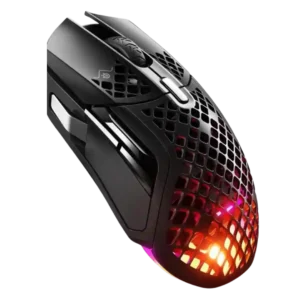
Product 1: SteelSeries Aerox 5 Wireless
4.1
Reviewers generally found the 2.4GHz dongle responsive and gaming-ready, though several disliked the USB-C dongle/adapter arrangement.
P2
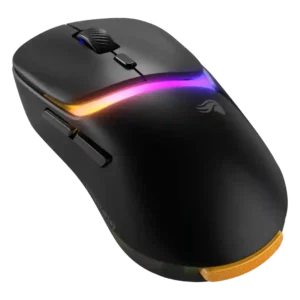
Product 2: Glorious Model D3
4.3
2.4GHz connectivity was positively supported by performance on Windows and a reviewer preference for 2.4 GHz.
Accuracy and tracking precision
P1
Product 1: SteelSeries Aerox 5 Wireless
4.6
Tracking accuracy was widely praised, with reviewers repeatedly describing precise, consistent, or pixel-perfect cursor control.
P2
Product 2: Glorious Model D3
4.7
Reviewers consistently found tracking accurate and precise, with only minor wireless consistency caveats elsewhere.
balance and weight distribution
P1
Product 1: SteelSeries Aerox 5 Wireless
4.0
The rear-weighted balance drew limited but positive feedback for improving control in palm grip.
P2
Product 2: Glorious Model D3
3.6
Balance drew mixed feedback: one review barely noticed any difference, while another felt rear battery weight.
battery life
P1
Product 1: SteelSeries Aerox 5 Wireless
3.6
Battery life was the most divisive area: some reviewers reported strong multi-session endurance, while others found real-world runtime far below claims.
P2
Product 2: Glorious Model D3
3.7
Battery life was mixed: some praised runtime, while others found high-polling or feature-heavy use below expectations.
Bluetooth support
P1
Product 1: SteelSeries Aerox 5 Wireless
3.6
Bluetooth was valued for versatility and secondary-device use, but several reviewers warned it is less suitable for serious gaming than 2.4GHz.
P2
Product 2: Glorious Model D3
4.5
Bluetooth support was positively supported by one reviewer using Bluetooth on Mac for work.
build quality
P1
Product 1: SteelSeries Aerox 5 Wireless
4.3
Build quality was consistently viewed as sturdy despite the honeycomb shell, with little flex, creaking, or fragility reported.
P2
Product 2: Glorious Model D3
4.3
Build quality was mostly praised as high quality, though one review found some side flex.
button customization
P1
Product 1: SteelSeries Aerox 5 Wireless
4.5
Button customization was a major strength, with reviewers liking the broad remapping options and flexible software control.
P2
Product 2: Glorious Model D3
4.7
Button customization was a clear strength, with reviewers praising flexible keybinds and dock controls.
button responsiveness
P1
Product 1: SteelSeries Aerox 5 Wireless
4.6
Button responsiveness was strongly praised, with reviewers describing immediate, satisfying, and reliable inputs.
P2
Product 2: Glorious Model D3
4.5
Button responsiveness was praised for direct, accurate inputs and consistent main clicks.
charging convenience
P1
Product 1: SteelSeries Aerox 5 Wireless
4.7
Charging convenience was a strength thanks to fast USB-C top-ups, charge-and-play support, and painless cable use.
P2
Product 2: Glorious Model D3
4.6
Charging convenience was a standout because the hot-swap battery system reduced cable interruptions, with minor one-handed and clutter caveats.
claw grip comfort
P1
Product 1: SteelSeries Aerox 5 Wireless
4.1
Claw grip support was mostly positive, though a few reviews noted holes or reach issues that can bother some claw users.
P2
Product 2: Glorious Model D3
4.2
Claw grip comfort was supported by one review that found the D3 suitable for claw-style use.
click noise
P1
Product 1: SteelSeries Aerox 5 Wireless
4.5
Click noise feedback was limited but positive, with one reviewer specifically liking the quiet, precise button actuation.
P2
Product 2: Glorious Model D3
3.9
Click noise was split, with one reviewer calling the mouse very quiet and another saying the switches were not especially quiet.
connection stability
P1
Product 1: SteelSeries Aerox 5 Wireless
4.9
Connection stability was repeatedly praised, especially over the 2.4GHz dongle, with reviewers reporting no dropouts or lag.
P2
Product 2: Glorious Model D3
4.4
Connection stability was mostly strong, especially during battery swaps, though one review reported occasional switching failure.
cross-platform compatibility
P1
Product 1: SteelSeries Aerox 5 Wireless
4.5
Cross-platform use was supported by positive Xbox testing, though software features were more limited outside Windows.
P2
Product 2: Glorious Model D3
3.5
Cross-platform compatibility was mixed: hardware use across Mac and Windows was positive, but software was Windows-only.
debounce customization
P1
Product 1: SteelSeries Aerox 5 Wireless
2.0
Debounce customization was only mentioned as a missing high-end feature, making it a weakness for advanced users.
P2
Product 2: Glorious Model D3
4.8
Debounce customization was praised as a useful tuning option for competitive players.
DPI range
P1
Product 1: SteelSeries Aerox 5 Wireless
4.1
The 18,000 CPI range was useful for most reviewers, but some considered it merely middling against other high-end mice.
P2
Product 2: Glorious Model D3
4.5
DPI control was viewed positively because reviewers could make fine adjustments and quick in-game changes.
durability over time
P1
Product 1: SteelSeries Aerox 5 Wireless
4.5
Long-term durability evidence was limited but positive where reviewers described the shell as rigid or durable despite low weight.
P2
Product 2: Glorious Model D3
3.0
Durability over time remained uncertain because one reviewer said the repeated battery mechanism would need time to prove itself.
ergonomic design
P1
Product 1: SteelSeries Aerox 5 Wireless
4.4
Ergonomics were generally praised for a comfortable right-handed shape suited to palm and claw grips.
P2
Product 2: Glorious Model D3
4.2
Ergonomics were usually praised as comfortable or top-notch, with one notable complaint about the D3 cut-through gap.
fingertip grip comfort
P1
Product 1: SteelSeries Aerox 5 Wireless
2.0
Fingertip grip support was weak; reviewers found the mouse too large or better suited to other grip styles.
P2
Product 2: Glorious Model D3
4.2
Fingertip grip comfort was supported by one review that found the D3 suitable for fingertip-style use.
firmware reliability
P1
Product 1: SteelSeries Aerox 5 Wireless
2.5
Firmware or settings reliability drew limited criticism around settings resets or update-related pairing issues.
P2
Product 2: Glorious Model D3
2.8
Firmware reliability had a caveat because one review saw the battery failover problem awaiting a firmware fix.
FPS gaming suitability
P1
Product 1: SteelSeries Aerox 5 Wireless
3.9
FPS suitability was mixed: reviewers liked the lightness and precision for casual or fast FPS play, but competitive-focused reviewers found the size/buttons limiting.
P2
Product 2: Glorious Model D3
4.7
FPS gaming suitability was supported by competitive precision and a reviewer calling it brilliant for gaming.
glide smoothness
P1
Product 1: SteelSeries Aerox 5 Wireless
4.7
Glide smoothness was one of the strongest areas, with PTFE feet repeatedly described as effortless, smooth, or floating on surfaces.
P2
Product 2: Glorious Model D3
4.9
Glide smoothness was consistently praised as effortless, low-friction, and smooth across pads or surfaces.
grip texture
P1
Product 1: SteelSeries Aerox 5 Wireless
3.8
Grip texture was mixed-positive: the matte/coarse finish helped grip for many, while a few found it slippery or affected by holes.
P2
Product 2: Glorious Model D3
2.5
Grip texture drew a negative note because the mouse lacked included grips.
left and right click quality
P1
Product 1: SteelSeries Aerox 5 Wireless
4.5
Left and right click quality was praised for crispness, responsiveness, and strong tactile feel.
P2
Product 2: Glorious Model D3
4.2
Left and right click quality was viewed as consistent and quality-feeling.
lift-off distance
P1
Product 1: SteelSeries Aerox 5 Wireless
2.5
Lift-off distance was mentioned negatively by reviewers who wanted adjustment or found the default higher than average.
P2
Product 2: Glorious Model D3
4.8
Lift-off distance earned positive mention as part of the useful competitive tuning options.
long-session comfort
P1
Product 1: SteelSeries Aerox 5 Wireless
4.6
Long-session comfort was strong, with reviewers citing low fatigue, cool hands, and comfort across extended use.
P2
Product 2: Glorious Model D3
4.6
Long-session comfort was praised through longer-session ergonomics and fatigue reduction from the lightweight body.
macro support
P1
Product 1: SteelSeries Aerox 5 Wireless
4.3
Macro support was positively received where reviewers noted broad macro assignment and useful extra-button workflows.
P2
Product 2: Glorious Model D3
4.5
Macro support was positively noted through the dock’s ability to execute macros.
materials quality
P1
Product 1: SteelSeries Aerox 5 Wireless
4.5
Materials quality was praised for high-quality plastic, soft-touch/matte finishes, and a premium impression.
P2
Product 2: Glorious Model D3
3.9
Materials quality was mixed: reviewers liked the matte modern surface but one described it as standard plastic.
motion consistency
P1
Product 1: SteelSeries Aerox 5 Wireless
5.0
Motion consistency was praised in testing, with movements registering without skipping or overshooting.
P2
Product 2: Glorious Model D3
4.2
Motion consistency was mostly strong, but one review noted slight fluctuations under certain wireless conditions.
onboard memory
P1
Product 1: SteelSeries Aerox 5 Wireless
3.7
Onboard memory was useful for saving profiles, but one reviewer criticized Bluetooth mode for not preserving some settings.
P2
Product 2: Glorious Model D3
4.2
Onboard memory was supported by saved programmable profiles that could be quickly loaded by game or preference.
palm grip comfort
P1
Product 1: SteelSeries Aerox 5 Wireless
4.4
Palm grip comfort was consistently positive because the taller body and thumb area fit palm users well.
P2
Product 2: Glorious Model D3
3.1
Palm grip comfort was split, with one reviewer calling the gap annoying and another finding the grip styles suitable.
polling rate
P1
Product 1: SteelSeries Aerox 5 Wireless
3.2
Polling rate feedback was split: 1000Hz was praised, while Bluetooth or efficiency modes dropping to 125Hz were criticized.
P2
Product 2: Glorious Model D3
4.1
Polling-rate support was useful and flexible, though 8K polling was criticized for draining battery quickly.
premium feel
P1
Product 1: SteelSeries Aerox 5 Wireless
4.5
Premium feel was praised where reviewers described the mouse as sturdy, high-quality, and premium in hand.
P2
Product 2: Glorious Model D3
4.5
Premium feel was supported by high-end presentation and modern, high-quality finish comments.
profile switching
P1
Product 1: SteelSeries Aerox 5 Wireless
4.0
Profile switching was positively noted in Windows software, especially for creating and switching multiple profiles.
P2
Product 2: Glorious Model D3
4.2
Profile switching was treated as useful because saved profiles could be quickly loaded for different games or preferences.
programmable buttons
P1
Product 1: SteelSeries Aerox 5 Wireless
4.5
Programmable buttons were a major strength, giving the mouse multi-genre flexibility and extra inputs beyond typical lightweight mice.
P2
Product 2: Glorious Model D3
4.5
Programmable button support was seen as useful across the mouse and dock, with freely assignable controls.
RGB features
P1
Product 1: SteelSeries Aerox 5 Wireless
3.3
RGB opinions were mixed: reviewers liked customization and glow, but often complained the lighting was hidden or underwhelming in use.
P2
Product 2: Glorious Model D3
2.8
RGB opinions were mixed to negative: customization was broad, but color quality, styling, and hand-feel tradeoffs drew criticism.
scroll wheel quality
P1
Product 1: SteelSeries Aerox 5 Wireless
4.0
Scroll wheel quality was mostly positive for resistance and tactility, though one reviewer found scrolling underwhelming.
P2
Product 2: Glorious Model D3
3.9
Scroll wheel feedback was mixed: some praised it as quiet or nice, while others found resistance, softness, or tactility lacking.
sensor performance
P1
Product 1: SteelSeries Aerox 5 Wireless
4.4
Sensor performance was mostly strong, with precise, reliable tracking, though a few reviewers considered it not top-tier.
P2
Product 2: Glorious Model D3
4.8
Sensor performance was praised for precision, speed, and dependable tracking in practical gaming use.
shape comfort
P1
Product 1: SteelSeries Aerox 5 Wireless
4.4
Shape comfort was broadly praised for a comfortable larger right-handed shape, though some found it big or less suited to small hands.
P2
Product 2: Glorious Model D3
4.0
Shape comfort was polarizing: several reviewers found the D3 very comfortable, while one strongly disliked the palm-gap feel.
side button quality
P1
Product 1: SteelSeries Aerox 5 Wireless
2.9
Side button quality was the most repeated ergonomic issue, especially the forward button and up/down rocker being hard to reach or actuate.
P2
Product 2: Glorious Model D3
4.0
Side buttons were generally accessible and comfortable, though one reviewer wanted larger D3 side buttons.
software usability
P1
Product 1: SteelSeries Aerox 5 Wireless
3.7
Software usability was mixed: some found SteelSeries GG clear and powerful, while others called it cluttered, bloated, or limited on macOS.
P2
Product 2: Glorious Model D3
4.4
Software usability was broadly praised for being clean, intuitive, simple, and informative, with one battery-percentage criticism.
surface compatibility
P1
Product 1: SteelSeries Aerox 5 Wireless
4.0
Surface compatibility was positive but lightly evidenced, with PTFE feet remaining usable across desk mats, wood, pads, and textured surfaces.
P2
Product 2: Glorious Model D3
4.8
Surface compatibility was praised through smooth movement on varied mouse pads and desk surfaces.
switch durability
P1
Product 1: SteelSeries Aerox 5 Wireless
4.0
Switch durability was supported by limited positive evidence around wear resistance and high-rated IP54 switches.
P2
Product 2: Glorious Model D3
4.5
Switch durability was supported by the reviewer’s positive durability wording around the optical switch design.
switch feel
P1
Product 1: SteelSeries Aerox 5 Wireless
4.5
Switch feel was frequently praised for crisp, tactile, consistent clicks.
P2
Product 2: Glorious Model D3
4.2
Switch feel was described as making a decent quality impression.
tilt gesture controls
P1
Product 1: SteelSeries Aerox 5 Wireless
2.4
Tilt/flick gesture controls were widely criticized as stiff, awkward, or hard to use under pressure despite occasional novelty value.
P2Product 2: Glorious Model D3
No score yetvalue for money
P1
Product 1: SteelSeries Aerox 5 Wireless
3.5
Value for money was mixed: sale pricing and feature density were praised, but many reviewers felt the launch price was too high.
P2
Product 2: Glorious Model D3
3.4
Value for money was mixed: reviewers liked the innovation and performance but repeatedly noted the high price or buyer-specific appeal.
water and dust resistance
P1
Product 1: SteelSeries Aerox 5 Wireless
4.2
Water and dust resistance was generally viewed positively, reassuring reviewers about the honeycomb shell and spill/dust exposure.
P2Product 2: Glorious Model D3
No score yetweight
P1
Product 1: SteelSeries Aerox 5 Wireless
4.4
Weight was usually praised as light and agile, though a few reviewers felt it was only middling by modern ultralight standards.
P2
Product 2: Glorious Model D3
4.5
Weight was mostly praised as light or a sweet spot, though one reviewer felt it was not exceptionally light.
wireless latency
P1
Product 1: SteelSeries Aerox 5 Wireless
4.7
Wireless latency was praised overall, with reviewers repeatedly reporting no noticeable latency over the 2.4GHz connection.
P2
Product 2: Glorious Model D3
4.7
Wireless latency was praised, with reviewers reporting no lag, no hiccups, or no detectable wired-versus-wireless difference.
wireless performance
P1
Product 1: SteelSeries Aerox 5 Wireless
4.3
Wireless performance was generally reliable and responsive, though Bluetooth was often treated as the weaker mode.
P2
Product 2: Glorious Model D3
4.6
Wireless performance was strongly positive overall, with reviewers reporting smooth everyday and gaming use.