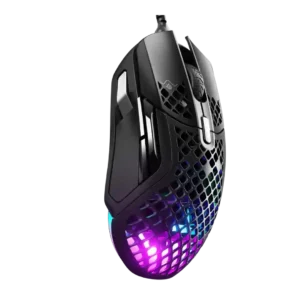
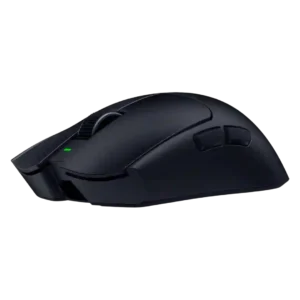
Wireless-specific review coverage describes the Aerox 5 Wireless variant as offering both 2.4GHz and Bluetooth connectivity, including SteelSeries Quantum 2.0 wireless technology.
Reviews reference HyperSpeed Wireless Gen-2 and the bundled low-latency dongle as key connection upgrades. This mouse is clearly designed around proprietary dongle wireless rather than casual secondary modes.
Reviewers mention acceleration as both a sensor specification and a software-adjustable setting. Coverage is generally positive about the available control, though one review found the controls overly granular.
Reviews mention Dynamic Sensitivity and related tuning that can change how speed or acceleration behaves. That gives advanced users meaningful control over pointer response.
Tracking precision is mostly praised, especially for flicks, accuracy, and high sensor specifications. One review found the sensor slightly less accurate and floaty compared with its daily mouse.
Reviews consistently describe the tracking as exact, precise, and highly dependable in play. Several reviewers say shots land where intended, especially in competitive shooters.
Reviews describe the weight as centered, balanced, or evenly distributed. That balance is repeatedly tied to better control and a lighter-feeling experience during play.
Battery-life evidence applies to the Aerox 5 Wireless variant. Reviews cite long claimed runtime and one reviewer used it for more than a week and a half before recharge.
Battery life is a consensus strength. Most reviews repeat the same core claim of up to 180 hours at 1,000Hz and 45 hours at 8,000Hz, and several say the real-world endurance feels excellent.
Wireless-version reviews confirm Bluetooth 5.0 support alongside 2.4GHz connectivity.
Reviews explicitly say Bluetooth is absent. The Viper V4 Pro prioritizes its gaming-focused dongle wireless setup instead.
Build quality is often described as solid, top notch, or protected by AquaBarrier, though one reviewer noticed slight compromises from the lightweight plastic shell.
Build quality is one of the strongest consensus wins in the review set. Reviewers repeatedly praise rigidity, lack of creak, and confidence-inspiring construction.
Customization is strong overall because reviewers repeatedly mention programmable controls, remapping, macros, CPI settings, and RGB changes. Criticism centers on the side-button layout rather than the range of settings.
Synapse and Synapse Web are repeatedly cited for remapping and control over the available buttons. Reviewers present customization as thorough rather than bare-bones.
Button responsiveness is mixed. Main buttons and general consistency receive praise, but multiple reviewers disliked the side-button placement, force, and accidental presses.
Button presses are consistently described as responsive, fast, and precise. Multiple reviewers also note that the mouse avoids misclick or laggy-feeling input.
Cable feedback is mostly positive: reviewers liked the detachable USB-C design and flexible fabric cable. One reviewer called the stock cable good, but not great compared with a paracord.
The included cable is serviceable for charging, but at least one review directly criticizes the wired experience. Cable feel is not treated as a strength of the package.
Charging convenience is mixed. The strong battery life means charging is infrequent, but charging remains cable-only and lacks the ease of a docked solution.
Claw-grip evidence is mixed. Some coverage says the shape suits claw grip, while another reviewer warns the honeycomb holes on the buttons may irritate claw users.
Claw grip is one of the clearest fit strengths in the reviews. Multiple outlets directly recommend the shape for claw users.
Latency and response-time comments are favorable. Reviewers mention no perceived click-latency issues, less lag on wired use, and reliable switches for better response times.
One review explicitly cites a 0.204 ms average click latency. That supports the V4 Pro’s positioning as a very fast competitive mouse.
Click sound evidence is limited but positive-to-neutral, with one reviewer saying side buttons share the main buttons' sound profile and feel sharp and clicky.
The main clicks are often described as loud, pingy, hollow, or more resonant than muted. This is one of the most common caveats in otherwise positive reviews.
Connection evidence is mostly from wireless-version coverage. Reviewers reported no lag and more than a week of steady use, while spec-focused coverage confirms wireless modes.
The new dongle and antenna design are repeatedly tied to stable, reliable connections. Reviewers describe the link as solid and dependable in real use.
Compatibility evidence is limited to SteelSeries GG software support on Windows and macOS.
Reviews explicitly note the absence of a dock or dock compatibility. That omission stands out because the rest of the mouse is positioned as a premium flagship.
DPI/CPI support is broad, with reviews citing 18,000 CPI, five CPI levels, and sensitivity adjustment. Some criticism appears around missing/default DPI behavior and confusing software controls.
One review highlights the 50,000 DPI ceiling as a meaningful expansion of the usable adjustment range. Even when reviewers did not need that maximum, they saw the headroom as a clear spec upgrade.
Durability evidence centers on IP54 protection, AquaBarrier shielding, click ratings, and long-lasting feel. Concerns appear around open-shell maintenance and lightweight plastic.
One review explicitly describes the V4 Pro as lighter and more durable than before. That supports the idea that the refinement is not just about speed, but also long-term robustness.
Ecosystem and lighting integration are supported through SteelSeries Engine/GG features, including in-game event lighting and smart RGB behavior.
Ergonomic feedback is mostly positive, with repeated praise for contouring, comfort, and right-handed shape. Some reviewers criticize side-button ergonomics or size-related fit.
The ergonomics are acceptable for a competitive symmetrical mouse, but not a headline strength. Reviews often contrast it with more sculpted ergonomic alternatives.
Fingertip-grip support is based on one review that says the lightweight body works well for players who use fingertip or wrist movement.
Fingertip grip is also highlighted as a good match for the Viper V4 Pro’s low-profile symmetrical design. Reviews regularly list fingertip among the preferred grip styles.
FPS suitability is divided. Several reviews praise the light weight, sensor, and flick performance, while one review strongly criticizes the lack of a DPI throttle for shooter use.
This is consistently framed as an elite FPS or competitive shooter mouse. Reviews repeatedly connect its shape, low weight, sensor, and latency profile to high-level shooter play.
Glide is one of the strongest areas, with reviewers praising the PTFE skates, smooth movement, low drag, and low initial friction across pads.
Feet and skates are repeatedly praised for smooth glide and easy fast movement. Several reviews connect the glide quality to the mouse’s competitive feel.
Grip texture receives limited but positive support from a review that liked the textured surface and contoured button area.
The shell texture or coating is repeatedly praised for helping grip without feeling slippery. Matte and coated finishes are a recurring positive in day-to-day use.
Handedness is a clear limitation: evidence describes the mouse as right-handed and calls out that it is not friendly to left-handed users.
Multiple reviews stress that this is effectively a right-handed mouse because the side buttons sit on the left side only. Left-handed flexibility is limited.
Left/right click quality is consistently positive, with reviewers praising light, crisp, satisfying, sharp, and snappy main clicks.
Primary clicks are commonly praised for being sharp, tactile, and consistent across the button surface. The consensus is stronger on feel than on sound.
Lift-off-distance evidence is limited and indirect. One reviewer notes the low sensor position affected initial tracking feel but did not hinder use after adjustment.
Lift-off controls and behavior are discussed directly in multiple reviews. Most describe the feature set or results positively, though one reviewer still wanted a lower default lift-off distance.
Long-session comfort is mostly positive, with reviewers citing better wrist comfort, long play sessions, all-day use, and hours of use without discomfort.
Low weight and balanced construction help reduce fatigue over long sessions. Multiple reviewers directly connect comfort over time to the mouse’s light, well-distributed design.
Macro support is directly mentioned in the customization software, with reviewers noting custom macros and mouse-based interactions.
One review explicitly says Synapse is where users create macros. Macro support exists, but it is not a major focus of most reviews.
Materials quality evidence is limited to ABS plastic and honeycomb construction, with durability handled separately through AquaBarrier and switch-rating comments.
Material quality is described as sturdy, dense, and notably premium for such a light mouse. Reviews reject the idea that the shell feels cheap just because it is ultralight.
MOBA suitability is supported by reviews that mention Dota, League of Legends, MOBA play, and mouse-side interactions for games needing more commands.
Motion consistency is generally strong, with reviewers citing consistent accuracy, no hindrance after adjustment, and one-for-one tracking.
Movement is described as smooth and more fluid, especially when the mouse is tuned well. Reviews connect that smoothness to tracking quality and high polling support.
One review explicitly mentions onboard profiles that can be adjusted in the browser. That suggests the mouse can hold profile data beyond a purely temporary software session.
Palm-grip support is generally positive, with multiple reviews saying the shape suits palm users or relaxed palm/claw grip styles.
Palm grip support is workable but not universal. Several reviewers were comfortable with it, while others preferred a more ergonomic shape or wanted more thumb-side contour.
Polling-rate support is well documented through 1000Hz/1ms specs and software controls, though some software-control criticism exists.
True 8,000Hz polling is a recurring selling point across the reviews. Several reviewers say the higher polling rate improves smoothness or responsiveness, even if some note the benefit is strongest for competitive play.
Portability benefits come from the low weight and detachable/standard cable, with reviewers calling it portable and easy to travel with.
Portability is not a major strength. One review specifically says the dongle-and-cable setup is less convenient for travel than a simpler all-in-one wireless approach.
Premium feel is mostly positive, with reviews calling the device premium, well-designed, great-feeling, or the best version of its shape.
Several reviews say the mouse feels distinctly premium in hand. That impression comes from the coating, shell rigidity, and overall finish rather than flashy extras.
Programmable-button coverage is broad. The Aerox 5 is repeatedly described as having nine programmable buttons or many buttons, with mixed opinions on layout quality.
Reviews confirm that the side buttons can be programmed. The mouse stays minimal on button count, but the available buttons are still treated as configurable.
RGB is widely covered and mostly liked, with three zones, millions of colors, underside lighting, bright effects, and some battery/heat tradeoffs.
The lack of RGB is mentioned again and again as part of the Viper V4 Pro’s stripped-down competitive focus. Reviews frame this as a deliberate trade-off for lower weight and better battery life.
Scroll-wheel quality is positive overall, with reviewers praising tactile steps, a heavier feel, ratchet feedback, and defined scrolling.
The optical scroll wheel is one of the mouse’s strongest recurring positives. Reviews praise its accuracy, defined steps, and consistency, although one review found the detents too soft for precise selection.
Sensor performance is mostly praised through TrueMove Air/Pro references, high specifications, and strong performance comments, though one reviewer calls it a rebranded sensor and another found it slightly floaty.
The Focus Pro 50K Gen-3 sensor is repeatedly described as accurate, fast, and technically impressive. Reviews frame it as one of the mouse’s core performance upgrades.
Shape comfort is one of the most consistently praised traits, especially for larger hands and relaxed grips, though small-hand fit and button placement remain caveats.
The safe symmetrical shell is widely described as comfortable and easy to adapt to. Even reviews with ergonomic reservations still treat the shape as broadly successful.
Side-button quality is the most controversial area. Reviewers like the extra controls in theory, but many criticize narrow buttons, awkward placement, accidental presses, and the flipper button.
Side buttons are generally seen as easy to reach and unusually good for a lightweight competitive mouse. Several reviews specifically praise their tactility or usability.
Skate durability evidence is limited to physical skate construction and thickness; reviewers praised PTFE feet and smoothness but did not provide long-term wear testing.
Software stability is mixed-to-negative. Some reviewers encountered confusing workflows or one-off lighting memory behavior, while others found the software improved or easy enough.
Software behavior is mostly positive, but not flawless. Reviews praise the new web approach while also mentioning older Synapse heaviness or a web app conflict in one case.
Software usability is highly split. Some reviewers found SteelSeries GG easy or refined, while others called it terrible, clunky, confusing, and overly granular.
Synapse Web is widely seen as a meaningful usability improvement because it makes tuning easier without a heavy install. Across the reviews, software control is generally presented as easy and full-featured.
Surface compatibility evidence is positive from one reviewer who tested the skates across multiple pads and found low initial friction on every pad.
Reviews mention reliable tracking and lift-off behavior across different surfaces. Surface handling is treated as dependable rather than finicky.
Switch durability is supported by 80-million-click ratings and positive comments about gold-plated or Golden Micro switches.
Multiple reviews cite the 100 million click rating and treat the switches as built for long competitive use. Durability is framed as a real upgrade, not a throwaway spec.
Switch feel is generally positive, with light, crisp, tactile, satisfying clicks, though side-button feel is less consistently liked.
The Gen-4 optical switches are usually described as tactile, crisp, lighter to actuate, and responsive. Even reviewers who questioned the sound still tended to praise the core feel.
Value is mixed-to-negative. Positive reviews call the mouse affordable or worth its features, while several reviewers say the wired model is overpriced at around $80.
Reviewers agree the V4 Pro performs at a premium level, but many still flag the price as hard to justify for non-competitive users. Value is strongest for buyers who specifically want top-tier lightweight FPS performance.
Weight is consistently praised. Reviewers repeatedly cite the 66g wired weight and describe it as lightweight, ultralight, easy to move, and comfortable.
Nearly every review treats the 49 to 50 gram weight as a defining advantage. The mouse is repeatedly described as feather-light, easy to move, and faster-feeling in hand.
Wireless latency evidence is positive but applies to the wireless variant. One reviewer reported no lag over Bluetooth or the USB-C dongle.
Several reviews call out very low latency figures or noticeably crisp wireless response. The low-latency wireless link is a major part of the product’s competitive positioning.
Wireless performance evidence is positive but applies to the wireless variant, with no-lag comments and steady longer-use feedback.
Wireless performance is broadly praised as fast, responsive, and confidence-inspiring. Reviewers often say it feels fully competitive with wired expectations.