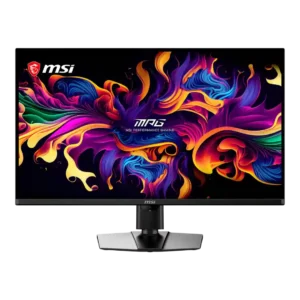
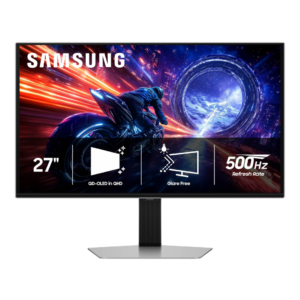
Average score
MSI MPG 322UR QD-OLED X24
4.4
Samsung Odyssey OLED G6 G60SF
4.3
DisplayPort connectivity
MSI MPG 322UR QD-OLED X24
5.0
Full-bandwidth DisplayPort 2.1a supports uncompressed 4K at 240Hz and is the preferred PC connection. Reviewers praised MSI for avoiding bandwidth compromises.
Samsung Odyssey OLED G6 G60SF
3.0
DisplayPort 1.4 with DSC can drive the full 1440p/500Hz experience and was considered functionally adequate. Still, several testers wanted DisplayPort 2.1 at this premium price.
console gaming compatibility
MSI MPG 322UR QD-OLED X24
4.6
Modern consoles receive strong 4K/120Hz, VRR, HDMI 2.1, and CEC support. Black-frame insertion cannot be used from a 120Hz console signal, and Dolby Vision is absent.
Samsung Odyssey OLED G6 G60SF
2.8
Current consoles work with VRR and high-refresh gaming, but they cannot exploit the 500Hz ceiling. For console-first setups, the G6 was repeatedly viewed as overkill.
port selection
MSI MPG 322UR QD-OLED X24
5.0
The port selection is comprehensive and premium, with DisplayPort 2.1a, two HDMI 2.1 inputs, USB-C power delivery, USB-A ports, KVM support, and a headphone jack.
Samsung Odyssey OLED G6 G60SF
3.5
The core gaming ports are practical and easy to reach, with HDMI 2.1, DisplayPort, USB-A, and audio covered. Missing USB-C, KVM, and DisplayPort 2.1 keep the selection from feeling fully flagship-grade.
gaming image presets
MSI MPG 322UR QD-OLED X24
2.0
The accurate color modes are excellent, but several game-themed presets are not recommended because they distort color.
Samsung Odyssey OLED G6 G60SF
3.5
Samsung provides useful picture controls and flexible sRGB/HDR adjustment, but the preset selection is thinner than some competitors and certain advanced settings are not very explicit.
value for money
MSI MPG 322UR QD-OLED X24
4.0
Reviewers generally consider the monitor strong value within the premium OLED category because it undercuts some same-panel rivals and includes extensive connectivity. It is still expensive, and cheaper trimmed-down models or discounted older QD-OLEDs may be better bargains.
Samsung Odyssey OLED G6 G60SF
2.7
Value is the G6’s biggest weakness: multiple outlets found it expensive versus similar 500Hz QD-OLED rivals or cheaper lower-refresh OLEDs. A few lower street prices improved the equation, so discounts matter a lot.
reliability over time
MSI MPG 322UR QD-OLED X24
3.9
OLED Care features, presence sensing, pixel shifting, panel refresh routines, and a three-year burn-in warranty improve confidence. Burn-in remains the main long-term uncertainty, especially for heavy static desktop use.
Samsung Odyssey OLED G6 G60SF
2.5
OLED remains vulnerable to permanent retention during long periods of static desktop use, so heavy all-day productivity carries more longevity risk than varied gaming and video use.
screen size
MSI MPG 322UR QD-OLED X24
4.6
The 32-inch screen creates strong immersion and provides useful desktop space without becoming an ultrawide. Its size is excellent for cinematic games, though some esports players may prefer a smaller panel.
Samsung Odyssey OLED G6 G60SF
3.3
The 27-inch size is ideal for close-up competitive play and smaller desks, but it can feel modest for the price and lacks the cinematic scale of larger displays.
Resolution
MSI MPG 322UR QD-OLED X24
4.9
The 3840×2160 resolution is exceptionally sharp at 32 inches and clearly more detailed than 27-inch QHD displays. It also demands a powerful GPU for high-refresh gaming.
Samsung Odyssey OLED G6 G60SF
3.6
1440p is a sensible match for very high frame rates and looks crisp in games at 27 inches, but it is noticeably less dense than 4K. Buyers prioritizing fine text or maximum detail may find the resolution modest for the price.
built-in speakers
MSI MPG 322UR QD-OLED X24
1.0
There are no built-in speakers, so buyers need headphones, a soundbar, or separate desk speakers.
Samsung Odyssey OLED G6 G60SF
2.3
There are no built-in speakers, and testers considered that a missed convenience for buyers without room for separate audio.
VRR compatibility
MSI MPG 322UR QD-OLED X24
3.8
VRR works with compatible Nvidia and AMD hardware across a broad 48–240Hz range. Like other OLEDs, the monitor can show brightness flicker during unstable frame rates, though reviewers generally found it mild.
Samsung Odyssey OLED G6 G60SF
5.0
VRR support covers both AMD FreeSync Premium Pro and Nvidia G-Sync compatibility, giving broad GPU flexibility.
sharpness
MSI MPG 322UR QD-OLED X24
4.7
4K pixel density and the glossy coating produce crisp text and fine detail. The triangular subpixel layout can create faint fringing at very close range, but most reviewers found it negligible at normal distance.
Samsung Odyssey OLED G6 G60SF
3.7
Gaming sharpness is generally good at 27-inch 1440p, but text and fine desktop detail lag behind 4K and same-resolution LCDs because of pixel density and QD-OLED’s subpixel layout.
single-player cinematic gaming suitability
MSI MPG 322UR QD-OLED X24
5.0
The large 4K OLED panel excels in atmospheric, colorful, and story-driven games, where its deep blacks and HDR highlights create a highly cinematic image. Reviewers repeatedly preferred it for RPGs and narrative titles.
Samsung Odyssey OLED G6 G60SF
4.0
Single-player games still benefit from OLED blacks, color, HDR, and fluid motion, and several testers loved the cinematic image. The small flat 27-inch format and 500Hz price premium make it less compelling if slower cinematic games are the main use.
picture-in-picture and picture-by-picture
MSI MPG 322UR QD-OLED X24
4.0
Picture-in-picture and picture-by-picture are included alongside the KVM and multi-input controls, strengthening the monitor’s multi-system flexibility.
Samsung Odyssey OLED G6 G60SF
3.0
Picture-in-picture is absent, but one tester considered that a minor limitation on a 27-inch display where split-screen use is less valuable.
USB hub functionality
MSI MPG 322UR QD-OLED X24
4.8
The two-port USB hub and built-in KVM make it easy to share a keyboard and mouse between systems. USB-C also supports a practical single-cable laptop connection.
Samsung Odyssey OLED G6 G60SF
3.8
The two-port USB hub is useful for peripherals and hard-to-reach PCs, but it is a basic hub rather than a high-end docking solution.
HDMI 2.1 support
MSI MPG 322UR QD-OLED X24
4.9
Two full-bandwidth HDMI 2.1 inputs provide proper 4K/120Hz support for current Xbox and PlayStation consoles.
Samsung Odyssey OLED G6 G60SF
4.0
The two full HDMI 2.1 inputs are a welcome part of the connectivity package and can support the monitor’s high-refresh gaming modes.
software support
MSI MPG 322UR QD-OLED X24
4.0
Gaming Intelligence, the remote app, firmware updates, and AI Care controls provide extensive customization. Some promised features were not available during testing, and a few mode settings are not remembered independently.
Samsung Odyssey OLED G6 G60SF
3.3
Firmware can be updated and Samsung offers some display-management tools, but desktop software control is less complete than several rivals. Buyers who frequently switch color or gaming settings may miss a fuller Windows app.
competitive gaming suitability
MSI MPG 322UR QD-OLED X24
4.2
The 240Hz refresh rate, fast response, and low native lag make competitive games look and feel excellent. Dedicated esports players may still prefer a smaller 27-inch, lower-resolution monitor with a higher refresh rate.
Samsung Odyssey OLED G6 G60SF
5.0
Competitive gaming is the G6’s clearest strength: 500Hz motion, near-instant pixel response, and very low lag make fast shooters exceptionally clear and responsive. The benefit is greatest when a powerful PC can push very high frame rates.
productivity versatility
MSI MPG 322UR QD-OLED X24
4.6
The 32-inch 4K workspace, crisp text, USB-C power delivery, and KVM make it useful for office work as well as gaming. Several reviewers felt it could replace separate work and entertainment monitors.
Samsung Odyssey OLED G6 G60SF
3.9
The G6 can handle office and creative work well thanks to strong color and usable 1440p sharpness, but opinions are split for all-day productivity. Text fringing, burn-in risk, missing USB-C, and limited smart/software features make it less ideal as a one-monitor-for-everything setup.
input lag
MSI MPG 322UR QD-OLED X24
4.3
Native 240Hz input lag is extremely low and competitive with the fastest gaming displays. Some testing found more noticeable delay at 60Hz and when motion-blur reduction is enabled.
Samsung Odyssey OLED G6 G60SF
5.0
Input lag is consistently described as effectively imperceptible or extremely low, helping the G6 feel immediate in reaction-heavy games.
design and aesthetics
MSI MPG 322UR QD-OLED X24
4.2
The understated black design, thin bezels, and restrained RGB are widely liked. The overall look is clean rather than flashy, though one reviewer thought the dark plastics appeared too ordinary.
Samsung Odyssey OLED G6 G60SF
4.8
The slim silver chassis, restrained styling, and rear RGB ring give the G6 a polished, modern look. Its design was repeatedly called sleek, classy, and more refined than many gaming-monitor rivals.
PC gaming compatibility
MSI MPG 322UR QD-OLED X24
4.9
The monitor is exceptionally well suited to high-end PCs through DisplayPort 2.1a, USB-C, KVM support, and broad VRR compatibility. Reviewers also reported flawless MacBook use over USB-C.
Samsung Odyssey OLED G6 G60SF
4.4
The G6 is excellent with a powerful gaming PC, especially in esports titles that can reach several hundred frames per second. Midrange systems can leave much of the 500Hz capability unused.
aspect ratio
MSI MPG 322UR QD-OLED X24
4.0
Selectable screen-size modes and a forced 4:3 option give competitive players extra flexibility. The feature is useful for shrinking the active image without changing monitors.
Samsung Odyssey OLED G6 G60SF
4.5
The familiar 16:9 layout was described as an easy, comfortable transition from typical gaming monitors.
curved screen immersion
MSI MPG 322UR QD-OLED X24
1.5
This is a flat 32-inch display, so it will not satisfy buyers seeking a curved, wraparound presentation. Reviewers point curved-screen fans toward other models.
Samsung Odyssey OLED G6 G60SF
2.0
The flat 27-inch format cannot match the wraparound immersion of a large curved display, making it less compelling for buyers prioritizing cinematic scale.
cable management
MSI MPG 322UR QD-OLED X24
3.0
USB-C can reduce clutter in a desktop-and-laptop setup, but the physical cable-routing grommet does not prevent sag. The hanging power cable is particularly difficult to hide.
Samsung Odyssey OLED G6 G60SF
2.5
The large external power brick makes minimalist desk setups harder to keep tidy and complicates cable management.
on-screen display usability
MSI MPG 322UR QD-OLED X24
4.8
The central joystick makes the on-screen menu quick and intuitive to navigate. MSI’s menus are praised for useful controls and easy access to the most important settings.
Samsung Odyssey OLED G6 G60SF
4.3
The joystick-driven OSD is generally fast, clear, and easy to navigate, with sensibly organized menus. Placement can be awkward, and some important HDR controls are buried deeper than beginners may expect.
black levels
MSI MPG 322UR QD-OLED X24
4.9
Black levels are a major strength, with true pixel-off blacks and noticeably less purple lift in brighter rooms than older QD-OLED panels. DarkArmor does not eliminate ambient-light tint completely, but it makes the improvement easy to see.
Samsung Odyssey OLED G6 G60SF
4.5
Deep, inky blacks are a major strength in darker rooms and games. Bright ambient light can lift QD-OLED blacks toward gray or purple, especially with the matte coating.
contrast
MSI MPG 322UR QD-OLED X24
5.0
Per-pixel illumination produces effectively infinite contrast with no blooming around bright objects. Reviewers consistently describe the contrast as dramatically better than LCD alternatives.
Samsung Odyssey OLED G6 G60SF
4.7
OLED contrast is effectively infinite in controlled lighting, with excellent shadow separation and no blooming. The matte QD-OLED surface can reduce perceived contrast when strong ambient light raises black levels.
eye comfort features
MSI MPG 322UR QD-OLED X24
3.7
A low-blue-light mode and uniform-luminance control can make long text sessions more comfortable. At maximum output, large white windows may still feel harsh on the eyes.
Samsung Odyssey OLED G6 G60SF
4.0
Eye-comfort options include glare reduction and settings aimed at reducing fatigue, plus a color-vision accessibility mode. The matte surface is especially helpful when bright reflections would otherwise be distracting.
build quality
MSI MPG 322UR QD-OLED X24
4.3
The stand and chassis generally feel sturdy and premium, with especially strong praise for the improved stand. A few reviewers still found the exterior plastics visually cheaper than the panel’s price suggests.
Samsung Odyssey OLED G6 G60SF
4.6
The metal-heavy chassis feels sturdy and flagship-grade, and several testers ranked its construction above competing 500Hz models. A few units showed flex around the rear port area.
stand adjustability
MSI MPG 322UR QD-OLED X24
4.5
The stand provides smooth height, tilt, and swivel adjustment and feels unusually sturdy for a 32-inch display. Rotation is limited and full portrait orientation is not available.
Samsung Odyssey OLED G6 G60SF
4.8
The stand is one of the most consistent strengths, with height, tilt, swivel, and pivot adjustment plus a compact flat base. Movement is generally smooth and stable, though one tester found it somewhat stiff.
premium feel
MSI MPG 322UR QD-OLED X24
4.8
The panel performance, sturdy stand, connectivity, and feature set create a convincingly premium package. The ordinary-looking exterior plastics are the main visual exception.
Samsung Odyssey OLED G6 G60SF
5.0
Metal construction, refined silver finishes, and a slim chassis give the G6 a consistently premium look and feel.
brightness
MSI MPG 322UR QD-OLED X24
4.5
Full-screen SDR brightness is now strong enough for normal office and gaming use, and dynamic mode can push smaller highlights higher. HDR remains bright for a monitor, though it still cannot match the searing output of premium OLED televisions or bright mini-LED displays.
Samsung Odyssey OLED G6 G60SF
4.3
Brightness is notably stronger than earlier QD-OLED generations, with roughly 300-nit full-screen SDR and high HDR peaks. It still trails the brightest LCD and newer tandem OLED options in some bright scenes.
color gamut
MSI MPG 322UR QD-OLED X24
4.9
QD-OLED delivers near-complete DCI-P3 coverage and strong HDR color volume. The wide gamut is excellent for games, movies, and some creative work, especially when the correct color-space mode is selected.
Samsung Odyssey OLED G6 G60SF
4.8
QD-OLED delivers a very wide gamut with strong DCI-P3 and Adobe RGB coverage, giving games and creative work rich, saturated color. Out-of-box saturation can run hot until sRGB or color management is enabled.
HDR performance
MSI MPG 322UR QD-OLED X24
4.6
HDR is the monitor’s headline strength, combining true blacks, vivid color, and bright highlights for a striking cinematic image. True Black 500, Peak 1000, and EOTF Boost each trade brightness against accuracy, so no single mode is ideal for every scene.
Samsung Odyssey OLED G6 G60SF
4.5
HDR is a major strength thanks to per-pixel lighting, deep blacks, wide color, and bright highlights. Peak brightness can approach 1,000 nits in small highlights, though bright-scene dimming and configuration quirks keep it from being universally class-leading.
color accuracy
MSI MPG 322UR QD-OLED X24
4.6
Factory calibration is excellent in the accurate color modes, with several reviewers measuring near-professional results. The default wide-gamut presentation can look oversaturated for unmanaged SDR content, and a slight warm bias may remain.
Samsung Odyssey OLED G6 G60SF
4.5
Color accuracy is generally excellent, with strong measured results and good factory calibration. One outlet found the SDR defaults too warm and oversaturated, while other tests found only minor tuning was needed.
refresh rate
MSI MPG 322UR QD-OLED X24
4.5
At 4K, 240Hz is considered a practical upper limit because few systems can exceed it in modern games. It is smooth enough for competitive play while preserving the detail needed for cinematic titles.
Samsung Odyssey OLED G6 G60SF
4.4
The 500Hz refresh delivers extraordinary smoothness when games can feed it enough frames, and several testers noticed a meaningful jump over 240Hz or 360Hz. Others saw diminishing returns and questioned whether most players need it.
adaptive sync performance
MSI MPG 322UR QD-OLED X24
4.4
Adaptive Sync works across Nvidia and AMD graphics cards and generally keeps gameplay tear-free. Flicker can still appear in darker scenes when frame rates fluctuate or cross the low-framerate compensation boundary.
Samsung Odyssey OLED G6 G60SF
4.3
Adaptive sync is usually smooth and tear-free across Nvidia and AMD GPUs, but one test found conspicuous VRR flicker in dark and mid-tone scenes. Samsung’s VRR Control can help, though it may add a little latency.
reflection handling
MSI MPG 322UR QD-OLED X24
4.4
DarkArmor substantially reduces the purple tint and improves perceived blacks in bright rooms while retaining a sharp glossy image. Direct light can still reveal some tint and reflections, so darker placement remains ideal.
Samsung Odyssey OLED G6 G60SF
4.4
The matte coating is highly effective at diffusing direct reflections and is especially useful near bright windows. The tradeoff is slightly reduced punch, occasional grain, and lifted QD-OLED blacks under strong ambient light.
motion clarity
MSI MPG 322UR QD-OLED X24
5.0
Motion is exceptionally clear and fluid at 240Hz, with near-instant OLED transitions making moving targets easy to follow. Black-frame insertion can improve clarity at lower frame rates but adds setup complexity and some lag.
Samsung Odyssey OLED G6 G60SF
4.9
Motion clarity is the standout feature. At very high frame rates, fast objects and text stay exceptionally clear, with multiple testers describing the 500Hz presentation as among the best they have seen.
response time
MSI MPG 322UR QD-OLED X24
5.0
Near-instant 0.03ms-class pixel response keeps action clean and smooth without conventional trailing. Reviewers consistently rank the speed among the monitor’s strongest gaming qualities.
Samsung Odyssey OLED G6 G60SF
5.0
Pixel response is a unanimous strength, with OLED transitions described as exceptionally fast and effectively free of the sluggishness seen on LCDs.
panel type
MSI MPG 322UR QD-OLED X24
5.0
The fourth-generation Penta Tandem QD-OLED panel is the core attraction, delivering richer color, deeper blacks, and higher usable brightness than older 32-inch QD-OLED models. Reviewers see it as one of the closest approaches yet to an ideal flat-panel display.
Samsung Odyssey OLED G6 G60SF
5.0
The QD-OLED panel is praised for combining rich color, deep blacks, instant response, and higher brightness than earlier 1440p OLED generations.
viewing angles
MSI MPG 322UR QD-OLED X24
5.0
OLED viewing angles remain excellent, with consistent image quality from off-center positions. Reviewers found the picture exceptional from virtually any normal angle.
Samsung Odyssey OLED G6 G60SF
5.0
Viewing angles are excellent, with little visible image degradation from off-center positions.
backlight bleed control
MSI MPG 322UR QD-OLED X24
5.0
The OLED panel has no conventional backlight, so it avoids IPS glow and backlight bleed entirely.
Samsung Odyssey OLED G6 G60SF
5.0
OLED’s self-emissive pixels eliminate the backlight-bleed look seen on LCDs, producing pitch-black edges and dark scenes.
ghosting control
MSI MPG 322UR QD-OLED X24
5.0
OLED response eliminates visible ghosting across the refresh range. There are no LCD-style overdrive artifacts to manage.
Samsung Odyssey OLED G6 G60SF
5.0
Fast-moving objects show essentially no visible trailing or overshoot, one of the clearest advantages of the OLED response behavior.
local dimming performance
MSI MPG 322UR QD-OLED X24
5.0
Per-pixel local dimming produces precise highlights without halos or blooming. Reviewers consider it fundamentally superior to even full-array local-dimming LCDs for dark HDR scenes.
Samsung Odyssey OLED G6 G60SF
5.0
Per-pixel OLED dimming gives precise control with minimal blooming and clean separation between bright highlights and dark objects.
overdrive tuning
MSI MPG 322UR QD-OLED X24
5.0
The panel does not require overdrive tuning because OLED transitions are already fast across the refresh range. That removes the overshoot and profile-selection compromises common to LCD monitors.
Samsung Odyssey OLED G6 G60SF
5.0
OLED response remains consistent across refresh rates, so there is no need to retune overdrive as frame rate changes.
screen uniformity
MSI MPG 322UR QD-OLED X24
5.0
Color and luminance uniformity are near-flawless, with only minor measured deviation across the panel. The default corner-uniformity setting should be left at its highest level.
Samsung Odyssey OLED G6 G60SF
5.0
The tested panel showed very even full-white and dark-gray fields with no dirty-screen effect, reinforcing QD-OLED’s strong uniformity.
ultrawide gaming experience
MSI MPG 322UR QD-OLED X24
2.5
The standard 16:9 screen is less effective than an ultrawide for expansive multitasking or wraparound immersion. Buyers prioritizing a wider field of view should consider a 34-inch ultrawide instead.
Samsung Odyssey OLED G6 G60SF
2.5
The 27-inch flat screen cannot deliver the scale or wraparound immersion of an ultrawide, so buyers focused on cinematic field of view have stronger alternatives.
VESA mount compatibility
MSI MPG 322UR QD-OLED X24
4.5
The quick-release stand can be removed for a standard 100×100mm VESA arm or wall mount, giving buyers an easy alternative to the stock stand.
Samsung Odyssey OLED G6 G60SF
4.5
Standard 100x100 VESA support makes it easy to move the display onto a third-party arm or wall mount when the included stand is not ideal.
black equalizer performance
MSI MPG 322UR QD-OLED X24
4.2
AI Vision can lift shadow detail without raising the black floor, helping players see into dark areas while preserving OLED blacks.
Samsung Odyssey OLED G6 G60SFNo score yet
burn-in protection
MSI MPG 322UR QD-OLED X24No score yet
Samsung Odyssey OLED G6 G60SF
3.7
Dynamic cooling and automatic dimming help reduce OLED burn-in risk, but Samsung’s OLED-care controls are less customizable than some rivals.
heat management
MSI MPG 322UR QD-OLED X24No score yet
Samsung Odyssey OLED G6 G60SF
5.0
Samsung’s passive heat-pipe and graphite-based cooling is repeatedly praised for keeping the OLED panel under control without active fan noise. The thermal system also supports burn-in prevention and longevity.
KVM switch performance
MSI MPG 322UR QD-OLED X24No score yet
Samsung Odyssey OLED G6 G60SF
2.3
There is no KVM switch, a recurring omission that makes the G6 less convenient for sharing peripherals between multiple computers.
overall picture quality
MSI MPG 322UR QD-OLED X24No score yet
Samsung Odyssey OLED G6 G60SF
4.8
Picture quality is consistently praised for vibrant color, deep blacks, strong contrast, and crisp gaming presentation. The matte coating and 1440p pixel density introduce tradeoffs, but the overall image remains excellent.
overall satisfaction
MSI MPG 322UR QD-OLED X24No score yet
Samsung Odyssey OLED G6 G60SF
4.4
Overall sentiment is strongly positive when the G6 is judged as a specialist high-end gaming monitor. The main reservations are price, limited all-round features, and whether a buyer can actually use 500Hz.
setup ease
MSI MPG 322UR QD-OLED X24No score yet
Samsung Odyssey OLED G6 G60SF
5.0
Assembly is consistently simple and tool-free, with stand pieces clipping or twisting securely into place.
warranty and support service
MSI MPG 322UR QD-OLED X24No score yet
Samsung Odyssey OLED G6 G60SF
4.3
The three-year burn-in warranty is a meaningful safety net and matches the stronger coverage offered by other premium 500Hz OLEDs.