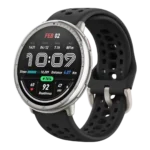
Amazfit Active 2 Feature Scores
Explore all 56 feature scores for Amazfit Active 2, organized into pros and cons.
Scores by Feature
Summary
56 reviewed features-
Very positive 4.5-5.09 (16%)
-
Positive 3.5-4.430 (54%)
-
Neutral 2.5-3.413 (23%)
-
Negative 1.5-2.44 (7%)
Pros
Sort
-
Value for money was the strongest consensus point, with nearly every reviewer calling the feature set exceptional for the price.
-
Reviewers consistently praised the huge workout-mode list and unusually broad sports coverage for a budget watch.
-
Display quality was one of the strongest points, with repeated praise for the AMOLED screen’s color, clarity, and responsiveness.
-
Style and design were a major strength, with repeated praise for the elegant, premium-looking round design at a low price.
-
Battery life was consistently better than typical premium smartwatches, even though always-on or heavy use reduced it to several days.
-
Fitness accuracy was generally strong for runs and many sports, though some reviewers still found gaps against dedicated sports watches or difficult workout types.
-
Outdoor visibility was repeatedly praised, with reviewers saying the screen remained readable in bright sunlight.
-
Comfort was usually positive thanks to the light, thin body, though one reviewer found it less comfortable than premium watches.
-
Notifications were generally reliable and well handled, with richer reply options depending on platform.
-
Customization was a clear strength, covering data fields, button behavior, watch faces, and display options.
-
Smartwatch features impressed for the price, though reviewers still noted barebones non-fitness apps compared with premium platforms.
-
Water resistance was a strong practical point, with reviewers using it in pools, showers, hot tubs, or swims without issue.
-
Cross-platform support was a strength, although some iOS/Android feature differences remain.
-
GPS accuracy was usually considered good for the money, but reviewers reported drift, imperfect curves, or weaker precision in tougher settings.
-
Build quality was widely viewed as strong for the price, with several reviewers saying it did not feel like a budget watch.
-
Step counting was one of the stronger basic metrics, with reviewers reporting close comparisons or very accurate results.
-
Bluetooth was mixed overall: phone and app connectivity complaints appeared, but external sensor and earbud pairing received strong praise.
-
Calling from the wrist was a pleasant surprise, with clear or convenient call handling despite the need for a nearby phone.
-
Software smoothness was mostly positive in daily use, but several reviewers still wanted more refinement and fewer quirks.
-
Brightness was generally excellent, though one reviewer criticized the ambient sensor responsiveness.
-
Materials impressed when reviewers focused on stainless steel or premium feel, though one reviewer found some parts cheap-feeling.
-
Reliability was mostly positive in broad use, although reviewers still flagged software and feature quirks elsewhere.
-
Watch faces were viewed positively, with reviewers praising sharp faces and a large selection.
-
The UI ranged from seamless and fluid to clunky or cramped, depending on reviewer expectations and use case.
-
Fit was mostly good for smaller wrists and monitoring, but some reviewers noted imperfect wrist flushness.
-
Touch responsiveness was strong overall, though one reviewer found it almost too sensitive.
-
Blood oxygen readings were viewed positively where tested, with one reviewer reporting very small deviations and another calling results accurate enough.
-
The companion app offers lots of data and has improved, but reviewers also complained about upselling, usability, and presentation.
-
Heart-rate results ranged from excellent parity in runs to weak performance during harder workouts, intervals, or some reviewer comparisons.
-
Voice assistant feedback was split between useful, surprisingly capable Zepp Flow results and lag, limits, or failed reply workflows.
-
Sleep tracking was often close to Oura-style benchmarks, but several reviewers reported wake-time and light-sleep detection problems.
-
Mapping and navigation were a standout budget feature but also one of the most uneven areas, with map quality, route import, and turn prompts criticized.
-
Pairing was praised in the square-model first look, where setup was described as very easy.
-
The app ecosystem is decent for the price, helped by data syncing, but it remains far from Apple or Google’s app depth.
-
Menu navigation was considered easy overall in the reviews that addressed it.
-
Charging speed was acceptable rather than class-leading, ranging from about 90 minutes to a couple of hours depending on reviewer.
-
Coaching tools were seen as useful and quick to set up, though the strength-training planner and terminology need refinement.
-
Zepp OS drew divided reactions: one reviewer called it buggy, while another praised its feature leadership and battery efficiency.
-
Music controls were a small but positive smartwatch feature, with one reviewer calling the playback widgets well optimized.
Cons
Sort
-
Music storage was a weak point because reviewers either found no onboard music support or complained that the available memory was too limited.
-
Third-party app support exists but reviewers repeatedly described the selection as limited or lacking versus fuller smartwatch platforms.
-
Wellness insights were mixed, with useful free data for some users but weak PAI, light context, or unhelpful algorithms for others.
-
Stress tracking drew criticism because one long-term reviewer said it almost never detected obvious stressful days.
-
Recovery and readiness insights were useful as guidance for some, but multiple reviewers found the scoring overly generous or not very actionable.
-
Wi-Fi was a clear limitation because some features require a nearby phone and the companion app running.
-
LTE was repeatedly treated as a missing option, with reviewers saying it could be a dealbreaker for some users.
-
Reviewers noted the lack of ECG as an expected limitation for this price rather than a surprising omission.
-
Automatic detection was inconsistent: one reviewer saw failed strength recognition, another saw a false motorcycle ride, while a video reviewer praised exercise recognition.
-
Contactless payments are useful in principle but limited by model, region, or the need to buy the premium version.
-
Calorie estimates were mixed: one reviewer found the gap respectable, while another found daily calorie burn much lower than a comparison tracker.
-
Charging convenience was mixed because the battery tools and USB-C puck helped, but reviewers disliked missing cables, proprietary charging, or no Qi.
-
Durability evidence was mixed, with one reviewer seeing scratches and another reporting a scratch-free test period.
-
Size options were limited, though reviewers felt the available size suits smaller-watch buyers.
-
Band opinions were mixed: reviewers praised some included straps but often criticized the silicone band as awkward or finicky.
-
Reviewers split on health accuracy: one found it insensitive or inconsistent, while lab-style checks and broader trend comparisons were more favorable.
-
Button controls were useful and sometimes responsive, but reviewers disliked the layout, tactile feel, or double-press workout behavior.