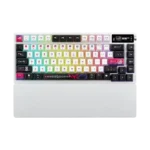
ASUS ROG Azoth X Feature Scores
Explore all 49 feature scores for ASUS ROG Azoth X, organized into pros and cons.
Scores by Feature
Summary
49 reviewed features-
Very positive 4.5-5.022 (45%)
-
Positive 3.5-4.422 (45%)
-
Neutral 2.5-3.43 (6%)
-
Negative 1.5-2.42 (4%)
Pros
Sort
-
Battery life drew near-universal praise, with many reviewers calling it impressive even when RGB or OLED reduced rated endurance.
-
Wireless performance was one of the strongest areas, with reviewers repeatedly reporting stable, drop-free, low-latency operation.
-
Reviewers generally liked the ROG NX Snow V2 switches, describing them as smooth, consistent, and pleasant, with a few noting they still lack Hall-effect gaming behavior.
-
Connectivity was highly praised: reviewers liked tri-mode support, dongle convenience, and smooth switching between wireless modes or devices.
-
Typing feel was the product’s strongest attribute: most reviewers found it smooth, satisfying, comfortable, and close to custom-keyboard quality, though one found it clunkier.
-
Customization options were a major strength, covering disassembly, OLED settings, RGB, macros, web tools, and component tinkering.
-
Key response was consistently praised as snappy, fast, and responsive across typing and gaming, especially with the light linear switches.
-
RGB lighting quality was widely praised for its soft glow, strong brightness, and distinctive translucent-side effect, despite a few muted-lighting complaints.
-
Compatibility was strong thanks to Mac support, PC/Mac switching, MX-style switch compatibility, and south-facing PCB keycap compatibility.
-
Design aesthetics were divisive but mostly positive: reviewers often liked the bold sci-fi white theme, while acknowledging it will not suit every desk setup.
-
Frame rigidity was a strength, with reviewers repeatedly noting no deck flex, no rattle, and a stable body.
-
The wrist rest was broadly welcomed as comfortable and useful, though some disliked the lack of magnets or found it harder than alternatives.
-
Build quality was generally sturdy and solid, but the plastic base, premium-price expectations, and scratch-prone finish produced mixed marks.
-
Sound dampening was a clear strength, with reviewers crediting the foam stack and damping layers for reducing ping and improving sound.
-
Stabilizers were consistently praised, with reviewers noting no rattle, tuned large keys, and clatter-free stability.
-
Switch replacement was praised as straightforward, with reviewers describing access or removal as quick and easy.
-
Acoustics were usually praised as crisp, deep, creamy, or fantastic, although the spacebar inconsistency kept this from being universally excellent.
-
Gaming performance was positive for casual and mainstream play, but reviewers noted it is less compelling for players seeking Hall-effect or esports-focused features.
-
Media controls were generally useful through the OLED and knob, but some reviewers wanted a more conventional or more satisfying control.
-
Key stability was praised through minimal stem wobble, stable keypresses, and no wobble or echo in typing tests.
-
Software quality was sharply mixed: Gear Link was praised as lightweight and easy, while Armoury Crate drew complaints about bloat, crashes, and setup friction.
-
Legend visibility was mostly praised thanks to clear labeling, visible lettering, and sharper printing, though small display icons and stylized legends had caveats.
-
Keycap quality was mixed-positive: many liked the texture, printing, durability, and RGB diffusion, while some disliked the smooth or tacky feel.
-
Hot-swappable switches were seen as a meaningful enthusiast-friendly advantage, especially for users who want to experiment or replace switches.
-
Typing comfort was strong, with reviewers describing long sessions as comfortable, pleasant, and easy.
-
Backlight brightness split reviewers: several found it exceptional or very bright, while one reviewer felt the lighting was underwhelming.
-
Latency evidence was strongly positive, with reviewers reporting delay-free input and no wireless latency problems in testing.
-
Actuation consistency was praised where discussed, with reviewers noting consistent switch feel and minimal friction across keypresses.
-
Desk space efficiency was praised because the keyboard stayed compact without feeling cramped and saved space versus larger layouts.
-
Macro customization was positive where discussed, with reviewers noting easy macro creation and broad remapping support.
-
Volume control was useful for most reviewers, though the toggle implementation was less satisfying to some than a dedicated knob or roller.
-
Reliability was mixed: wireless operation was stable, but software instability and finish scratching hurt confidence.
-
Ergonomics were positive where covered, mainly due to the wrist rest and FR4/typing changes that improved comfort.
-
The 75% size was praised as practical, with reviewers calling it a useful and near-perfect form factor for gaming desks.
-
Extra gaming features were mixed: Speed Tap and the OLED were useful or fun, but reviewers questioned the OLED’s value and noted missing Hall-effect features.
-
Most reviewers found the 1,000Hz polling rate adequate, but several treated the paid 8,000Hz booster requirement as a caveat.
-
Durability evidence was positive but limited, mainly tied to durable dye-sub legends and premium construction.
-
Cable quality had limited positive evidence: reviewers liked the sleeved/braided cable, though one noted its gray color did not match the white board.
-
Layout evidence was limited but positive, with one reviewer saying the layout made sense and was clearly labeled.
-
Portability had limited positive support, mainly from long battery life making the board better for LAN parties or mobile work.
-
Profile management had limited positive evidence, with one reviewer saying profile switching was quick and easy.
-
RGB customization had limited but positive support, with one reviewer highlighting bold color behavior and preset variety.
-
Switch choice received limited but positive coverage, with reviewers noting the option between tactile/clicky and smooth linear ROG NX V2 switches.
-
Key spacing had limited mixed evidence, with one first-impression review noting the smaller-feeling keys may require adjustment.
Cons
Sort
-
Analog input support was consistently marked down because reviewers repeatedly called out the absence of Hall-effect or analog switch features.
-
Rapid trigger support was a repeated weakness because reviewers noted the Azoth X lacks true rapid trigger or relies on Speed Tap instead.
-
Value for money was the most common concern, with many reviewers calling the high price hard to justify despite the strong typing and wireless experience.
-
Noise level was mixed: dampening helped keep the board acceptable, but several reviewers complained about a loud or thunky spacebar and higher overall volume.
-
Materials quality was mixed: PBT caps and metal elements helped, while plastic construction and finish complaints hurt the premium impression.