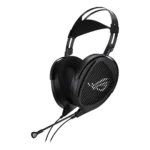
ASUS ROG Kithara Feature Scores
Explore all 53 feature scores for ASUS ROG Kithara, organized into pros and cons.
Scores by Feature
Summary
53 reviewed features-
Very positive 4.5-5.017 (32%)
-
Positive 3.5-4.418 (34%)
-
Neutral 2.5-3.46 (11%)
-
Negative 1.5-2.46 (11%)
-
Very negative below 1.56 (11%)
Pros
Sort
-
Clarity, speed, detail, and natural presentation are the Kithara’s defining strengths across games, music, and media. Most listeners rate it above typical gaming headsets, though a minority finds the sound underwhelming or poorly suited to music.
-
The open-back planar design creates a broad, airy, highly detailed stage that often feels more speaker-like than conventional gaming headsets. A few FPS users disagree sharply about its directional usefulness.
-
Most users find the suspension headband and huge pads exceptionally comfortable for multi-hour sessions. Comfort becomes less reliable on smaller heads or for those sensitive to the 420-gram weight.
-
The box is unusually complete, with two pad sets, multiple cables, modular plugs, a USB-C adapter, and a unit-specific tuning card. Several buyers consider the bundle a major part of the value.
-
Layering, detail retrieval, and frequency separation are major strengths. Busy game scenes, instruments, dialogue, and subtle environmental sounds remain easy to distinguish.
-
Channel matching and overall response consistency are repeatedly praised. The velour pads provide the more linear midrange, while the stock presentation stays close to a neutral studio-style target.
-
Most buyers are enthusiastic about the clarity, comfort, and unusual audiophile-gaming blend, often calling it a favorite or endgame headset. Returns and low scores are concentrated around mic limitations, insecure fit, and quality-control failures.
-
Both leatherette-mesh and velour pads are plush, roomy, and generally comfortable. Velour runs cooler, while a few users find the pads scratchy, thin, pressure-inducing, or insufficiently durable.
-
The swappable 3.5mm, 4.4mm, 6.3mm, dual-3.5mm, and USB-C options cover PCs, consoles, phones, DACs, and amps. The flexibility comes with more cables and setup complexity than a typical gaming headset.
-
Most users hear footsteps, reloads, and distant movement with excellent precision, making the headset strong for competitive play. A smaller group reports merely average or even poor directional placement, so game and listener fit can affect results.
-
Two pad sets are included and meaningfully change comfort and tonality. Velour is softer and smoother, while the hybrid set offers a tighter seal and stronger focus.
-
The restrained metal-and-open-grille styling looks premium and mature to many buyers, though the tall frame and oversized cups can look awkward or comically large on smaller heads.
-
Although there is no dedicated app, the planar drivers respond extremely well to external EQ. Small bass adjustments can add substantial low-end weight without obvious distortion.
-
At around $299, many buyers see unusually strong audiophile sound, comfort, and accessories for the price. Others consider it too expensive once a DAC/amp is added or when compared with more convenient wireless headsets.
-
Hardware noise rejection works well in several tests without software processing, especially against steady background noise and keyboards. Other users report substantial room pickup, so placement and environment matter.
-
The roomy pads and forgiving planar bass work well with glasses, with little loss of low-end response from an imperfect seal.
-
The analog plug-and-play design requires no Armoury Crate or other app. That simplicity appeals to purists but removes built-in EQ, RGB, and surround controls.
-
PC, PlayStation, Switch, phones, and DAC setups are broadly supported, but the required cable or adapter changes by device. Console microphone support is the main complication.
-
Treble is highly detailed and often cleaner than sharper planar rivals, but the tuning varies with pads and can sound bright, forward, restrained, or fatiguing depending on the listener.
-
The stock tuning favors clarity, speed, and competitive detail over heavy bass. Many enjoy it immediately, while others prefer a small low-shelf boost or find it better for gaming than music.
-
The included USB-C adapter expands phone, laptop, Switch, PlayStation, and PC compatibility and supports high-resolution playback. It can add volume, but it is not consistently powerful enough to replace a dedicated DAC/amp.
-
The premium box, sound-signature certificate, and organized presentation make the unboxing feel special, though the large number of parts can initially feel overwhelming.
-
Bass is fast, clean, and easy to separate from the rest of the mix, but stock sub-bass and physical rumble divide listeners. A DAC or modest EQ can add satisfying impact without obvious muddiness.
-
The removable boom mic is useful when switching to music-only listening. Its cable-based design is practical, though balanced listening cannot be combined with the mic in some setups.
-
The large cups offer generous rotation and can sit naturally on the head or lay flat for packing.
-
The planar drivers maintain very low distortion and tolerate aggressive volume or bass EQ cleanly, providing substantial headroom when properly driven.
-
The metal-heavy frame, hinges, and premium finish impress most users, but several customers report serious quality-control failures such as dead drivers, popping, and defective adapters.
-
Midrange detail is generally clean and well separated, but pad choice changes the presentation. Velour sounds more linear, while some listeners hear vocals and instruments sitting slightly farther back.
-
The modular audiophile cable feels premium and the connection options are extensive. The mic cable draws more criticism for feeling cheaper, being cumbersome, or running slightly short.
-
The oversized frame works especially well for large heads and glasses, but smaller heads may struggle to achieve a secure fit. The low clamp can cause slipping even when the acoustic seal remains forgiving.
-
The 420-gram build is objectively heavy, yet the suspension strap distributes it well for many users. Others feel top pressure, jaw pressure, or fatigue, especially when the fit is loose.
-
Voice clarity is good for Discord, Teams, and ordinary calls, but it still sounds like a headset mic and is not a substitute for a dedicated streaming or podcast microphone.
-
Volume is highly source-dependent. Some devices drive it extremely loudly, while controllers and motherboard outputs may require the USB-C adapter or a dedicated DAC/amp.
-
The mic cable is easy to remove and exchange for the dedicated listening cable, making it simple to move between gaming and music setups.
-
The included USB-C adapter improves compatibility and often raises volume, but results vary by device and some users report limited power or inconsistent Windows behavior.
Cons
Sort
-
The extremely open cups provide little to no passive isolation. Household sounds, fans, conversations, and other room noise remain easy to hear.
-
Sound freely escapes the open earcups and can be audible to people nearby. A few users find leakage less severe than expected, but shared rooms remain a poor fit.
-
This is a fully wired headset with no Bluetooth. Buyers who prioritize wireless freedom will need a different model.
-
A recurring complaint is that no carrying case or hard case is included, despite the large headset and extensive cable bundle.
-
Xbox support is a major limitation: audio can work through a controller, but microphone support is absent or requires awkward workarounds.
-
The headset can slide or drop a notch when the clamp or suspension sliders are loose, especially on smaller heads. Properly adjusted replacement units may remain stable.
-
There is no built-in virtual surround or spatial-audio processing. The natural open-back stage can still feel immersive, and external options such as Dolby Atmos may work well.
-
There is no active noise cancellation. The open-back design is intentionally built for awareness rather than blocking the room.
-
The included pads can be swapped, but the small proprietary clips feel fiddly and potentially fragile. Aftermarket choices are also limited by the mounting system.
-
There is no dedicated game/chat mix control, which makes the physical control set feel sparse compared with feature-rich gaming headsets.
-
The metal headband and hinges usually feel robust, yet broader quality-control failures make long-term confidence uneven.
-
The USB-C adapter adds convenient digital connectivity, but its power and quality are inconsistent; the included DAC can feel weak and power-hungry.
-
Console support is not fully plug-and-play: PlayStation mic use may require USB-C, controllers can sound underpowered, and Xbox microphone support is the biggest gap.
-
The cups can rotate flat, but the large wired open-back design is desk-bound and poorly suited to commuting or travel.
-
Clamp is relaxed and comfortable for many large-headed users, but it is often too weak for smaller heads and can let the headset slide during movement.
-
The inline mute and volume controls are convenient, but the wheel can be overly sensitive and some users heard clicks or artifacts when toggling the mic.
-
The suspension band offers broad sizing and can fit very large heads, but loose early units and slipping sliders are a repeated concern. Later replacement or retail units sometimes hold their position correctly.
-
The detachable MEMS mic is clear enough for chat, calls, and meetings, but opinions range from excellent to disappointing. Common complaints include nasal tone, plosive sensitivity, position dependence, and room pickup.