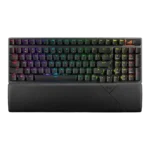
ASUS ROG Strix Scope II 96 Wireless Feature Scores
Explore all 51 feature scores for ASUS ROG Strix Scope II 96 Wireless, organized into pros and cons.
Scores by Feature
Summary
51 reviewed features-
Very positive 4.5-5.017 (33%)
-
Positive 3.5-4.426 (51%)
-
Neutral 2.5-3.45 (10%)
-
Negative 1.5-2.43 (6%)
Pros
Sort
-
Battery life is one of the most consistently praised attributes, with reviewers calling it beastly, impressive, class-leading, or unusually long-lasting.
-
Reviewers repeatedly praised the NX Snow switch feel as smooth, refined, light, and satisfying, with only minor taste-based caveats from those who prefer clickier switches.
-
Wireless performance is strongly positive overall, with reviewers reporting stable, fast, low-lag 2.4GHz use and only small Bluetooth caveats.
-
Acoustics are a major strength, with repeated praise for thocky, deep, muted, and premium-sounding keystrokes.
-
Connectivity is a major strength, with repeated praise for tri-mode wired, 2.4GHz, Bluetooth, multi-device, and dual-PC flexibility.
-
Typing feel is one of the product's strongest reviewed attributes, with broad praise for smooth, satisfying typing and only a small amount of layout or switch-preference pushback.
-
Sound dampening is strongly praised, with reviewers repeatedly crediting foam, pads, and dampening materials for reducing ping, hollowness, and reverberation.
-
Typing comfort is very strong overall, with reviewers reporting comfortable long sessions, pleasant typing, and reduced hand strain.
-
Gaming performance is strongly praised across reviews, with repeated comments about responsive keys, strong wireless gaming behavior, and enjoyable play in competitive and casual contexts.
-
Build quality is consistently strong, with reviewers describing the keyboard as solid, tank-like, well made, and premium-feeling.
-
Latency is a major strength in the evidence: reviewers report low response times, no felt lag, and near-zero wireless delay in real gaming use.
-
Value for money is positive despite the premium price; reviewers often say it is worth it, competitive, or justified by the feature set.
-
Key responsiveness is consistently praised, with reviewers describing fast keystrokes, low effort actuation, reduced accidental presses, and responsive gaming inputs.
-
Frame rigidity is strong across reviews, with evidence about sturdy frames, desk stability, minimal flex, and resistance to twisting.
-
Noise level is mostly positive because the board is quieter than expected, though one reviewer found it neither silent enough nor noisy enough for their taste.
-
Stabilizer quality is mostly praised for smoothness, low rattle, and stable large keys, though one reviewer disliked the proprietary stabilizer design.
-
Wrist rest quality is mostly positive for comfort and magnetic attachment, though reviewers disagree on stiffness and one disliked using it while typing.
-
Volume control is positively reviewed, especially the roller implementation, which several reviewers enjoyed or found handy.
-
Keycap quality is generally positive thanks to PBT or shine-resistant caps, though some regional ABS-keycap comments are more cautious.
-
Media controls are useful and flexible for many reviewers, but one reviewer considered the compact wheel-and-button setup lacklustre.
-
Customization options are strong overall, with many key, lighting, wheel, and software options, though power users may find some limits.
-
Hot-swappable switches are widely praised as a long-term ownership and tinkering advantage.
-
Actuation consistency is viewed positively, with reviewers citing stable presses, minimal mis-presses, consistent keystrokes, and reliable simultaneous key processing.
-
Extra gaming features are well liked, including Game Bar hotkeys, recording controls, built-in shortcuts, and broad feature coverage.
-
Ergonomics are generally positive thanks to the wrist rest, adjustable angle, and typing comfort, with few direct complaints.
-
RGB customization is viewed positively, with reviewers noting per-key control, effects, color customization, and software-based sync options.
-
Size and form factor are mixed-positive: many like the compact numpad layout, while others feel it is stuck between full-size and truly compact boards.
-
Desk space efficiency is usually praised for giving more mouse room, but a minority say the 96% layout does not free up enough meaningful space.
-
Key stability is a strong point: reviewers describe reduced wobble, stable keystrokes, better typing stability, and almost no wobble on the switches.
-
Materials quality is generally good because of aluminum, PBT, foam, and premium-feeling parts, though some reviewers note plastic chassis elements.
-
RGB lighting quality is mixed, ranging from attractive and tasteful to dim, gamery, or less impressive than competitors.
-
Reliability evidence is positive but limited, with reviewers citing uninterrupted wireless sessions and a keyboard that works reliably out of the box.
-
Macro customization is useful and sometimes easy, but one review notes the keyboard only has one programmability layer.
-
Durability evidence is positive overall, especially around PBT caps and long-term build confidence, with one caveat about leatherette longevity.
-
Ease of switch replacement is positive in the limited evidence, with reviewers saying switches can be swapped using the included tools or supported sockets.
-
Profile management is positive where discussed, especially because profiles can be tweaked for games and used after software setup.
-
Cable quality and USB-C handling are generally acceptable, though evidence includes a caution about the recessed USB-C port with third-party cables.
-
Per-key lighting control receives clear positive evidence from one review that described the customization as nearly endless.
-
Onboard memory is praised for letting users store profiles on the keyboard and reduce dependence on the software.
-
Polling-rate evidence is limited to one review, but it links the 1000Hz behavior to more responsive-feeling inputs for competitive play.
-
Compatibility is mixed: reviewers liked device flexibility and ROG receiver pairing, but macOS software customization is limited.
-
Portability is mixed: one reviewer liked taking it along easily and another said it fits a backpack, while another found it not exactly portable.
-
Evidence on switch options is limited, but the available reviewer sentiment says buyers choosing between the Snow and Storm styles should be happy either way.
Cons
Sort
-
Software quality is the clearest recurring weakness: Armoury Crate is described as bloated, slow, cumbersome, annoying, or hard to navigate despite useful controls.
-
Analog input support is a limitation rather than a strength, with reviewer evidence pointing analog-gaming shoppers toward a different keyboard.
-
Backlight brightness is a weak spot in the evidence, with PCMag specifically calling the RGB lighting underwhelming and dim.
-
Rapid-trigger support is a weakness for niche rhythm or rapid-trigger-focused players, with one reviewer saying another board would be better for that demand.
-
Legend visibility is mixed to negative: reviewers liked some fonts, but several found the gamer styling or unlit secondary legends harder to read.
-
Layout options are polarizing: reviewers like the full-size key coverage in a 96% design, but several struggled with muscle memory or cramped placement.
-
Key spacing is the most common layout complaint, with reviewers repeatedly noting cramped keys, adjustment time, or awkward muscle-memory changes.
-
Design aesthetics are mixed: one reviewer called it gorgeous, while others disliked the gamer font or floating-key look.