- Similar: PM2.5 removal speed PCMag found the 311i Max matched the Levoit Vital 200S in its PM2.5 scrub test.
- Similar: particle removal performance AirPurifierFirst placed the 311i Max's particle result on the same level as the Levoit Vital 200S.
- Better: particle removal speed and price HouseFresh measured the 311i Max as slower than the cheaper Levoit Vital 200S.
Blueair Blue Pure 311i Max Review
Bottom Line
Choose the Blueair Blue Pure 311i Max for fast, quiet particle cleaning, low energy use, and easy app control. Skip it if VOCs, serious odors, no-ionizer operation, or a fully childproof lock matter most.
Best for people who mainly need fast particle reduction in bedrooms, living rooms, offices, or medium-to-large spaces. Review evidence is strongest for smoke particles, dust, pollen, pet dander, quiet sleep use, and low running costs.
Not ideal for people whose main concern is VOCs, chemical off-gassing, serious odors, or avoiding ionization entirely. It is also weaker for buyers who want a fully childproof lock, a built-in numeric PM2.5 display, or a handle.
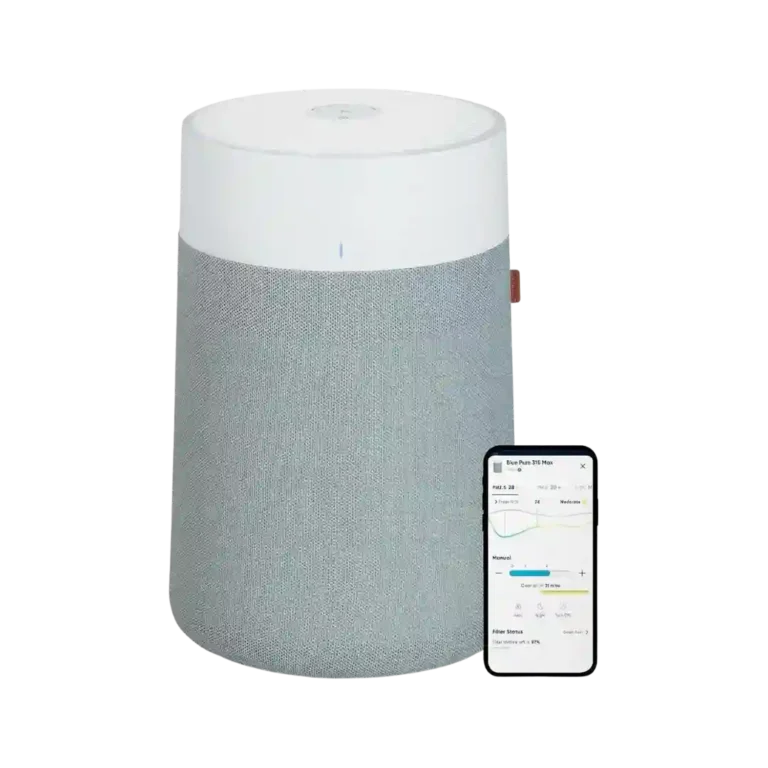
Across the review set, the Blueair Blue Pure 311i Max stands out for rapid particle removal, quiet low-speed operation, efficient power use, and a polished app experience. Reviewers repeatedly liked it for bedrooms, medium-to-large rooms, and everyday pollutants such as smoke particles, dust, pollen, and pet dander. The tradeoff is filtration philosophy: its HEPASilent system is effective, but reviewers noted it is not technically a True HEPA filter and uses an always-on ionizer that produces small certified-low ozone levels. The carbon layer is also a weak point, making VOCs and serious odors the least convincing use case.
Compared in Reviews
Products reviewers directly compared with this model, grouped into quick takeaways.
- More expensive: monthly electricity cost AirPurifierFirst said the 311i Max costs much less to run than the Winix 5510 under the same conditions.
Austin Air HealthMate Jr.
- Better: smoke removal and carbon capacity AirPurifierFirst used the Austin Air HealthMate Jr. as an example of a stronger smoke purifier with far more carbon.
Feature Scorecards
Summary
49 reviewed features- Very positive 4.5-5.0 39% 19 features
- Positive 3.5-4.4 33% 16 features
- Neutral 2.5-3.4 24% 12 features
- Negative 1.5-2.4 4% 2 features
- Very negative below 1.5 0% 0 features
Pros
-
Voice assistant compatibility was excellent in the available evidence, with Alexa commands working perfectly.
-
Smoke particle removal was repeatedly praised, including fast chamber clearing and strong real-world smoke handling.
-
Wi-Fi reliability was positive in the reviews that tested it, including immediate connection and no connection drops.
-
Fan speed control was praised, especially because the app allows fine-tuning beyond simple preset levels.
-
Pollen performance was praised alongside other particles, especially in tests and summaries focused on allergen-heavy use.
-
Power consumption was praised as low for the airflow delivered, with reviewers citing low wattage and low monthly or yearly energy cost.
-
Sleep mode received very strong praise for quiet operation and dimmed lights, making the unit suitable for bedrooms.
-
Allergen reduction was strongly positive where mentioned, especially for pollen and pet dander as part of rapid particle removal.
-
Pet dander removal was rated highly where tested, with reviewers grouping it with rapidly removed airborne allergens.
-
Particle removal was the strongest consensus point, with reviewers reporting rapid PM and smoke-particle reductions and several calling it among the best tested.
-
Energy efficiency was one of the clearest strengths, with reviewers repeatedly calling the motor and running costs well optimized.
-
Reviewers consistently described the 311i Max as a strong purifier, with lab and home tests praising fast, effective air cleaning across multiple spaces.
-
App connectivity was a strong positive, with reviewers reporting easy setup, useful controls, and dependable day-to-day operation.
-
The washable prefilter was consistently praised for being easy to clean, reusable, and helpful for catching larger debris.
-
Auto mode was well received as useful and responsive, increasing fan speed when pollution rises and saving energy or filters when air is cleaner.
-
CADR and airflow were rated strongly, with reviewers tying the 250 CFM class performance to quick cleaning and good efficiency.
-
Air changes per hour evidence was positive, with one review noting the unit could cycle air often enough to keep up in a suitable room.
-
Reliability evidence was limited but positive, with long-term use since 2023 described as consistently handling smoke, dust, and pollen.
-
Smart features were rated well overall, including app control, sensor support, routines, voice control, and useful operating modes.
-
Portability was generally positive because the purifier is light for its class, despite broader size and handle caveats.
-
Room coverage was broadly praised for medium-to-large spaces, though some reviewers still framed ideal use around recommended room sizes.
-
Dust removal evidence was positive, with reviewers saying dust was tackled well and visibly captured by the prefilter.
-
Maintenance was mostly rated easy, especially main filter replacement, with one caveat about the fabric prefilter needing finesse.
-
Design and appearance were widely praised for modern, attractive styling, though one reviewer disliked the exposed prefilter look.
-
Filter-stage feedback was positive in the supporting review because the large cylindrical filter was framed as a practical filtration advantage.
-
Safety certification evidence was positive, with CARB certification used as support that ozone emissions remain within strict limits.
-
Noise feedback was mostly positive at low and normal settings, but reviewers flagged buzzing or less-than-ideal sound at higher speeds.
-
Real-time monitoring was positive, especially through app access to current and historical indoor air quality data.
-
PM2.5 detection was treated as a useful smart feature, though most detailed numeric readings appear through the app rather than a built-in display.
-
Value for money was mostly positive thanks to performance, app features, and low running cost, but one review preferred cheaper HEPA competitors.
-
Scheduling was useful and generally easy, though the evidence emphasizes basic app routines rather than advanced timer options.
-
HEPA-related filtration was mixed: reviewers found it effective at particle capture, but some criticized the proprietary non-True-HEPA approach.
-
The prefilter drew mixed feedback: several reviewers liked its washable, easy-clean fabric design, while others disliked exposed debris or harder refitting.
-
Filter cost opinions were mixed, with some calling costs fair or lower than peers and one reviewer saying annual filter cost was comparatively high.
-
Build quality was viewed as adequate rather than premium, with one reviewer calling it good enough but not extraordinary.
Cons
-
Filter life was mixed: reviewers accepted the 6-to-9-month range, but several considered replacement more frequent than competing models.
-
Filter availability was mixed: generic replacements were seen as helpful, while model/filter changes raised the risk of buying the wrong filter.
-
Size and footprint feedback was mixed, with reviewers calling it somewhat bulky or harder to move despite its light weight.
-
Handle design was a mild drawback; reviewers found the unit movable but explicitly said a handle would help.
-
Indicator light feedback was mixed: the color LED was useful, but one reviewer disliked lights remaining on in night mode.
-
Display readability was mixed to weak because reviewers wanted clearer numeric PM2.5 information or more quantitative LED color meanings.
-
Odor reduction was mixed: reviewers found it adequate for light everyday smells but weak for serious odors.
-
The activated carbon layer was the most criticized filter element, generally described as thin or weaker than pellet-based carbon.
-
Ozone-free operation was a concern: reviewers noted low certified ozone levels, but also an always-on ionizer that cannot be disabled.
-
Sensor accuracy drew concern from reviewers who identified the sensor as optical and less accurate or maintenance-sensitive than laser sensors.
-
Durability evidence was limited and negative, centered on concern that the visible fabric prefilter can deteriorate over time.
-
Reviewers repeatedly noted that the filter is not technically True HEPA, which mattered most to reviewers focused on proven filter standards.
-
VOC reduction was a clear limitation, with multiple reviewers saying chemical filtering lagged behind particle performance.
-
Child lock was a weakness in the only opinionated review, which found it not fully childproof.
Compared With Category Average
Compared with other Air Purifiers, this product is above average in app connectivity, smart features, below average in ozone-free operation, durability, child lock.
Summary
8 compared features- Above average 0.4+ pts higher 25% 2 features
- Same as average within 0.3 pts 0% 0 features
- Below average 0.4+ pts lower 75% 6 features
| Attribute | This product | Category average | Difference |
|---|---|---|---|
| ozone-free operation | 2.5 | 4.5 | -2.0 |
| durability | 2.5 | 4.2 | -1.7 |
| child lock | 2.2 | 3.7 | -1.5 |
| app connectivity | 4.6 | 3.4 | +1.2 |
| display readability | 2.8 | 4.0 | -1.2 |
| smart features | 4.5 | 3.4 | +1.1 |
| VOC reduction | 2.3 | 3.4 | -1.1 |
| air quality sensor accuracy | 2.5 | 3.6 | -1.1 |
FAQ
Is the Blueair Blue Pure 311i Max good at removing particles?
Yes. Multiple reviewers praised its particle removal, including fast PM2.5 and smoke-particle clearing in lab tests.
Is it quiet enough for a bedroom?
Yes for most bedroom use. Reviewers repeatedly praised Sleep Mode and low-speed noise, though some noted buzzing or less pleasant sound at higher speeds.
Does it remove odors and VOCs well?
Only lightly. Reviewers found everyday odor handling acceptable in some cases, but VOC and serious odor filtration were recurring weaknesses.
Is the filter a True HEPA filter?
Reviewers repeatedly said it is not technically True HEPA. They still found particle performance strong, but the filter design may matter to buyers who want a proven True HEPA standard.
Does the 311i Max produce ozone?
Reviewers noted that its HEPASilent system uses an ionizer and produces small certified-low ozone levels. The bigger caveat is that the ionizer cannot be disabled.
How good is the app?
The app was one of the better-liked features. Reviewers reported easy setup, useful controls, scheduling, air-quality data, and reliable connectivity.
Sample Expert Reviews We Analyzed
These are a few of the reviews included in our analysis.
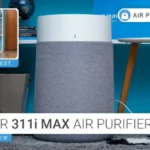
Video Reviews
- Review score
- 4.1/5
- Review score
- 4.3/5
- Review score
- 4.6/5
Article Reviews
- Review score
- 3.6/5
Consider This Instead
If you want better ozone-free operation
Choose Levoit Vital 200S. It scores 5.0 vs 2.5 for ozone-free operation, with a 4.3 overall score.
If you want better VOC reduction
Choose Blueair Blue Pure 511i Max. It scores 4.7 vs 2.3 for VOC reduction, with a 4.3 overall score.
If you want better child lock
Choose Blueair Blue Pure 211i Max. It scores 4.7 vs 2.2 for child lock, with a 3.9 overall score.
If you want better durability
Choose Coway Airmega Mighty AP-1512HH. It scores 5.0 vs 2.5 for durability, with a 3.8 overall score.
Overall Top Air Purifiers Alternatives
Best for compact rooms, strong particle removal, quiet sleep use, and useful app controls. Skip it for large spaces, heavy odors, or exact PM2.5 readings.
Pros: Wi-Fi reliability, filter stages
Cons: PM2.5 detection
Best for fast particle removal, quiet smart bedroom use, pet-friendly pre-filtering, and strong value. Skip it for medical HEPA certainty, serious VOC/odor problems, premium design, or very large spaces needing...
Pros: allergen reduction, safety certifications
Cons: PM2.5 detection, true HEPA filter
Best for quiet, efficient bedroom air cleaning, strong app controls, and low upkeep costs. Skip it for large open spaces, pet-heavy homes, or buyers needing fast, highly accurate sensors.
Pros: energy efficiency, power consumption
Cons: handle design, air quality sensor accuracy
Best for quiet, efficient small-room purification with useful smart controls. Skip it for large rooms, detailed VOC monitoring, or fully reliable auto/app behavior.
Pros: ozone-free operation, safety certifications
Cons: VOC sensor accuracy, handle design