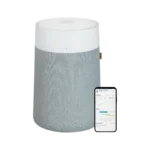
Blueair Blue Pure 311i Max Feature Scores
Explore all 49 feature scores for Blueair Blue Pure 311i Max, organized into pros and cons.
Scores by Feature
Summary
49 reviewed features-
Very positive 4.5-5.021 (43%)
-
Positive 3.5-4.414 (29%)
-
Neutral 2.5-3.49 (18%)
-
Negative 1.5-2.45 (10%)
Pros
Sort
-
Particle removal was the strongest area, with lab and home tests reporting fast PM2.5, smoke-particle, and general pollutant reductions across nearly all sources.
-
Reviewers broadly praised the purifier’s core cleaning ability, describing it as solid, efficient, powerful, or among the best tested; one negative-value review still acknowledged its airflow but did not recommend it overall.
-
Energy efficiency was a major strength, with reviewers repeatedly highlighting low energy use and strong CADR-to-watt performance.
-
App connectivity was a consistent strength: reviewers repeatedly said setup was easy, controls were useful, and the app worked well.
-
Power consumption evidence was strongly positive, with low wattage and low annual or monthly electricity costs repeatedly noted.
-
Room coverage was generally praised for medium to large spaces, though a few reviewers framed ideal use around more moderate room sizes.
-
Noise was mostly praised at low or sleep settings, but some reviewers complained about top-speed loudness or buzzing.
-
Design and appearance were widely praised for modern, stylish, fabric-wrapped looks, though one reviewer disliked visible debris on the exposed filter.
-
The washable pre-filter was consistently praised as easy to wash or clean, with reviewers liking its role in maintenance.
-
Auto mode was viewed as useful and responsive, with reviewers noting automatic fan adjustments and energy or filter savings.
-
Sleep mode was mostly excellent for bedroom use, though one reviewer disliked that night mode left an LED illuminated.
-
CADR and airflow were viewed positively, with reviewers describing the 250 CFM class performance and CADR-to-power ratio as strong.
-
Smoke-particle removal was one of the clearest strengths, with reviewers reporting fast smoke clearing in lab chambers and real living spaces.
-
Wi-Fi reliability was praised where reviewers reported immediate connection or no connection drops.
-
Value was generally strong because reviewers liked performance, efficiency, and pricing, though one review rated the unit poorly versus HEPA competitors.
-
Smart features were praised overall, especially app control, air quality sensing, auto mode, and scheduling.
-
Maintenance was generally easy, especially filter replacement and setup, although some reviewers found the fabric sleeve fiddly.
-
Scheduling was praised as useful and easy, especially through the app for routines and daily operation.
-
Fan speed control was praised, especially through app-based fine tuning and simple controls.
-
Portability was generally positive thanks to the light body, despite some caveats about bulk and missing handle.
-
Allergen reduction was praised through rapid removal of dust, pollen, pet dander, and other small and large airborne particles.
-
Pet dander removal was treated positively, especially where reviewers said common allergens and pet-related particles were rapidly removed.
-
Pollen removal was praised as part of the purifier’s strong allergen and particle-cleaning performance.
-
Voice assistant support was positively scored because Alexa commands worked perfectly in two reviews.
-
The fabric pre-filter was usually praised for easy washing and styling, though some reviewers disliked its exposed debris and removal difficulty.
-
Filter replacement cost was split between fair OEM pricing in positive reviews and higher yearly costs versus top competitors in one negative review.
-
Dust removal was directly praised in long-term use where the unit was said to handle dust like a champ.
-
Air changes per hour were scored where a reviewer judged the unit able to cycle room air around five times per hour in a realistic room-size recommendation.
-
Filter-stage design was praised in one review because the large cylindrical filter occupied much of the device and aided filtration.
-
Real-time monitoring was praised where the sensor and app allowed users to check current air quality at any time.
-
Reliability was supported by long-term use evidence showing it continued tackling dust, smoke, and pollen since 2023.
-
PM2.5 detection was useful but limited, with reviewers appreciating live PM2.5 monitoring while noting missing detail or no on-unit numeric display.
-
Safety certification evidence was positive where CARB certification was described as strong proof of safe ozone emissions.
-
Build quality was judged adequate but not exceptional in the one review with opinionated build-quality evidence.
-
Size and footprint were mixed: the unit was light, but reviewers still called it somewhat bulky or harder to move.
Cons
Sort
-
True HEPA support was a recurring caveat because reviewers noted Blueair’s HEPASilent approach is not technically a true HEPA filter.
-
Activated carbon performance was the most criticized filtration stage, with several reviewers calling the carbon fabric thin or weaker than pellet carbon.
-
Ozone-free operation was mixed to negative because the purifier produces small ozone amounts and the ionizer cannot be disabled, despite low or certified levels.
-
Air quality sensor accuracy was a concern in the evidence because reviewers criticized the optical sensor as less sensitive and maintenance dependent.
-
VOC reduction was consistently a limitation, with multiple reviewers saying chemical filtration trailed particle performance or was not effective enough.
-
Child lock was a weakness in the one opinionated review that said it was not fully childproof.
-
Handle design was a recurring weakness, with reviewers saying a handle would have improved room-to-room movement.
-
Indicator lights were criticized because the reviewer wanted a way to turn all lights off at night.
-
Odor reduction was mixed: reviewers found it acceptable for light everyday smells but weak for serious odors because of the limited carbon media.
-
Display readability was mixed to negative because reviewers wanted numeric PM2.5 display or better night light control.
-
Durability was a concern in the one review that warned the exposed fabric pre-filter would deteriorate over time.
-
Filter availability and options were mixed, with generic filters helping cost but model-specific designs and limited application filters raising concerns.
-
HEPA-style filtration drew mixed responses: reviewers accepted household effectiveness but criticized the proprietary particle filter compared with standard HEPA filters.
-
Filter life was mixed: washable pre-filter benefits helped, but several reviews disliked or cautioned about 6-to-9-month replacement intervals.