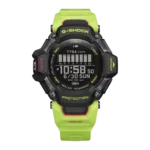
Casio G-Shock GBD-H2000 Feature Scores
Explore all 49 feature scores for Casio G-Shock GBD-H2000, organized into pros and cons.
Scores by Feature
Summary
49 reviewed features-
Very positive 4.5-5.010 (20%)
-
Positive 3.5-4.414 (29%)
-
Neutral 2.5-3.415 (31%)
-
Negative 1.5-2.42 (4%)
-
Very negative below 1.58 (16%)
Pros
Sort
-
Battery life is one of the strongest areas, with reviewers praising solar assistance, week-plus use, and sometimes near charge-free ownership.
-
Band quality is one of the most consistently praised physical attributes, with reviewers calling it flexible, comfortable, pliable, and secure.
-
Durability is usually a major strength, though one drop-test failure shows the toughness is not unlimited.
-
Comfort is surprisingly strong for such a large watch, helped by light weight and strap design, though cycling and overnight wear were issues for some.
-
Fit is strong when the strap and lugs hold the watch in place, especially compared with older bulky models.
-
Outdoor visibility is a major strength, with multiple reviewers finding the display easy to read outdoors and in bright sunlight.
-
Style and design are a major selling point for G-Shock fans, though the bold look is not universally liked.
-
Charging convenience is excellent because solar charging reduces how often users need the proprietary cable.
-
Build quality is praised as rugged and tank-like, with reviewers noting the watch looked good after hard outdoor use.
-
Overall fitness tracking is broadly respected, especially for casual running and activity logging, though one review flagged wider data discrepancies.
-
Brightness and backlight impressions were very positive where reviewers mentioned them.
-
Water resistance is praised as a strong G-Shock advantage, with reviewers highlighting 200m protection.
-
Customization is mostly good, especially data pages and watch-face options, though one reviewer wanted more watch-face control.
-
GPS distance and tracks were often accurate, but slow satellite lock and occasional drift made the experience inconsistent across reviewers.
-
Display quality is generally strong for outdoor readability and glanceable stats, but a few reviewers disliked its basic monochrome presentation.
-
Energy-use and calorie-related views were appreciated as useful workout context, though accuracy depends on the heart-rate data feeding them.
-
Sleep tracking received strong praise from reviewers who could wear the watch overnight, but one reviewer could not get sleep data because fit and comfort interfered.
-
Bluetooth connectivity was generally dependable in positive reviews, though one owner still reported occasional app-side bugs.
-
Recovery insights are useful when the underlying data is accurate, but some reviewers found the numbers abstract while others praised the actionable HRV-style feedback.
-
Charging speed is considered acceptable to good, with reviewers reporting roughly two to two-and-a-half hours for a full or top-up charge.
-
Auto-pause was praised as accurate and useful during runs.
-
Blood oxygen tracking was lightly covered but positively judged in the one review that evaluated it directly.
-
Health metrics were treated as directionally useful, with trends matching reviewer expectations even when the watch was not positioned as a deep health device.
-
Watch face quality was judged positively by the one reviewer who discussed the available face choices.
Cons
Sort
-
Third-party app support is one of the clearest weaknesses, especially the lack of Strava, Polar Flow, Apple Health, Google Fit, and export options.
-
Mapping and navigation are repeatedly criticized because the watch records GPS but lacks route import, breadcrumb guidance, or meaningful navigation help.
-
The app ecosystem is restrictive, with reviewers repeatedly objecting to trapped data and limited syncing with outside services.
-
Music controls are weak or absent, with reviewers noting no music support or media-control capability.
-
Call handling is essentially absent and was criticized when compared with fuller smartwatches.
-
Software smoothness is a recurring complaint, with lag, slow menu movement, and processor-speed criticism appearing in multiple reviews.
-
Contactless payment support is absent and was listed as part of the watch’s minimal smartwatch feature set.
-
ECG is effectively a missing health feature, noted as part of the watch’s limited deep-health toolkit.
-
Stress tracking is not a strength; one review grouped it with other deeper health metrics that are largely absent.
-
The companion app is the largest usability complaint: it can work, but reviewers frequently called it clunky, confusing, ad-heavy, or poorly organized.
-
Menu navigation is a weak spot, with reviewers calling it fiddly and difficult to move between pages.
-
The user interface ranges from basic-but-workable to complicated and not user-friendly, with the negatives outweighing the positives.
-
Smartwatch features are modest; reviewers liked some widgets and sensors but consistently placed it below full smartwatch experiences.
-
Size options are a limitation because reviewers repeatedly warn that the large case will not suit every wrist.
-
Pairing and syncing are inconsistent: one setup was straightforward, while other reviewers reported connection terminations and repeated sync attempts.
-
Materials quality is mixed; one reviewer appreciated the lightness but felt the plastics and resin were less premium.
-
Notification handling is mixed: some reviewers found it sufficient for glanceable alerts, while others complained about delays, buzzing, and no replies.
-
Coaching feedback is basic and sometimes hard to interpret, though some Polar-powered training messages were appreciated.
-
Reliability is uneven: ruggedness earns praise, but app bugs and missed workout starts hurt confidence.
-
Heart-rate evidence is split: several running and chest-strap comparisons were strong, but cycling, tattoos, and some outdoor sessions produced questionable or inflated readings.
-
Workout variety is improved over prior G-Shock models but still trails fuller sports watches, with reviewers repeatedly calling the supported profile list limited.
-
Button controls divide reviewers: some found them easy and tactile, while many complained about mushy, unresponsive, or multi-press behavior.
-
The operating system is viewed as a meaningful step forward by one reviewer, but another still found the overall experience only middling.
-
Wellness insights collect a lot of useful sleep, recovery, and body-state information, but presentation and actionability are uneven.
-
Value is highly context-dependent; G-Shock fans often see value, while sports-watch reviewers criticize the $399 feature tradeoff.