- Better: heart rate accuracy Connect The Watts finds heart-rate accuracy good but not quite at Apple Watch level.
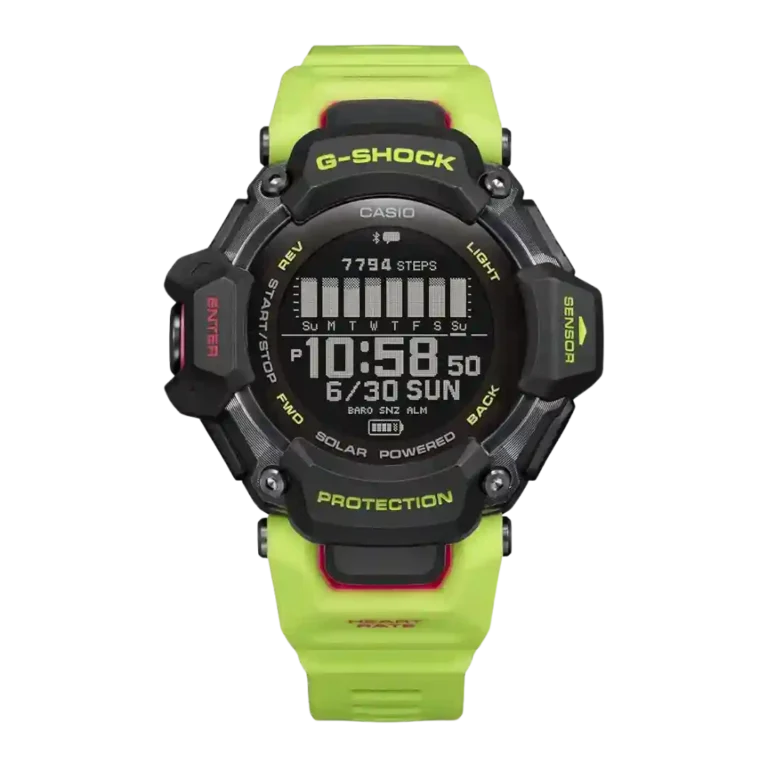
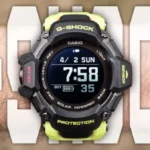
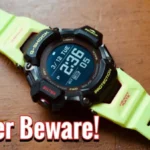
Casio G-Shock GBD-H2000 Review
Bottom Line
Choose it for G-Shock toughness, solar-assisted battery, and solid run tracking. Skip it if you need Strava sync, rich smartwatch apps, music, calls, or a polished companion app.
Best for G-Shock fans, runners, gym users, hikers, and casual athletes who prioritize rugged design, long battery life, button controls, and glanceable fitness data over a full smartwatch platform.
Not for users who need Strava or Apple Health syncing, onboard music, call handling, contactless payments, advanced navigation, or a polished training app with deep explanations.
The Casio G-Shock GBD-H2000 stands out as a rugged hybrid for people who want a real G-Shock first and a fitness wearable second. Reviewers repeatedly praise the lighter case, comfortable bio-resin strap, solar-assisted battery life, strong outdoor readability, and generally capable GPS and activity tracking. The tradeoff is that its software ecosystem feels much weaker than the hardware: the Casio app is often described as busy, confusing, or buggy, and third-party syncing is largely absent. Heart-rate accuracy is credible for running in several reviews but less dependable for cycling and some optical-sensor scenarios. It works best when its durability and design matter as much as the metrics.
Compared in Reviews
Products reviewers directly compared with this model, grouped into quick takeaways.
- Worse: rugged exterior and watch design The reviewer positions the GBD-H2000 as tougher and more watch-like than an Apple Watch Ultra-style smartwatch.
- Cheaper: workout companion value Wareable says a Garmin Forerunner 255 costs less and presents workout analysis better.
Feature Scorecards
Pros
-
Water resistance is a strong, consistent advantage, with many reviews citing the 200-meter or 20-bar rating.
-
Review evidence supports a strong auto-pause implementation, but broader automatic activity recognition is not a major theme.
-
Outdoor visibility is a strong point, with reviewers repeatedly describing the display as easy to read outside and in bright light.
-
Charging convenience is a major positive thanks to solar charging plus a backup USB/proprietary charger.
-
Battery life is one of the strongest recurring positives, helped by solar charging and long runtime in normal watch use.
-
Durability is a core strength, with multiple reviewers emphasizing G-Shock toughness, protective lugs, and rugged construction.
-
Band feedback is generally positive, with reviewers praising the pliable bio-resin strap and improved wrist stability.
-
Build quality is consistently framed as rugged and sensor-packed, with the classic G-Shock protective design remaining central.
-
Brightness and backlighting are well regarded, especially the clear backlight and readable screen in low-light moments.
-
Style and design are a major selling point for G-Shock fans, though reviewers agree the bold look is not universal.
-
Comfort is better than earlier large G-Shocks and often praised, though some cycling and sleep-use cases expose the watch’s bulk.
-
Charging speed is described as reasonable, with reviewers mentioning about two to two-and-a-half hours for a full or meaningful top-up.
-
Health tracking accuracy benefits from Polar algorithms and useful sensors, but its value depends on the accuracy of the underlying readings.
-
Blood oxygen tracking is present and usually discussed as part of the improved sensor package, though it is not deeply tested in every review.
-
Fitness tracking accuracy is broadly good for running and general activity, but not uniformly reliable across every sport or metric.
-
Cross-platform notification support is a plus, with evidence that it can work with both iPhone and Android.
-
Sleep tracking receives several positive accuracy comments, but the watch’s size can limit overnight comfort for some reviewers.
-
Materials quality is seen as lightweight and practical due to bio-resin construction, though at least one reviewer finds it less premium than metal rivals.
-
GPS accuracy is usually praised once locked, though several reviewers note slow lock times or occasional drift.
-
Bluetooth connectivity works for phone syncing and notifications, but some reviewers report occasional bugs or reconnection friction.
-
The operating system is lean and functional, but it carries a learning curve and relies heavily on button navigation.
-
Display quality is functional rather than fancy, but reviewers often praise its contrast, readability, and low-power practicality.
-
Calorie and energy-source data can be useful, but confidence depends on heart-rate accuracy and the app’s ability to explain the numbers.
-
Fit is generally improved through strap holes and stabilizing wedges, though the large case may still be too much for smaller wrists.
-
Recovery insights are present through Nightly Recharge, cardio load, strain, and related Polar features, though presentation can be confusing.
-
Customization is mixed: data fields and some watch faces can be configured, but watch-face freedom is limited compared with mainstream smartwatches.
-
Stress tracking is lightly supported through breathing exercises, nervous system status, and wellness features rather than a deep stress platform.
Cons
-
Wellness insights cover steps, calories, sleep, recovery, and daily body status, but the app presentation often limits usefulness.
-
Workout variety is improved over earlier G-Shocks but still limited compared with modern sports watches.
-
Coaching features exist through Polar-derived cardio load, training status, and daily advice, but several reviewers find the guidance too opaque for beginners.
-
Watch face quality is mixed, with some customization available but reviewers wanting more flexible and personal designs.
-
Safety-adjacent features are limited but include pressure alerts and outdoor planning information rather than full emergency tools.
-
Heart-rate accuracy is mixed: reviewers praise it on runs and indoor sessions, but cycling and some optical readings produce questionable results.
-
Button controls split reviewers: some find them large and usable, while others complain about mushy, unresponsive, or laggy presses.
-
Smartphone notifications are useful for glanceable alerts, but interactivity is limited and delays or buzzing can become annoying.
-
Value is divisive: some see strong G-Shock value, while many think it is expensive beside Apple, Garmin, Coros, and other sports-watch rivals.
-
The user interface is usable after learning it, but reviewers often call it basic, quirky, complicated, or not very consumer-friendly.
-
Pairing reliability is mixed: some reviewers report reliable Bluetooth use, while others mention buggy app syncing or reconnections.
-
Software smoothness is inconsistent, with reviewers noting lag, slow reactions, bugs, and improvements over the previous generation.
-
The companion app is the most common pain point, with reviewers calling it busy, confusing, ad-heavy, buggy, or underdeveloped despite useful data.
-
Reliability is mixed because the rugged hardware impresses, but app bugs and syncing issues keep appearing in reviews.
-
Menu navigation is a weakness, with several reviewers describing the interface and app paths as confusing or hard to navigate.
-
Smartwatch features are intentionally minimal, so the watch cannot match fuller Apple, Samsung, or Wear OS-style devices.
-
The ecosystem is a weak point because reviewers repeatedly note that data is trapped in Casio’s app instead of flowing to broader platforms.
-
Third-party app support is one of the clearest weaknesses because reviewers repeatedly mention no Strava, Polar Flow, Apple Health, or Google Fit sync.
-
Call handling is poor because reviewers describe notifications but no real ability to take calls or interact deeply from the watch.
-
Music controls are effectively absent, with reviewers noting no music or media-control functionality.
-
Touchscreen responsiveness is not applicable in practice because the watch has no touchscreen.
-
Contactless payments are absent, making the watch weaker than full smartwatch rivals.
-
ECG functionality is essentially absent, and reviewers explicitly contrast that with deeper health watches.
-
Onboard music storage is not supported; reviewers describe no music integration or support.
Compared With Category Average
Compared with other Smart Watch, this product is below average in touchscreen responsiveness, music controls, call handling.
| Attribute | This product | Category average | Difference |
|---|---|---|---|
| touchscreen responsiveness | 1.0 | 3.7 | -2.7 |
| music controls | 1.0 | 3.5 | -2.5 |
| call handling | 1.0 | 3.1 | -2.1 |
| app ecosystem | 1.5 | 3.6 | -2.1 |
| third-party app support | 1.2 | 3.1 | -2.0 |
| menu navigation | 2.0 | 3.8 | -1.8 |
| contactless payments | 1.0 | 2.9 | -1.9 |
| onboard music storage | 1.0 | 2.9 | -1.9 |
FAQ
Is the Casio G-Shock GBD-H2000 a full smartwatch?
No. Reviewers describe it more as a rugged G-Shock with fitness tracking, notifications, and sensors than as a full smartwatch with apps, calls, payments, or music.
How good is the battery life?
Battery life is one of its strongest areas. Reviews repeatedly praise solar-assisted charging, week-plus use, and long watch-mode runtime, though GPS-heavy use drains it faster.
Is the GBD-H2000 accurate for workouts?
Workout accuracy is mixed but generally positive for running and GPS distance. Heart-rate readings are praised in some run tests but criticized during cycling and some optical-sensor situations.
Does it sync with Strava, Apple Health, or Google Fit?
Reviewers repeatedly say third-party syncing is missing. That makes the watch frustrating for users who want their workout history outside the Casio ecosystem.
Is it comfortable despite the large G-Shock design?
Many reviewers say the lighter body and softer strap make it surprisingly comfortable, especially compared with older G-Shock Move models. Some still found it bulky for cycling positions or sleep.
What is the biggest drawback?
The companion app and ecosystem are the most repeated drawbacks. Reviewers describe the app as busy, confusing, buggy, or too limited for serious data analysis.
Consider This Instead
If you want better touchscreen responsiveness
Choose Fitbit Sense 2. It scores 4.9 vs 1.0 for touchscreen responsiveness, with a 3.5 overall score.
If you want better third-party app support
Choose Samsung Galaxy Watch 8. It scores 4.8 vs 1.2 for third-party app support, with a 4.0 overall score.
If you want better contactless payments
Choose Apple Watch SE 3. It scores 4.8 vs 1.0 for contactless payments, with a 4.1 overall score.
If you want better call handling
Choose Huawei Watch Fit 4 Pro. It scores 4.6 vs 1.0 for call handling, with a 4.0 overall score.
Overall Top Smart Watch Alternatives
Good if you want the most rugged Apple Watch, brighter outdoor screen, better battery, LTE, and top apps. Skip it if you need Garmin-like mapping, recovery analytics, smaller sizing, or...
Pros: display quality, heart rate accuracy
Cons: cross-platform compatibility, recovery insights
Choose the Galaxy Watch 6 for a polished Android smartwatch with a bright screen, strong apps, and broad health tracking. Skip it if battery life, iPhone support, or full non-Samsung...
Pros: outdoor visibility, workout tracking variety
Cons: cross-platform compatibility, battery life
Good if you need a rugged Garmin with deep outdoor, tactical, GPS, training, and battery features. Skip it if you want a cheaper lifestyle watch or do not need the...
Pros: materials quality, durability
Cons: LTE connectivity, value for money
Good if you want premium golf maps, virtual caddie tools, health metrics, music, notifications, and long battery life in one watch. Skip it if you only need basic yardages or...
Pros: pairing reliability, brightness
Cons: software smoothness, user interface